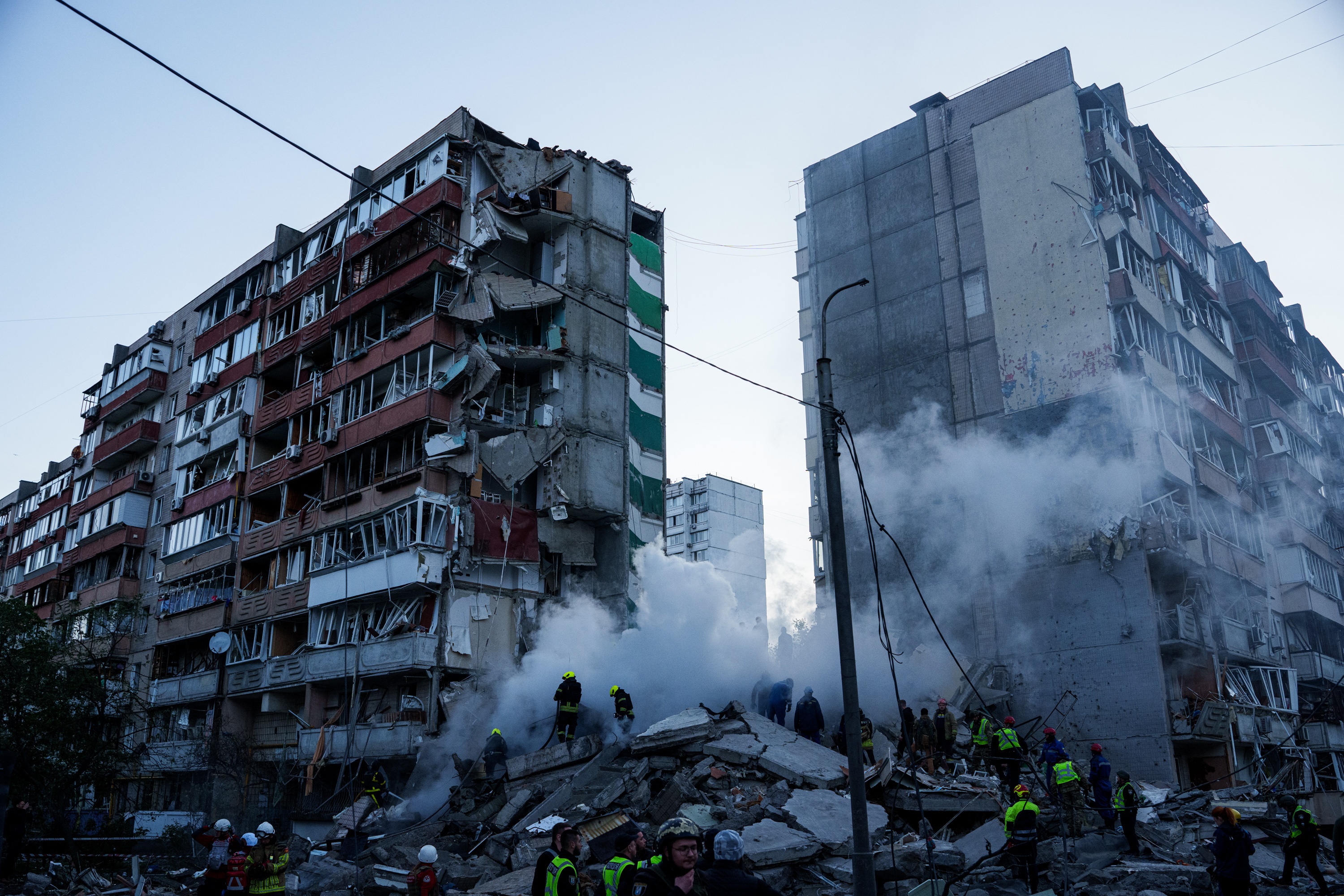
The recent escalation in aerial strikes against Kyiv reflects a transition from opportunistic targeting to a calculated strategy of air defense saturation. By utilizing a hybrid sequence of low-cost loitering munitions followed by high-velocity ballistic missiles, the offensive seeks to expose the functional limits of tiered interceptor networks. The death of one individual and the wounding of 31 others represent the human cost of a broader mechanical objective: the exhaustion of the kinetic and economic resources required to maintain a "closed" sky over a strategic center.
The Mechanics of Integrated Aerial Assaults
Modern urban bombardment is no longer a matter of singular delivery systems. It operates as a coordinated multi-vector operation designed to overwhelm the decision-making cycle of integrated air defense systems (IADS).
1. Preliminary Saturation (The Decoy Phase)
Initial waves typically utilize Geran-series or similar loitering munitions. These subsonic platforms serve three primary functions:
- Sensor Mapping: Forcing radar arrays to activate, thereby revealing the current positioning of mobile surface-to-air missile (SAM) batteries.
- Inventory Depletion: Inducing the defender to expend high-cost interceptors—often costing millions of dollars—against drones that cost a fraction of that amount.
- Cognitive Overload: Flooding the air picture with dozens of low-priority targets to mask the approach of high-priority threats.
2. The Velocity Gap (The Ballistic Phase)
Once the defense grid is preoccupied with low-altitude, slow-moving targets, ballistic missiles are introduced. The physics of ballistic flight—ascending into the upper atmosphere before descending at hypersonic speeds—creates a compression of the reaction window. While a drone may offer thirty minutes of warning, a ballistic missile detected mid-flight may offer less than five. This creates a "priority conflict" within the defense battery: does the system engage the immediate swarm or reserve its limited ready-to-fire canisters for the high-velocity threat?
The Cost-Exchange Ratio as a Weapon of War
The fundamental constraint on any air defense system is not just technology, but the cost-exchange ratio (CER). This is the relationship between the cost of the attacking projectile and the cost of the interceptor.
- Asymmetric Expenditure: A standard Patriot (PAC-3) interceptor costs roughly $4 million. A Shahed-type drone costs approximately $20,000 to $50,000. Engaging a swarm of 20 drones with high-end interceptors results in an economic loss of $80 million to neutralize $1 million in threat value.
- Inventory Depth: Unlike munitions production, which can be scaled in lower-tech facilities, advanced interceptors have long lead times and complex global supply chains. The strategy of the striker is to achieve "interceptor depletion," where the defender physically runs out of missiles before the attacker runs out of drones.
Structural Vulnerabilities in Urban Defense Architecture
Urban environments present unique challenges for kinetic interception. When a ballistic missile is successfully intercepted over a high-density area like Kyiv, the laws of physics dictate that the remaining mass must go somewhere.
The Debris Field Velocity Function
Kinetic energy is defined by $KE = \frac{1}{2}mv^2$. Even when a warhead is neutralized, the structural mass of the missile (the airframe, remaining fuel, and motor) retains significant velocity. The "kill" occurs at high altitude, but the resulting debris field expands as it falls, turning a single point-threat into a multi-point hazard for civilian infrastructure. This explains why casualties often occur miles from the intended military or energy target.
Fragmentation and Collateral Impact
Many modern interceptors utilize a "hit-to-kill" mechanism or a proximity fragmentation warhead. In the latter, thousands of tungsten pellets are discharged to shred the incoming missile. These pellets, along with the shattered casing of the missile, fall back to the ground. In a city of millions, the probability of debris striking a residential structure approaches statistical certainty during large-scale raids.
The Interdependency of Infrastructure and Defense
The strike logic targeting Kyiv is inextricably linked to the city's role as a centralized node for power and logistics. Air defense batteries require significant electrical power to run radar sets and cooling systems. By targeting energy substations, the attacker attempts to force these systems onto localized generators, which are finite, loud, and easier to detect via thermal imaging.
This creates a feedback loop:
- Strikes damage the power grid.
- Air defenses become more reliant on isolated fuel supplies.
- Logistical chains for fuel become new targets.
- Defense readiness fluctuates based on fuel availability rather than just missile stock.
Defensive Scaling and the Requirement for Layered Interception
To counter the current threat profile, the defense must move toward a more rigid three-tier architecture that minimizes the use of high-cost assets for low-cost threats.
- Tier 1: Point Defense (Mobile AA): Utilizing heavy machine guns and short-range MANPADS (Man-Portable Air-Defense Systems). These are the most cost-effective solution for drones but require high density and visual or acoustic detection.
- Tier 2: Medium-Range Surface-to-Air: Systems like NASAMS or IRIS-T. These bridge the gap, handling cruise missiles and more sophisticated drones without exhausting the "silver bullets" of the fleet.
- Tier 3: Strategic Ballistic Defense: Patriot and SAMP/T systems. These are reserved exclusively for ballistic and hypersonic threats.
The failure point in the Kyiv strikes often occurs when the volume of the Tier 1 and Tier 2 threats exceeds the capacity of those specific units, forcing the Tier 3 systems to engage. This is the definition of a successful saturation attack: forcing the most expensive asset to do the cheapest job.
Technical Limitations of Current Detection Arrays
Radar systems face a "horizon problem" in urban settings. High-rise buildings create "clutter" and blind spots, particularly against low-flying cruise missiles or drones that use terrain-following guidance.
- The Shadow Effect: Large structures can mask the radar return of a small drone until it is within the inner perimeter of the defense.
- Multi-Path Interference: Radar waves bouncing off glass and steel facades create "ghost" targets, slowing the automated identification process of the battery's fire-control computer.
These technical hurdles necessitate the use of human observers and acoustic sensors networked via mobile apps, a decentralized approach that attempts to fill the gaps left by traditional electromagnetic sensors.
The Strategic Outlook for Urban Persistence
The intensification of strikes suggests an attempt to break the "normalization" of life in the capital. While the immediate objective is kinetic destruction, the secondary objective is the erosion of civil stability through sleep deprivation, psychological fatigue, and the steady degradation of the housing stock.
The data indicates that while interception rates remain high—often exceeding 80%—the 20% that penetrates or the debris from successful kills is sufficient to maintain a state of permanent crisis. The attacker’s math assumes that the cost of repair and the psychological toll on the 31 injured and their families will eventually outweigh the defender's will or capacity to keep the sky closed.
To maintain defensive integrity, the strategic pivot must be toward "Deep Magazine" solutions. This involves the integration of Directed Energy Weapons (DEW) or high-capacity microwave systems that offer a near-zero cost-per-shot. Until these technologies are deployed in theater, the conflict remains a contest of industrial throughput: who can manufacture and field mass-produced kinetic energy faster than the opponent can manufacture the means to stop it. The current casualty figures are not anomalies; they are the projected externalities of a war of attrition where the city itself has become the primary laboratory for saturation tactics.