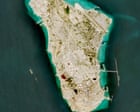
The arrival of the USS Tripoli and the USS Boxer in the Middle East marks a definitive end to the era of purely "over-the-horizon" warfare. While President Donald Trump continues to publicly signal a desire to wind down military operations against Iran, the Pentagon is moving in the opposite direction. Approximately 7,000 additional troops, including elite paratroopers from the 82nd Airborne and specialized Marine Expeditionary Units, are currently entering the theater. This buildup is not designed for a wide-scale invasion of the Iranian mainland, which would require hundreds of thousands of personnel. Instead, it is a surgical preparation for a specific, high-risk objective: the seizure of Kharg Island.
Kharg Island is a nine-square-mile coral outcrop that functions as the jugular vein of the Iranian economy. Roughly 90% of the country’s crude oil exports flow through this single terminal. By occupying this patch of land, the Trump administration believes it can force Tehran to reopen the Strait of Hormuz and agree to a 15-point peace plan that has so far been flatly rejected. However, the military reality on the ground—and under the water—suggests that "taking" the island is the easy part. Holding it without sustaining catastrophic casualties is where the strategy risks unraveling.
The Arithmetic of Escalation
The current deployment brings the total U.S. ground force in the region toward 17,000, bolstered by an additional 10,000 troops currently under consideration by the Pentagon. This isn't the massive "armada" seen in 1991 or 2003. It is a leaner, more lethal force tailored for amphibious assault and rapid seizure of strategic assets.
Secretary of State Marco Rubio and other administration officials maintain that U.S. goals can be met without "boots on the ground" in a traditional sense. This is a semantic distinction. Landing Marines on an island 16 miles off the Iranian coast is a ground operation, regardless of whether those boots ever touch the mainland. The administration's "dual-track" approach—public diplomacy paired with quiet mobilization—aims to create a credible threat of economic strangulation.
Why Kharg Island Matters
- Economic Leverage: Without Kharg, Iran loses its primary source of hard currency.
- Strategic Positioning: It sits 350 miles past the Strait of Hormuz, deep within the Persian Gulf.
- Nuclear Recovery: U.S. intelligence is still hunting for 440kg of highly enriched uranium that went missing following strikes in 2025. Special forces may use the island as a staging base for recovery missions.
The Iranian Response Strategy
Tehran is not waiting for the first landing craft to hit the beach. Intelligence reports indicate the IRGC has spent weeks turning Kharg Island into a "porcupine." They have deployed MANPADS (Man-Portable Air-Defense Systems) to counter U.S. helicopters and laid extensive minefields along the shorelines.
The Iranian military doctrine has shifted entirely toward asymmetric attrition. They understand they cannot win a conventional naval battle against a U.S. Carrier Strike Group. Instead, they rely on "mine droppers" and swarms of fast-attack craft. Trump recently claimed that the Iranian Navy is "100% dead," yet history shows that it only takes one well-placed sea mine or a single successful drone strike to turn a tactical victory into a political nightmare.
The danger for U.S. forces is the "Strait of Hormuz Trap." Once troops are on Kharg Island, they must be resupplied. This requires a constant flow of ships through a narrow waterway that Iran can still harass with mobile missile batteries hidden in the Zagros Mountains. If the U.S. occupies the island but cannot safely transit the Strait, the occupying force becomes a group of well-armed hostages.
The Congressional Vacuum
While the White House moves toward a potential ground component, the legislative branch is largely absent. House Democratic leaders have delayed votes on a new Iran War Powers Resolution until mid-April. This creates a window of executive freedom that Trump appears ready to utilize. The Senate Armed Services Committee isn't scheduled for public hearings on the conflict until after the spring recess.
This lack of oversight means the decision to escalate rests almost entirely with the Commander-in-Chief. Trump's history of utilizing military force as a "closer" in negotiations suggests he sees the 10,000-troop surge as a way to "do a number" on the Iranian regime and exit the conflict quickly. But the Middle East has a long history of swallowing "quick" operations and turning them into decade-long commitments.
The Red Line of April 6
Trump has extended a pause on strikes against Iran's power grid and critical infrastructure until April 6. This is the deadline for diplomacy. If no breakthrough occurs, the transition from "Operation Epic Fury"—which has focused on air and naval degradation—to a ground-based "Phase Two" becomes a near certainty.
The immediate tactical question is whether the 31st Marine Expeditionary Unit can execute a contested landing under fire. The broader strategic question is whether the American public is prepared for the casualties that an island occupation will inevitably produce. Iran’s "leaderless" military, as Trump describes it, still possesses thousands of short-range rockets and a motivated paramilitary force that has spent decades preparing for this exact scenario.
The U.S. is not just sailing toward a piece of land; it is sailing toward a decision point that will define the next decade of American foreign policy. If the gamble on Kharg Island fails to break Tehran’s resolve, the U.S. may find itself stuck in a high-intensity stalemate that the current force posture is not equipped to sustain.
Would you like me to analyze the specific logistics of an amphibious assault on Kharg Island or investigate the current status of the missing uranium stockpiles?