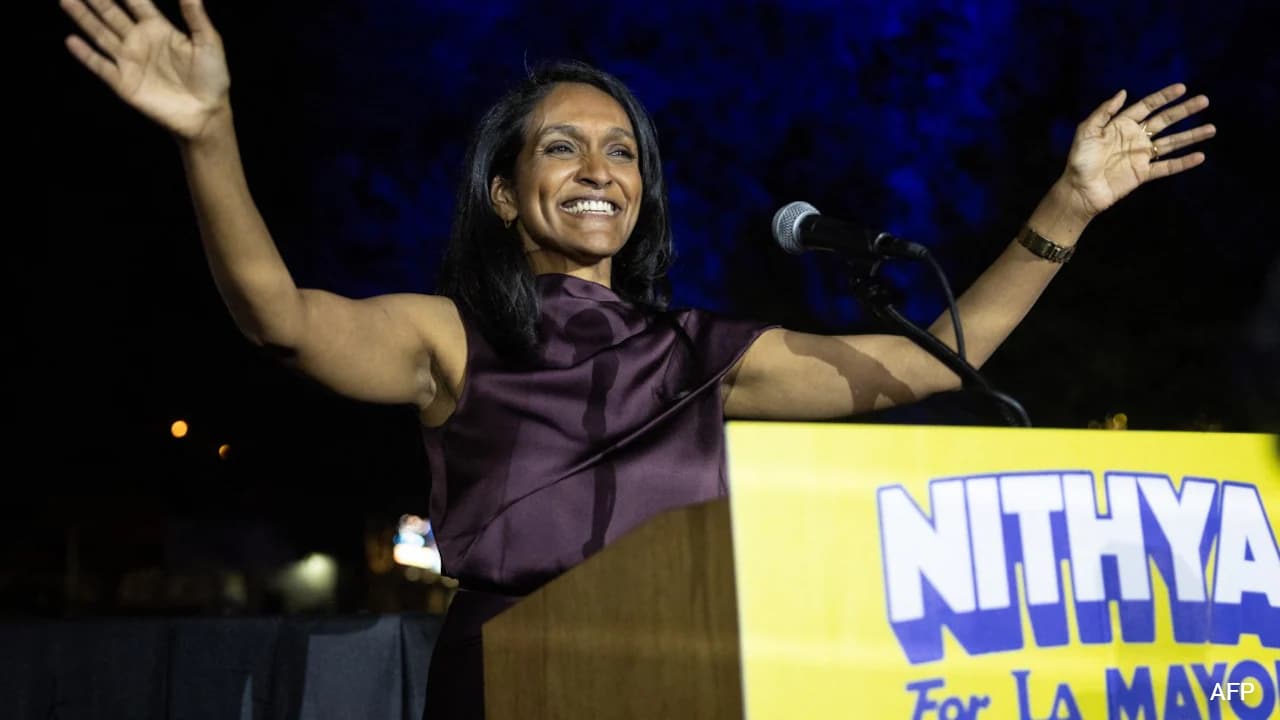
Yes, a Kerala-born candidate—specifically Los Angeles City Councilmember Nithya Raman—is a central figure in the conversation surrounding the 2026 Los Angeles mayoral race, though winning City Hall requires overcoming formidable entrenched political machines. Following the high-profile rise of Indian-origin progressive leaders in New York City, political observers are closely watching whether Los Angeles will follow a similar trajectory. Raman, born in Kerala and raised in Louisiana, represents the sharp edge of a growing progressive movement in Southern California, yet her path to the mayor’s office is complicated by the city’s brutal housing politics, fractured labor alliances, and the sheer scale of Los Angeles governance.
To understand why a Kerala-born politician is leading progressive speculation in Los Angeles, you have to look beyond biographical novelty. Standard international coverage tends to flatten this story into a simple narrative of diaspora triumph, drawing a straight line from New York’s South Asian political wave—exemplified by figures like Zohran Mamdani and Shahana Hanif—directly to the Pacific coast. That framing misses the mechanics of how power actually works in California's largest city. Los Angeles does not elect mayors based on national demographic trends alone; it elects them through bruising battles over zoning, policing, homelessness, and municipal union endorsements.
The Structural Differences Between New York and Los Angeles Politics
Comparing New York City to Los Angeles is a favorite pastime for national political commentators, yet the two cities operate on completely different municipal engines. New York runs on a strong-mayor system with a dense, hyper-local neighborhood machine where grassroots organizing can rapidly flip low-turnout primaries. Los Angeles, by contrast, is a sprawling, decentralized metropolis where the mayor shares immense administrative power with a 15-member City Council, each member functioning almost like a mini-mayor over a district of roughly 260,000 people.
When Nithya Raman shocked the Los Angeles political establishment in 2020 by unseating incumbent David Ryu in Council District 4, she did not win because of her heritage. She won because she built an unprecedented volunteer apparatus focused squarely on housing affordability and homelessness reform. Her background as an urban planner with degrees from Harvard and MIT gave her policy credibility, while her grassroots fundraising bypassed the traditional real estate and developer money that usually dictates LA elections.
The comparison to New York holds weight only when examining the organizing blueprint. In both cities, a younger, more diverse generation of progressive candidates has realized that traditional Democratic Party gatekeepers are vulnerable when confronted with door-to-door field operations and crisp, uncompromising messaging on the cost of living. However, scaling that blueprint from a single council district to a city of nearly four million residents is an entirely different beast.
Why Nithya Raman Stands at the Center of the 2026 Conversation
Raman’s political ascent has been anything but smooth, which is precisely why she commands serious attention. After taking office in late 2020, she quickly became both a progressive icon and a lightning rod for moderate backlash. Her critics—ranging from conservative neighborhood councils to business coalitions—accused her of being overly ideological on homelessness encampment removals and public safety budgets.
Redistricting in 2021 nearly ended her career before it truly began. The City Council redrew District 4, stripping away much of her progressive base in Silver Lake and Los Feliz and replacing it with more moderate, homeowner-heavy neighborhoods in the San Fernando Valley. Many seasoned operatives in City Hall assumed she was finished.
Instead, Raman adapted. In the March 2024 primary, facing well-funded challengers backed by police unions and real estate interests, she won outright with over 50 percent of the vote, avoiding a costly runoff. That victory proved she could win over skeptical, single-family homeowners—the exact demographic that decides Los Angeles mayoral elections. It also cemented her status as the most viable progressive contender capable of mounting a citywide campaign.
The Mechanics of an LA Mayoral Run
Winning a citywide race in Los Angeles requires assembling a coalition across deep geographic and economic divides. A candidate cannot simply run up the score in the hipster enclaves of the Eastside and expect to win. You have to compete in South LA, the Harbor area, the Westside, and the San Fernando Valley.
Historically, successful LA mayors have relied on a specific formula:
- Organized Labor: Specifically the Los Angeles County Federation of Labor, whose ground game and independent expenditure committees can swing tens of thousands of votes.
- Business and Real Estate: Downtown developers and Westside financiers who fund the massive television and digital ad buys required to reach voters across a 500-square-mile media market.
- The San Fernando Valley: Often referred to as the city's political kingmaker, Valley voters tend to prioritize public safety, street maintenance, and property values over sweeping ideological reforms.
Raman’s challenge—and the challenge for any outsider candidate—is that her core platform directly threatens the status quo favored by two of those three pillars. Her push for aggressive tenant protections, dense housing development, and alternative crisis response models puts her at odds with major real estate lobbies and traditional law enforcement unions.
The Diaspora Factor and Its Real Limits
Media outlets in India and diaspora publications in the United States naturally highlight Raman’s roots in Kerala. Representation matters. Seeing a Malayali woman occupy one of the most powerful seats in American local government is a milestone for a community that has historically been underrepresented in municipal politics compared to its numbers in medicine, engineering, and academia.
Yet inside Los Angeles City Hall, ethnic identity alone rarely carries a candidate across the finish line. South Asian Americans make up a growing, affluent, and politically active segment of Southern California, particularly in surrounding suburbs like Artesia, Cerritos, and parts of the Valley. However, within the actual city limits of Los Angeles, the South Asian voting bloc is far too small to decide a citywide election on its own.
For Raman or any Indian-origin candidate to win the mayor's office, diaspora support serves primarily as a fundraising catalyst rather than a decisive voting bloc. National networks of South Asian donors have demonstrated a willingness to fund candidates who break barriers, providing crucial early cash that allows campaigns to hire top-tier consultants and build field offices. Once the campaign hits the streets of Boyle Heights, Van Nuys, or Crenshaw, however, voters care far less about where a candidate was born and far more about whether the city is cleaning up trash, fixing potholes, and addressing the visible crisis on the sidewalks.
The Incumbency Hurdle and the Political Reality of City Hall
Any discussion about the next mayor of Los Angeles must reckon with the current occupant of the office, Karen Bass, and the broader political environment of 2026. Bass entered City Hall in late 2022 with immense goodwill, decades of coalition-building experience, and a singular focus on declaring a state of emergency over homelessness.
While Bass has faced mounting scrutiny over the pace of housing placements, budget deficits, and the massive logistical preparations for the 2026 World Cup and the 2028 Summer Olympics, unseating an entrenched Democratic incumbent—or winning an open seat against a crowded field of moderate establishment figures—is an uphill battle.
The political climate in California has also shifted noticeably since the peak of the 2020 progressive wave. Across the state, voters have grown impatient with the slow pace of recovery in urban cores. Ballot measures toughening penalties for retail theft and drug offenses have gained traction, and several high-profile progressive district attorneys and city council members in Northern California have faced recalls or decisive electoral defeats.
In Los Angeles, this rightward—or at least more pragmatic—shift means that a progressive candidate cannot run strictly on idealistic rhetoric. Voters want measurable outcomes. If a candidate argues for housing-first policies, they have to explain why billions of dollars in bond measures like Proposition HHH took years to produce units at exorbitant per-door costs. If they argue for reforming police budgets, they must simultaneously reassure anxious business owners in Hollywood and Downtown that storefronts will be protected.
What Actually Decides the Next Mayor of Los Angeles
The obsession with matching New York’s political headlines obscures the real story unfolding in Los Angeles. The city is currently experiencing a generational tug-of-war over what kind of metropolis it wants to be.
On one side is the old guard: a coalition of moderate Democrats, building trades unions, and real estate interests who favor incremental change, heavy policing, and protecting single-family zoning. On the other side is a rising progressive bloc—populated by renters, younger voters, service-sector unions, and urbanists—who view the current housing and affordability crisis as an existential threat that requires radical intervention.
Nithya Raman is the clearest avatar of that second group. Her trajectory from a Kerala-born urban planner to a two-term Los Angeles councilmember proves that the progressive coalition is no longer a fringe movement; it is a permanent, formidable force in Southern California politics. Whether that force is strong enough to capture the fifth floor of City Hall depends entirely on whether its leaders can translate grassroots energy into tangible improvements in the daily lives of working-class Angelenos before the next ballot is cast.