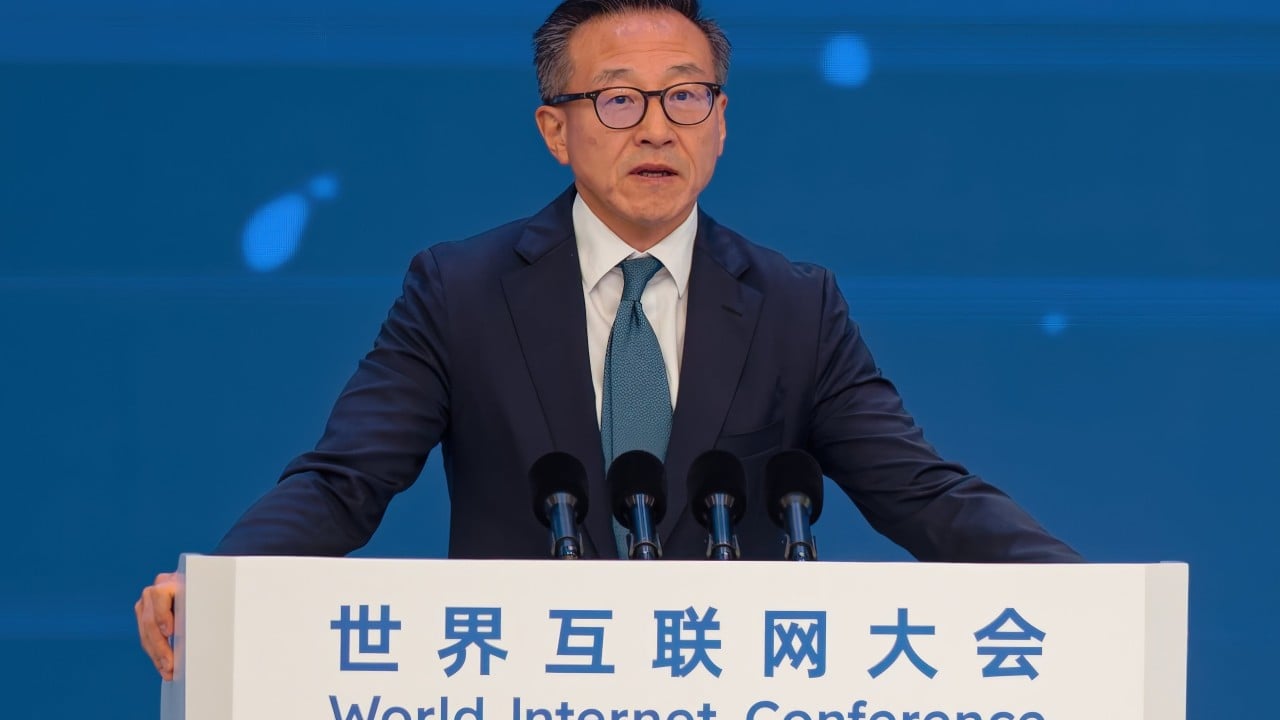
Silicon Valley wants you to believe that artificial intelligence belongs behind a paywall. Alibaba’s Chairman Joe Tsai disagrees, and he didn't mince words at the World Internet Conference in Wuzhen.
While U.S. tech giants lock their best models behind proprietary APIs and Washington tightens chip export controls, China's biggest e-commerce and cloud player is giving its crown jewels away for free. That sounds crazy on the surface. Why spend hundreds of millions of dollars training massive foundation models only to hand the weights to your competitors?
Because it's the smartest survival move on the board. When you're blocked from buying Nvidia's top-tier H100 and Blackwell chips, you can't win a brute-force compute race against OpenAI or Google. Instead, you change the rules of the game. You flood the market with free, high-performing open-weight models like Qwen, turning global developers into your unpaid R&D department and making your cloud infrastructure the default home for enterprise AI.
What Actually Happened at the Wuzhen Summit
The annual World Internet Conference in Wuzhen has always been Beijing's premier stage for signaling its tech priorities to the world. During the summit, Joe Tsai stepped up to the podium with a clear message about the future of artificial intelligence. He argued that open-source development isn't just a nice-to-have philosophy for academic researchers. It's the only way to prevent a handful of wealthy tech monopolies from controlling the most important technology of our lifetime.
Tsai pointed directly to Alibaba’s own track record. Over the past couple of years, the company has released dozens of open-weight models under its Qwen (Tongyi Qianwen) family. These aren't watered-down toy models either. Versions like Qwen-72B and the newer Qwen 2.5 series routinely trade blows with—and occasionally beat—Meta’s Llama models and proprietary offerings from Anthropic and OpenAI on standard coding and reasoning benchmarks.
His speech landed right as geopolitical tension over AI hit a boiling point. U.S. lawmakers have repeatedly floated restrictions on open-source AI weights, worried that Chinese firms could use American open models—or that Chinese open models could become the backbone of global software. Tsai’s counterargument was simple and sharp. Closing off AI slows down global innovation and starves smaller businesses of tools they can't afford to build from scratch.
The Business Logic Behind Giving Away Free AI
If you've ever managed cloud infrastructure or built enterprise software, you know nothing in tech is truly free. Alibaba isn't running a charity. When Tsai champions open-source AI, he's executing a classic "commoditize your complement" strategy.
Think about how Alibaba makes its real money outside of Taobao and Tmall. Alibaba Cloud is the largest cloud provider in China and a major player across Asia. For years, cloud growth had plateaued as businesses finished their initial migrations from on-premise servers. AI changed that overnight. Every company suddenly needed massive GPU clusters, data pipelines, and inference endpoints.
Here is how the math works for Alibaba:
- Zero-cost customer acquisition. Startups and mid-sized enterprises don't want to pay exorbitant per-token fees to OpenAI if they can run a Qwen model on their own servers or private cloud instances. Once a company builds its internal tools around Qwen's specific architecture and tokenization, switching away becomes painful.
- Cloud lock-in. You can download Qwen weights from Hugging Face and run them anywhere, sure. Yet optimizing those models for low-latency production traffic is hard. Alibaba Cloud offers managed services, fine-tuning pipelines, and specialized hardware acceleration tailored specifically for Qwen. Free software drives paid compute.
- Bypassing the brand trust deficit. Many Western companies hesitate to send sensitive corporate data through an API hosted in mainland China. Open-weight models solve this instantly. A bank in Frankfurt or a logistics firm in Singapore can download Qwen, audit the weights, run it inside their own air-gapped data center, and never send a single byte back to Hangzhou.
It's brilliant. Honestly, it's the exact same playbook Meta used with Llama, except Alibaba has a massive public cloud business ready to capture the downstream revenue that Meta lacks.
How U.S. Pushback Forced China’s Hand
You can't understand Tsai’s Wuzhen speech without looking at Washington’s export controls. Since October 2022, the U.S. Department of Commerce has systematically choked off China's access to advanced semiconductors, extreme ultraviolet lithography machines, and high-bandwidth memory.
In the West, many analysts assumed these sanctions would cripple Chinese AI development within two years. They were wrong. Restrictions didn't kill Chinese AI; they forced radical efficiency.
When you have unlimited compute, you get lazy. You throw 100,000 GPUs at a problem and brute-force your way to a smarter model. When you're stuck using older Nvidia A800s, H800s, or domestic Huawei Ascend chips, every FLOP counts. Chinese AI labs—including Alibaba, DeepSeek, and 01.AI—became obsessed with training efficiency, mixture-of-experts architectures, and aggressive quantization.
Open-sourcing those breakthroughs serves two geopolitical purposes at once:
- It neutralizes U.S. regulatory leverage. Washington can ban the export of physical chips, and it can block American companies from selling cloud access to Chinese entities. Stopping open-source code from crossing borders is practically impossible. By embedding Chinese-developed models into the global open-source ecosystem on platforms like GitHub and Hugging Face, Alibaba makes it vastly harder for U.S. regulators to isolate China's tech sector without breaking tools that American developers rely on every day.
- It builds soft power in the Global South. Developers in Southeast Asia, the Middle East, Latin America, and Africa are building AI applications rapidly. Most of them can't afford Silicon Valley API pricing, and they need models that actually understand languages beyond English. Qwen supports dozens of languages natively, making it an easy default choice for builders outside the U.S. and Europe.
What Most Tech Analysts Get Wrong About Open Weights
There's a common misconception in Western tech media that Chinese open-source AI is just derivative—simply copying Meta’s Llama architecture and training it on scraped internet data. If you actually look under the hood of recent Qwen releases, that narrative falls apart fast.
Alibaba’s engineering teams have made genuine architectural improvements, particularly in multilingual tokenization, long-context handling, and domain-specific coding and math performance. On Hugging Face’s Open LLM Leaderboard, Qwen derivatives frequently dominate the top spots across multiple parameter sizes, from tiny 0.5-billion parameter models that run locally on a smartphone up to 72-billion parameter beasts.
Another blind spot is assuming developers care about geopolitics when they're trying to ship a product. They don't. I've talked to plenty of founders in Austin, London, and Bangalore who use Qwen in production. Their decision-making process is brutally pragmatic. They download three models, run their internal evaluation suite, check the latency and memory footprint, and ship whichever one gives the best accuracy per dollar. Right now, Alibaba is winning a huge share of those blind taste tests.
Still, we shouldn't ignore the real friction points. "Open-source" in AI usually means "open-weights," and Alibaba’s licensing isn't pure MIT or Apache 2.0 across the board. While smaller Qwen models carry permissive Apache 2.0 licenses, the massive 72B flagship models come with custom community licenses that restrict commercial use if your service has more than 100 million monthly active users. That's a generous ceiling for 99.9% of businesses, yet it proves Alibaba keeps a tight grip on the biggest tech giants.
Content censorship is another legitimate trade-off. Base models trained under Chinese regulatory frameworks carry built-in guardrails around politically sensitive topics in Beijing. For a startup building a customer support bot or a SQL query generator, that doesn't matter at all. For media companies, researchers, or consumer chatbots operating in Western markets, those guardrails require extra post-training work to strip out or adjust.
Why Enterprise Buyers Are Quietly Shifting to Open Models
Joe Tsai’s timing at Wuzhen wasn't accidental. Enterprise AI adoption is hitting a wall of buyer's remorse.
Throughout 2024 and 2025, Fortune 500 companies rushed to sign massive enterprise contracts with proprietary AI vendors. Now the bills are coming due, and CTOs are realizing two uncomfortable truths. First, sending proprietary company data to third-party APIs creates a compliance nightmare for legal teams. Second, relying on a single vendor means your entire product breaks or changes behavior whenever that vendor quietly updates its model weights behind the scenes.
Open-weight models fix both problems immediately. When you host a model like Qwen 2.5 or Llama 3 inside your own Virtual Private Cloud, the weights never change unless you decide to update them. Your data never leaves your perimeter. And your marginal cost per query drops dramatically once you pass a baseline volume of traffic.
Tsai knows this shift is happening. By positioning Alibaba as the most reliable supplier of high-grade open weights, he's ensuring that even if Western enterprises never buy a single server from Alibaba Cloud, Alibaba’s software stack still sits at the center of global enterprise AI.
How Developers and Tech Leaders Should React
You don't need to pick a side in the U.S.-China tech rivalry to take advantage of what's happening right now. Whether you're an independent developer, a startup CTO, or an enterprise architect, this fierce competition between open and closed ecosystems is the best thing that could happen to your budget.
Stop defaulting to expensive proprietary APIs for every single task in your stack. Start benchmarking open-weight models—including Alibaba’s Qwen family alongside Llama and Mistral—against your actual production data. Focus specifically on smaller, specialized models (7B to 32B parameters) fine-tuned on your domain data; they routinely outperform giant frontier models at a fraction of the latency and cost.
Keep your inference layer model-agnostic by using standard OpenAI-compatible API wrappers like vLLM or Ollama. If you decouple your application logic from the underlying model weights today, you can swap between Western and Chinese open models in minutes whenever a better release drops. Let the tech giants fight over geopolitics and market share while you pocket the savings.