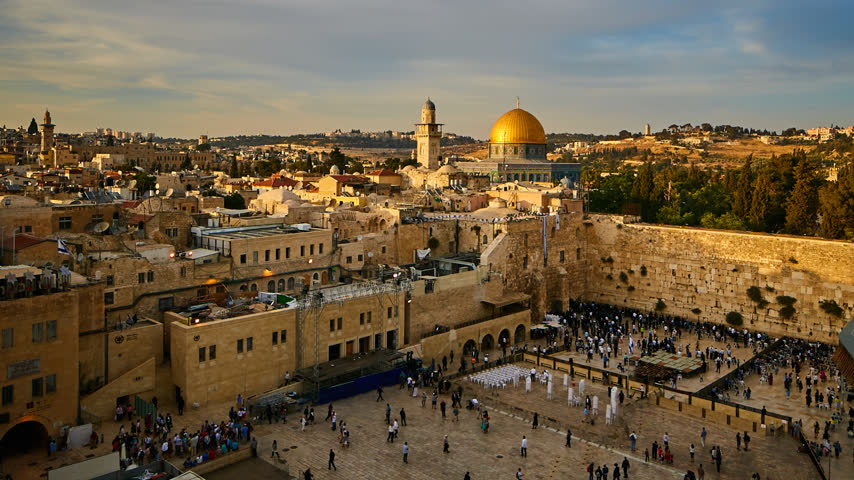
Media outlets love a predictable villain. Every year, the Jerusalem Day "Flag March" provides a convenient script: thousands of young Israelis streaming through the Muslim Quarter, shouting provocations, and clashing with police. The coverage is always the same. It’s framed as a localized eruption of "ultranationalism" that threatens a fragile peace.
This narrative is lazy. It’s a shallow reading of a much deeper, structural shift in Middle Eastern geopolitics. If you think this march is just about a few thousand angry teenagers with flags, you’ve fallen for the bait.
The real story isn’t the shouting. It’s the ritualization of friction.
The Sovereignty Performance
Mainstream reporting focuses on the "racist slogans" because they are easy to record and even easier to condemn. But focusing on the noise misses the signal. The Flag March isn't a protest in the traditional sense; it is an annual stress test of sovereignty.
In any contested space, power isn't maintained by high-level diplomacy or signed papers in Oslo or Washington. It is maintained by the physical presence of bodies in the street. Critics call it a provocation. From a cold, realist perspective, it is a calibration exercise.
The Israeli state allows the march because not allowing it would be a de facto admission that it does not control the Old City. This is the nuance the "consensus" media misses. They treat the march as an optional event that the government should simply cancel to keep the peace. They fail to understand that in the zero-sum logic of the Levant, a vacuum of presence is immediately filled by the opposition.
The Myth of the "Status Quo"
We hear the phrase "maintaining the status quo" constantly. It’s a favorite of State Department spokespeople and European Union bureaucrats. Here is the uncomfortable truth: the status quo doesn't exist. It is a polite fiction.
Jerusalem is a dynamic, shifting ecosystem. Every renovation of a house in Silwan, every new security camera in the Muslim Quarter, and every Jewish prayer session on the Temple Mount is a modification of reality. The Flag March is simply the most visible, loudest version of this constant negotiation.
The "lazy consensus" argues that these marches disrupt a stable equilibrium. I’ve spent enough time analyzing regional security data to tell you that the equilibrium is a myth. Violence doesn't happen because people march; the march happens because the underlying conflict is unresolved. Canceling the march wouldn't bring peace; it would merely shift the theater of confrontation to a different day or a different neighborhood.
Why the "Racism" Angle is a Distraction
Does the march feature racist chanting? Yes. Is it abhorrent? Obviously. But if you are analyzing a geopolitical flashpoint based on the manners of the participants, you are an amateur.
The media fixates on the slogans because it allows them to moralize a territorial dispute. By turning a complex historical and religious conflict into a simple story of "bullies vs. victims," they ignore the strategic objectives of both sides.
- For the marchers: It is about asserting a theological and national right to a unified city.
- For the Palestinian counter-protesters: It is about demonstrating that the city is not, and never will be, unified under Israeli rule.
- For Hamas: It is a recruitment goldmine that allows them to position themselves as the "Defenders of Al-Aqsa" from the safety of bunkers in Gaza or hotels in Qatar.
When you focus only on the slogans, you are looking at the paint on the car while the engine is exploding.
The Security Architecture of Friction
Imagine a scenario where the Israeli government bans the march tomorrow.
The immediate result wouldn't be a sigh of relief from the international community. It would be a massive surge in radicalization within the Israeli right-wing, who would view the move as a capitulation to threats from Hamas. Simultaneously, it would be framed by Palestinian factions as a total victory for "resistance," likely triggering a wave of opportunism.
Security isn't always about the absence of tension. Sometimes, it’s about the management of it. The Flag March acts as a pressure cooker. It’s loud, it’s ugly, and it’s dangerous—but it’s also predictable. The Israeli security establishment knows exactly when it’s happening, where it’s going, and who will be there.
In the world of intelligence and policing, predictable friction is often preferred over the unpredictable kind. The "status quo" isn't a state of harmony; it’s a controlled burn.
The Failure of "People Also Ask"
If you search for "Jerusalem Day," you’ll see questions like "Is it safe to travel during Jerusalem Day?" or "Why do they march through the Muslim Quarter?"
These questions assume there is a "correct" way to conduct a nationalist march in a city that two peoples claim as their exclusive capital. There isn't. The premise that this march can be "fixed" or "made respectful" is a Western projection. It’s an attempt to apply suburban, democratic norms to a struggle that is fundamentally about identity and survival.
The advice often given to tourists is to "avoid the area." That’s sensible for a vacationer, but for a political analyst, avoiding the area is a mistake. The Muslim Quarter is the route precisely because it is the most contested. Marching through West Jerusalem would be a parade; marching through the Damascus Gate is a claim.
The Demographic Clock
The media treats these marches as if they are outliers, the work of a fringe group of "ultranationalists." This is the most dangerous misconception of all.
Look at the birth rates. Look at the migration patterns. The people in those marches represent the fastest-growing demographic in Israel. This isn't a fringe movement that will eventually be moderated by "enlightened" secular values. This is the future of the Israeli electorate.
The "contrarian" take here isn't just that the march is misunderstood; it’s that the march is the new baseline. The world keeps waiting for Israel to return to the labor-zionism of the 1970s. It’s not happening. The Flag March is the visual representation of a country that has moved decisively to the right and has no intention of looking back.
Stop Looking for "Solutions"
We have a pathological need to "solve" Jerusalem. Every year, after the march, pundits write op-eds about how to "bridge the divide" or "foster dialogue."
Stop.
There are some problems that aren't meant to be solved; they are meant to be managed. The Jerusalem Day march is a yearly reminder that the "Two-State Solution" is a corpse that the international community refuses to bury. The marchers know it. The residents of the Muslim Quarter know it. Only the foreign press seems to have missed the memo.
The reality on the ground is a single state with varying levels of citizenship and rights, locked in a permanent struggle for the soul of its capital. The Flag March is just the most honest day of the year. It strips away the diplomatic niceties and shows the world exactly what the conflict looks like: raw, uncompromising, and physical.
If you find the march offensive, you’re reacting to the symptoms. If you want to understand the Middle East, you have to stop looking for villains and start looking at maps. The map doesn't care about your slogans. It only cares about who is standing on the ground.
Accept that the friction is the point. The march is the message. The rest is just noise for the evening news.
Go look at the demographic data again and tell yourself that this is "fringe." You’re lying to yourself.