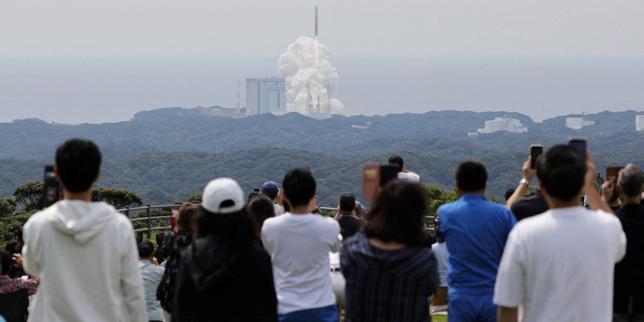
Japan just pulled off a massive win in the global space race. Early Friday morning on June 12, 2026, the flagship H3 rocket bolted into the sky from the Tanegashima Space Center, successfully delivering six small satellites into orbit.
It looks like a standard satellite deployment on paper. It isn't. This specific flight was a do-or-die moment for the Japan Aerospace Exploration Agency (JAXA) and its manufacturing partner, Mitsubishi Heavy Industries. After a devastating mission failure last December that left a geolocation satellite stranded due to a malfunctioning second-stage engine, the pressure was immense. Another failure would have crippled Japan's space ambitions, potentially derailing a high-profile Mars mission scheduled for 2028. Don't forget to check out our earlier post on this related article.
Instead, the second stage fired perfectly. The trajectory held true. Japan is officially back in the game, and they're bringing a radically different weapon to the commercial market.
The Secret Weapon is a Bare-Bones Setup
Everyone knows the big issue with traditional space programs. They cost way too much money. To fix this, JAXA debuted a completely new setup for this flight, known as the "30 configuration." To read more about the background here, CNET provides an in-depth summary.
Most heavy-lift rockets rely on massive solid rocket boosters strapped to the sides to punch through the thickest parts of the atmosphere. The 30 configuration scraps the boosters entirely. Instead, it relies on three liquid-fuel LE-9 main engines.
Scrapping the boosters means you lose a bit of raw lifting power, but you drop the manufacturing and assembly costs off a cliff. It's a hyper-focused, low-cost variant built for a specific job: hauling smaller, lighter payloads without paying for unnecessary muscle.
The industry is currently dominated by Elon Musk's SpaceX, which relies heavily on reusable Falcon 9 rockets to dictate market prices. Japan can't match SpaceX's reusability infrastructure yet, so they're attacking the problem from a different angle. They simplified the hardware, embraced 3D printing for engine parts, and minimized the total component count.
What Was on Board?
The six small satellites safely tucked inside the nose cone weren't just commercial placeholders. They represent the practical, commercial future JAXA is trying to build. Developed by universities and private tech firms, the payload included:
- Ocean observation satellites designed to track maritime traffic and environmental changes.
- Experimental tech platforms testing new ways to track and remove space debris.
- Performance testing equipment to validate this new rocket configuration for future commercial clients.
High Stakes and Heavy Engineering
To understand why people in Tokyo were holding their breath during the live stream, look at the H3's track record. It was supposed to be the seamless successor to the aging H-2A, a rocket with a near-perfect success rate but a price tag too high for modern commercial customers.
Then reality hit. The H3's debut flight in March 2023 ended in self-destruction when the second-stage engine refused to ignite. JAXA engineers spent months redesigning the electrical systems. They launched a couple of successful flights, but then December 2025 brought another gut punch. The second-stage engine malfunctioned again, failing to put a critical navigation payload into its proper orbit.
Spaceflight leaves no room for error. If your flagship rocket fails every few launches, commercial clients won't trust you with their multi-million-dollar hardware. Insurance rates spike. Government funding dries up.
By proving that the three-engine, boosterless variant can successfully govern its trajectory and ignite its upper stage without a hitch, JAXA didn't just salvage its reputation. They proved the underlying architecture of the H3 is adaptable.
Moving Toward a Fast-Paced Launch Cadence
The ultimate goal for JAXA and Mitsubishi Heavy Industries isn't just to launch occasionally. They want to scale up to six or eight H3 launches every single year.
That kind of frequency is essential for national security and sovereign space access. Relying on foreign commercial entities to launch military or climate-tracking hardware is a massive geopolitical risk. Japan needs its own stable, cost-effective ride to orbit.
The success of the 30 configuration gives them options. Need to launch a massive, heavy geostationary communications satellite? Strap four solid rocket boosters to the side. Need to launch a constellation of small university tech-demos or commercial imaging satellites? Use the boosterless version and save millions.
If you're an engineer, a tech investor, or just a space enthusiast watching the industry evolve, watch what Japan does next. The next step for JAXA is analyzing the telemetry from this flight to lock in manufacturing schedules for the rest of the year. For global satellite operators looking for an alternative to American or European launchers, the H3 just became a very real, very affordable option.