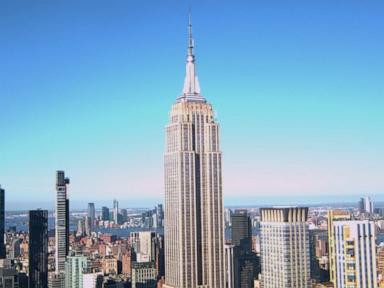
The wind at a thousand feet doesn’t just blow. It howls with a predatory hunger, a relentless scouring force that tries to peel the skin off your face. In 1930, men with nothing but flat caps and nerves of tempered steel stood on narrow beams suspended in that void. They ate their sandwiches while dangling their boots over a four-hundred-meter drop, watching the city below crawl like a collection of clockwork toys. They weren't just building an office tower. They were trying to prove that gravity was a suggestion, not a law.
Ninety-five years later, that defiance still stands.
We look at the Empire State Building now and see a postcard. We see a backdrop for romantic comedies or a place to take cousins from out of town. But we’ve forgotten the desperation that birthed it. It rose during the darkest days of the Great Depression, a time when the American spirit wasn't just bruised—it was hemorrhaging. The building was a middle finger to the economic collapse. It was a 102-story shout into the abyss.
A Race Against the Ghost of Time
Construction didn't just happen; it exploded. The pace was frantic, almost violent. They finished the frame in less than six months. On average, they were adding four and a half floors every single week. Think about that the next time a local road repair takes three summers to complete.
The architects, Shreve, Lamb & Harmon, didn't have the luxury of overthinking. They were locked in a literal race for the sky. The Chrysler Building was creeping upward just a few blocks away, and Walter Chrysler was a man who hated losing. To beat him, the Empire State team had to be lean. They used a "penciled-in" design that favored speed and verticality over the ornate flourishes of their rivals.
Imagine a young riveter named Giuseppe. He’s twenty-two, his hands are calloused into leather, and he knows that if he slips, he’ll be a headline before he hits the pavement. He isn't thinking about architectural legacy. He’s thinking about the four dollars and fifty cents he’s earning a day to keep his mother fed in a tenement in the Bronx. Every rivet he hammers is a heartbeat in the city’s new iron chest. There were 3,400 men like him on-site at the peak of production. They were the muscle behind the dream, the anonymous ghosts who gave the Art Deco monster its soul.
The White Elephant of 34th Street
When the ribbon was finally cut in 1931, the triumph was bittersweet. The building was a masterpiece, but it was empty.
New York was broke. Businesses were folding by the hour. For years, the upper floors remained dark, earning the tower the mocking nickname "The Empty State Building." Critics laughed. They called it a monument to hubris. It took nearly twenty years for the building to finally turn a profit.
This is the part of the story we often skip. We like the victory, but we shy away from the long, quiet struggle in the middle. The Empire State Building survived because it was built for a future that hadn't arrived yet. It was designed with a dirigible mooring mast at the top—a wildly optimistic plan to let transatlantic zeppelins dock in the middle of Manhattan. It was a failure, of course. The winds were too high, and the logistics were a nightmare. But that failed mast gave the building its iconic silhouette. Sometimes, our most beautiful features are born from our most impractical ideas.
The Night the Sky Fell
On a foggy Saturday morning in July 1945, the building faced its greatest test. A B-25 Mitchell bomber, lost in a thick gray soup of clouds, slammed into the 79th floor.
The impact was catastrophic. One of the engines tore through the building and exited out the other side, landing on a nearby roof. Fuel erupted in a localized inferno. Eleven people in the building died, along with the three crewmen on the plane.
But the building didn't flinch.
The steel held. The fire was contained. Incredibly, parts of the building were open for business the very next Monday. It’s a testament to the over-engineering of the era—a time when "good enough" wasn't in the vocabulary. They built things to last centuries, not to satisfy a quarterly earnings report. When the plane hit, the Empire State Building didn't just stand there; it absorbed the blow and kept breathing.
The Light at the Top of the World
If you stand at the corner of 5th Avenue and 34th Street tonight, you’ll see the crown glowing. Maybe it’s red and green for the holidays, or a soft, spectral blue to honor a fallen hero. These lights are the city’s mood ring.
In the 1960s, they installed the first floodlights. Before that, the tower disappeared into the darkness at sunset. Now, it serves as a beacon for millions. It’s a lighthouse for the landlocked. There is a specific kind of comfort in seeing that spire from a taxi window when you’re returning from a long trip. It says you’re home. It says that despite the chaos of the streets, something remains fixed.
The transition to LED technology in 2012 changed the game. Suddenly, the building could pulse with 16 million colors. It could dance to a soundtrack broadcast on the radio. It became a living digital canvas. Yet, underneath the high-tech glitter, the bones are still the same limestone and granite hauled from Indiana and Germany nearly a century ago.
The Human Scale of a Giant
We often think of skyscrapers as cold, impersonal things. Glass boxes that reflect nothing but the sky. But the Empire State Building is tactile. It’s made of materials that age, that weather, that have texture.
Inside the lobby, the gold leaf and marble evoke a sense of cathedral-like reverence. You can feel the weight of the history. You can almost hear the echoes of the millions of feet that have shuffled through the elevators—the tourists, the dreamers, the heartbroken, and the power brokers.
Every year, athletes from around the world gather to run up the 1,576 steps to the 86th-floor observatory. It’s a grueling, lung-burning ascent that mirrors the building’s own climb from the dirt of the Depression to the peak of the skyline. Why do they do it? For the same reason the ironworkers climbed those beams in 1930. To see how far they can push against the limits of the possible.
The Living Monument
At 95, the Empire State Building isn't a relic. It’s an active participant in the city’s evolution. It has undergone massive "deep energy" retrofits to reduce its carbon footprint, proving that even an old giant can learn new tricks. It has outlived the men who built it, the architects who drew it, and the skeptics who mocked it.
It has seen the rise and fall of the World Trade Center, the transformation of the harbor, and the endless churning of the New York skyline. New towers have risen that are taller, thinner, and shinier. They are engineering marvels in their own right, but they lack the specific gravity of the 34th Street titan. They are buildings; the Empire State is an icon.
There is a certain humility in its height now. It is no longer the tallest in the world, nor even the tallest in the city. But height was never its true strength. Its strength was the audacity of its timing. It is a 365,000-ton reminder that when the world is at its absolute worst, humanity is capable of reaching its highest point.
As the sun sets and the first LEDs begin to flicker to life, the building stands in a golden haze. It is a silhouette of American ambition, carved out of the gray New York air. It doesn't need to shout anymore. It just stays.
The rivets hold. The stone remains cool to the touch. And somewhere, a thousand feet up, the wind still howls against the mast, searching for a ghost of a zeppelin that will never arrive, while the city below keeps spinning its frantic, beautiful web.