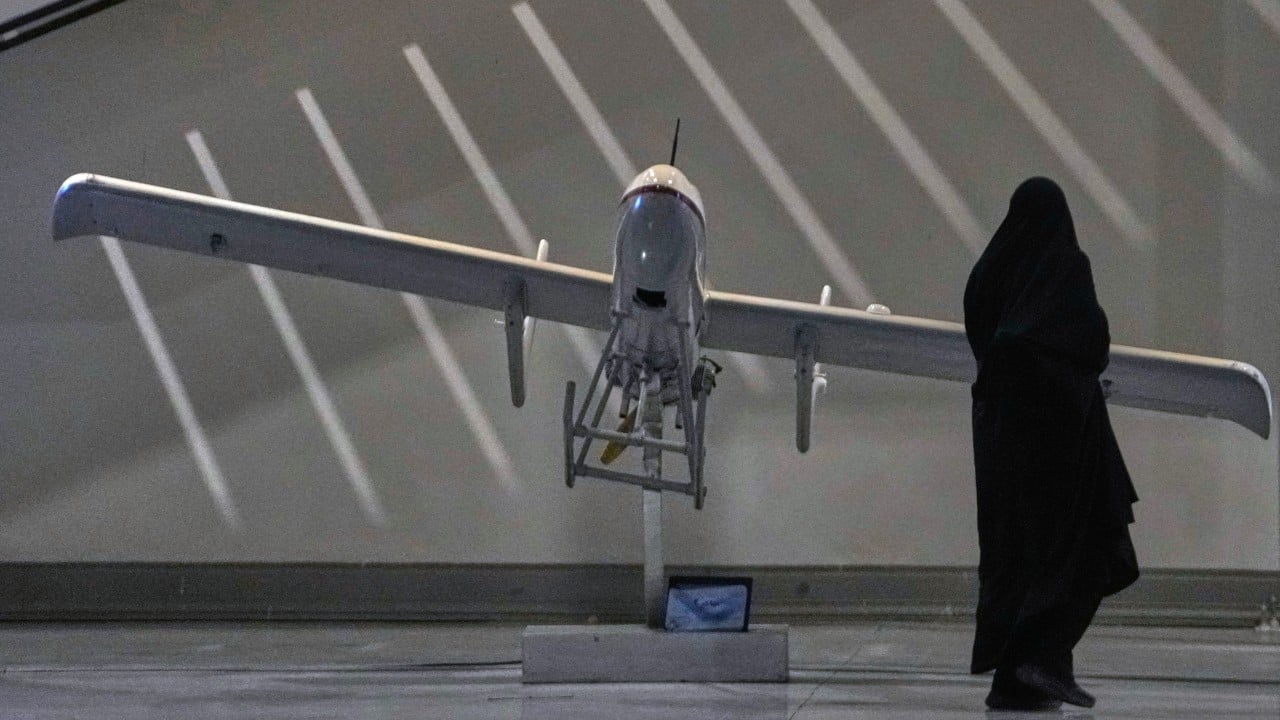
Mainstream defense commentary treats every Iranian drone launched toward a U.S. military facility in Bahrain as a traditional kinetic battle—a simple test of whether American air defenses can knock a flying object out of the sky. That framing misses the point entirely. When low-cost unmanned aerial vehicles (UAVs) target high-value American radar installations in the Persian Gulf, the real contest isn't tactical interception. It is an asymmetrical war of attrition waged on a balance sheet.
Defense analysts and wire reports routinely default to a binary scorecard: did the Patriot battery, C-RAM, or naval interceptor destroy the incoming drone, or did the drone hit the radar? If the system holds, pundits declare deterrence intact. If debris falls near a base in Manama, commentators warn of imminent regional escalation. Both reactions rely on a lazy consensus that measures modern conflict using Cold War metrics.
In reality, firing a multi-million-dollar interceptor to destroy a twenty-thousand-dollar one-way attack drone is not a defensive victory. It is a slow-motion economic hemorrhage.
The Cost-Exchange Trap Nobody Wants to Calculate
To understand what actually happens when Iranian drones target U.S. radar systems in Bahrain—home to the U.S. Navy’s Fifth Fleet and a critical node in regional early-warning networks—you have to look at the math of asymmetric warfare.
According to defense budget analyses from the Center for Strategic and International Studies (CSIS), modern surface-to-air interceptors like the Patriot PAC-3 or Standard Missile variants cost anywhere from $2 million to over $4 million per shot. Meanwhile, Iranian-designed one-way attack drones, such as the Shahed series, cost an estimated $20,000 to $50,000 to manufacture.
The math is brutal:
- The Attacker’s Ledger: Launching twenty drones costs roughly $400,000 to $1 million.
- The Defender’s Ledger: Firing two interceptors per target—standard military doctrine to ensure a high probability of kill—costs between $80 million and $160 million.
- The Result: Even a 100% interception rate leaves the defender poorer by two orders of magnitude, while depleting finite missile stockpiles that take years to manufacture.
I have watched defense contractors and Pentagon planners spend billions optimizing for the "exquisite threat"—hypersonic glide vehicles, stealth fighters, and heavy ballistic missiles—while treating cheap unmanned systems as an afterthought. When you build an air defense architecture around stopping a $15 million ballistic missile, an adversary does not need to beat your technology. They just need to bankrupt your magazine depth.
Why Radar Systems Are the Real Chokepoint
Most coverage treats a military radar installation as just another building on a base. It isn't. In the Persian Gulf, high-powered AN/TPY-2 and naval radar arrays serve as the central nervous system for the entire regional missile defense network.
Without continuous radar tracking, billion-dollar interceptor batteries are blind. They cannot calculate trajectories, discriminate between decoys and warheads, or cue automated defenses.
By directing inexpensive drones specifically at radar infrastructure in Bahrain, an adversary forces a lose-lose dilemma:
- Burn expensive interceptors to protect the radar, accelerating stockpile depletion.
- Hold fire to conserve missiles, risking damage to the fragile phased-array antennas that take months or years to repair and recalibrate.
Notice that the attacker does not even need to destroy the radar dome to achieve a strategic effect. Forcing a radar system to power down, relocate, or operate under constant electronic and kinetic suppression degrades situational awareness across the entire Gulf.
The Escalation Myth
Another staple of conventional reporting is the claim that drone harassment in the Gulf signals an immediate slide into full-scale regional war. That misreads how grey-zone coercion works.
States use low-cost drones precisely because they sit below the threshold that triggers massive conventional retaliation. Historically, launching manned aircraft or heavy ballistic missiles at a U.S. base in Bahrain would guarantee an overwhelming military response. A swarm of small, deniable, or attritable drones creates ambiguity.
Politicians and military commanders hesitate to launch a major retaliatory campaign over intercepted drones that caused zero casualties. That hesitation is the exact political space Iran exploits. As scholars at the International Institute for Strategic Studies (IISS) have documented, grey-zone tactics succeed not by winning decisive battles, but by gradually normalizing higher levels of friction until the defender accepts a degraded strategic position as the new status quo.
What People Get Wrong About Drone Defense
When headlines break about drones near U.S. assets in the Gulf, public debate immediately jumps to the wrong questions.
"Why can't the U.S. just shoot them all down?"
Shooting them down is the easy part; sustaining the rate of fire is the problem. Traditional kinetic air defense relies on complex supply chains for solid rocket motors, microelectronics, and seekers. You cannot surge production of advanced interceptors overnight, whereas commercial-grade components used in basic UAVs can be sourced globally and assembled in workshops.
"Doesn't electronic warfare solve this?"
Jamming and GPS spoofing help, but they are not silver bullets. Modern drones increasingly use inertial navigation systems (INS) combined with optical or terrain-matching guidance for their terminal phase. Once a drone locks onto a fixed radar site's coordinates or visual signature, cutting its radio link does nothing to stop its momentum.
"Are directed-energy weapons ready to replace missiles?"
High-energy lasers and high-power microwave systems offer a theoretical cost-per-shot of just a few dollars. However, in the real world of the Persian Gulf, atmospheric dust, extreme heat, and high humidity scatter laser beams and degrade their effective range. Directed energy is a useful layer, not a standalone replacement.
The Hard Truth About Fixing the Vulnerability
If the Pentagon wants to break out of the cost-exchange trap in Bahrain and across the Middle East, buying more of the same interceptors will only make the problem worse.
First, defense procurement has to embrace attritable mass. Defending against cheap threats requires cheap counters—gun-based systems with programmable airburst munitions, reusable counter-drone interceptors, and automated kinetic nets that cost less than the targets they destroy.
Second, radar architecture must shift from monolithic to distributed. Putting all regional sensing capability into a handful of massive, static, easily mapped radar installations creates irresistible targets. Replacing single giant arrays with networked, mobile, low-signature sensors makes it vastly harder for an adversary to blind the network with a single strike.
Third, deterrence cannot remain purely defensive. A posture that only catches arrows while leaving the archer untouched guarantees eventual exhaustion. Effective deterrence requires imposing tangible, asymmetric costs on the logistics, command networks, and launch infrastructure behind the attacks.
The Trade-Offs Nobody Admits
Moving toward distributed sensors and lower-cost point defenses comes with genuine risks. Cheaper, mobile radars generally have shorter detection ranges and lower power output than massive fixed installations, meaning defenders get less warning time against high-speed ballistic missiles. Similarly, relying on short-range gun systems or electronic warfare increases the risk that debris—or an occasional leaker—impacts near populated areas like Manama, creating severe diplomatic fallout with host nations.
There is no risk-free architecture. Every defensive choice trades one vulnerability for another.
As long as commentators keep measuring success by whether a $3 million missile successfully obliterated a $30,000 drone over the Persian Gulf, they will keep celebrating a strategy that is mathematically designed to lose.


