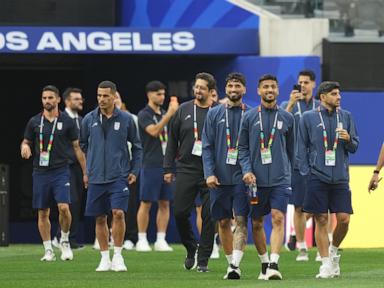
You can feel the tension in the air around Southern California right now. When Iran walks onto the pitch at SoFi Stadium in Inglewood to play New Zealand, thousands of people won't be cheering. They'll be screaming in anger.
The World Cup is supposed to be a moment of pure sporting joy. For the massive Iranian American diaspora, it's a political minefield. The match serves as a painful reminder of the ongoing turmoil back home, tearing a deep rift through the community. Some see the team as a symbol of national pride. Others view them as a propaganda arm of a brutal government.
The Battle of the Flags Outside SoFi Stadium
The heart of the conflict sits right outside the stadium gates. Los Angeles holds the largest concentration of Iranians outside of Iran. It's an energetic community often called Tehrangeles. Many families arrived here after the 1979 Islamic Revolution. They carry deep scars, and those wounds reopened after Tehran's brutal crackdown on dissent.
Activists are organizing massive rallies outside the venue. They aren't carrying the official green, white, and red flag of the Islamic Republic. Instead, they're waving the pre-revolutionary Lion and Sun flag.
Organizers like Sid Mohasseb, a 65-year-old activist, are coordinating buses to transport thousands of protesters from across California. They want a massive turnout to ensure the world cannot ignore what's happening back home. For these demonstrators, cheering for the team is impossible. Ali Javahery, a 59-year-old consultant from Orange County, is refusing to step foot inside. He says the players are under intense pressure to carry out the government's agenda. In his view, the squad is no longer Team Melli, the beloved national team. It's the team of the Islamic Republic.
Football and Propaganda Inside the Arena
FIFA finds itself caught in the middle of a security and public relations nightmare. The governing body strictly bans any political messaging or symbols inside the stadium during matches. That includes the Lion and Sun flag.
This policy has enraged the diaspora. The Iranian American Institute for Voices for Liberty even filed a lawsuit in California to challenge the stadium ban.
Activists are finding clever workarounds. Ticket holders are printing the pre-revolutionary flag onto T-shirts, hiding them under jackets until they pass security. What happens if thousands of fans strip down to reveal these shirts inside the arena? The official stance from Tehran is severe. Iranian Sports Minister Ahmad Donyamali publicly warned that if political symbols appear inside the venue, team officials have a duty to stop the match entirely.
The atmosphere inside the tournament is already toxic. During the opening ceremony in Los Angeles, a large portion of the crowd booed loudly when the official Iranian flag was brought onto the field.
The Impossible Position of the Players
It's easy to look at the squad and demand defiance, but the reality for these athletes is terrifying. In Iran, speaking out carries severe consequences.
Look at the team sheet for proof. Star striker Sardar Azmoun was completely left off the World Cup squad this year. The reason? A social media post that angered authorities in Tehran. Back in 2022, a legendary former member of the national team was arrested for supporting anti-government protests. The players know that every move they make is being watched by security officials.
Team captain Mehdi Taremi tried desperately to defuse the situation during his pre-match press conference, stating that the team plays for every Iranian and aims to bring joy, completely avoiding politics.
But for a community grieving from decades of oppression, staying neutral feels like betrayal. Iman Foroutan, an activist from Orange County, openly calls the players traitors for saluting officials and singing the regime's anthem. Others feel deep sympathy for the squad. Ali Eslami, a 70-year-old former tennis coach living in Tijuana, points out that the players are trapped in an impossible situation, forced to compete under a cloud of intense hostility.
Finding Joy in the Chaos
Despite the rage, a quieter segment of the diaspora is choosing to watch. They separate the sport from the regime.
Reza Garajedaghi, 57, is staying home in San Diego to watch the match on television with his 96-year-old father. He couldn't afford the sky-high ticket prices anyway, but he refuses to let a government rob him of his love for Persian football. He believes the boys on the pitch represent the historic spirit of the Iranian people, not the politicians in power.
Watch parties are happening in restaurants and living rooms across Southern California. For these fans, the 90 minutes on the field offer a rare chance to feel connected to their homeland. It's a fragile peace, though. Many fans who bought tickets months ago ended up selling them in disgust as news of fresh crackdowns filtered out of Iran.
If you want to understand the true impact of this match, stop looking at the scoreboard. The real story is happening in the stands, on the sidewalks of Inglewood, and in the fractured homes of a diaspora trying to navigate a game that is never just a game.