Silence.
That is the first thing you notice when a maritime GPS unit loses its mind at three in the morning, seventy miles off the coast of Nova Scotia, with freezing Atlantic spray slapping the wheelhouse glass and a storm front brewing on the eastern horizon.
Let us invent a man to sit in that wheelhouse. Call him Arthur. Arthur is a fictional composite of the thousands of commercial fishermen, cargo pilots, and emergency responders who rely on invisible threads of radio light bouncing off the ceiling of our sky to keep from dying. In our hypothetical scenario, Arthur is staring at a screen that suddenly insists his sixty-foot trawler is parked in a cornfield outside Winnipeg. No alarms blare. No engines sputter. The ocean simply stops making sense because, roughly two hundred miles above his head, the ceiling just vanished.
We tend to think of space launches as neat, contained spectacles of fire and thunder. We watch the white column of the Space Launch System roar off Launch Complex 39B at Kennedy Space Center, feel the bass rattle our ribs through our television speakers, and cheer as four astronauts arc toward the lunar horizon. We see the flame. We do not see the chemical wake tearing through the upper atmosphere like a speedboat slicing through a quiet pond.
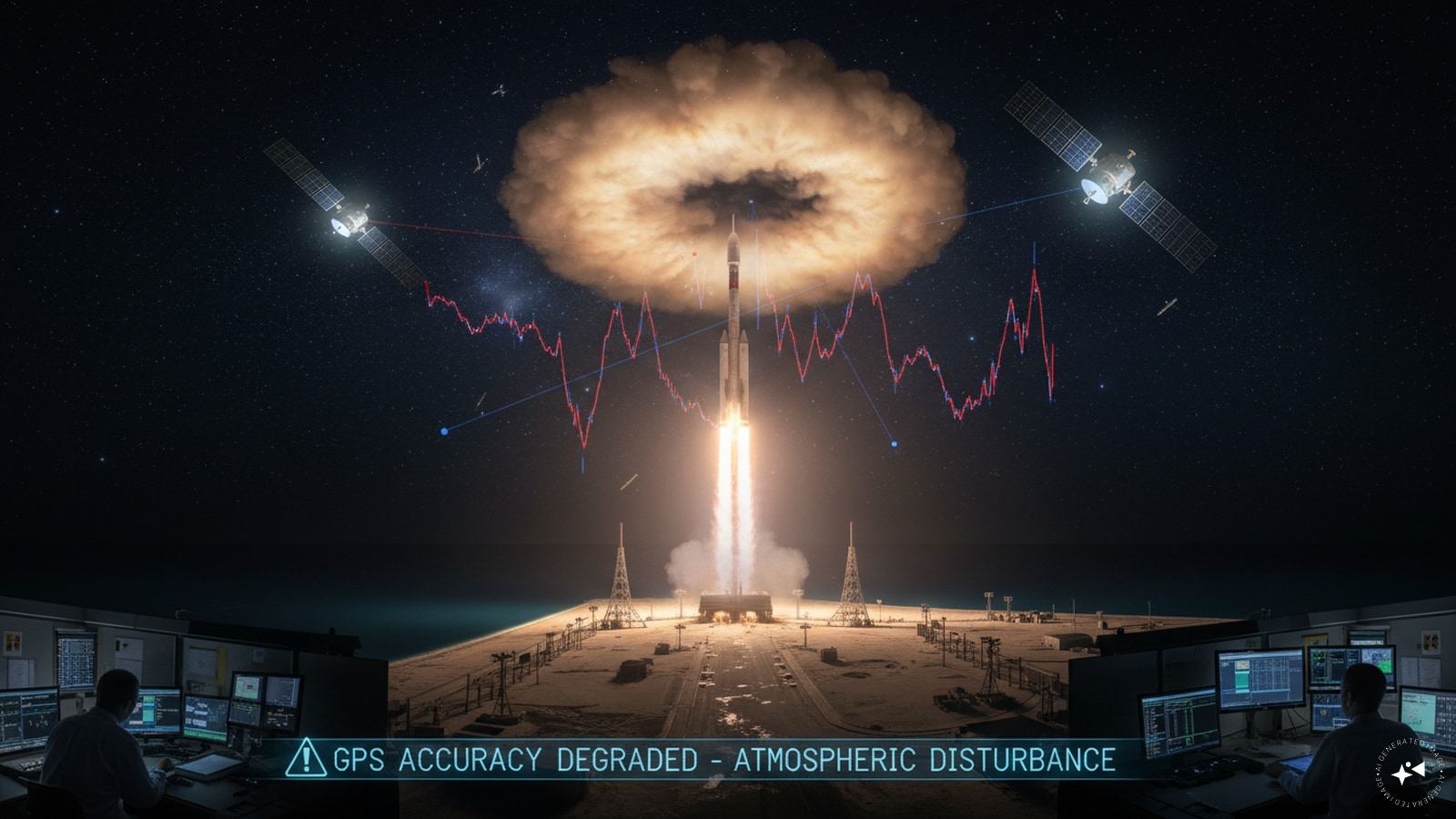
When NASA’s Artemis II mission climbed out of Earth’s gravity well, its massive engines did more than carry humans back toward the Moon for the first time in over half a century. As the rocket punched through the upper reaches of the atmosphere, its exhaust carved temporary, invisible voids into the ionosphere—challenging the stability of a region of charged particles that spans up to 5,000 kilometers across.
Five thousand kilometers. To put that in perspective, that is roughly the distance from New York City to London, or from the coast of California all the way across the continental United States and well into the Atlantic Ocean.
Most people have never heard of the ionosphere, and those who have usually dismiss it as trivia from a high school earth science textbook. Yet you touch it every single day. Every time you order a rideshare, every time an airliner lands in heavy fog, every time a high-frequency radio call crosses an ocean, you are trusting a fragile shell of electrified gas floating between fifty and four hundred miles above the dirt.
And right now, as humanity prepares to launch thousands of heavy rockets over the coming decade, we are punching holes in that shell faster than we understand how to measure the bruises.
The Ceiling Made of Sunlight
To understand what a rocket actually does to the sky, you first have to stop thinking of the atmosphere as empty air.
Up near the edge of space, the air is vanishingly thin, bathed in relentless ultraviolet radiation from the sun. That solar radiation acts like a cosmic hammer, smashing into gas molecules and knocking electrons loose from their atoms. The result is a vast, shimmering sea of free-floating electrons and positively charged ions. Think of it as an invisible mirror suspended at the top of the world.
For more than a century, human civilization has used that mirror to bounce radio waves around the curve of the Earth. Even more critically, the satellites orbiting above that layer—the constellations that power GPS navigation, synchronize global financial transactions, and guide precision agriculture—must beam their signals straight down through this electrified soup to reach your phone.
Because the ionosphere is electrically charged, it bends and slows those radio signals as they pass through. Engineers build complex mathematical models to account for this delay, correcting for the bending light the same way your brain adjusts for the bent appearance of a straw sitting in a glass of water. Those corrections work beautifully, provided the water stays relatively still.
Now enter a heavy-lift rocket.
When the core stage of a rocket like the Space Launch System burns liquid hydrogen and liquid oxygen at altitudes above one hundred miles, it is not merely pushing itself forward. It is dumping massive quantities of water vapor and hydrogen molecules directly into a region where those gases almost never naturally exist.
Here is where the chemistry turns violent.
Those exhaust molecules immediately collide with the free electrons and oxygen ions that keep the ionosphere alive. Through a rapid cascade of chemical reactions—specifically dissociative recombination, a process where molecular ions grab free electrons and split apart into neutral atoms—the rocket exhaust acts like a giant chemical sponge. It soaks up the free electrons. Within minutes, a region of charged plasma that took hours of sunlight to build is neutralized, hollowed out into an empty pocket of neutral gas.
Scientists call it an ionospheric hole.
I remember the first time I stood in a cramped university monitoring lab watching real-time Total Electron Content maps during a major orbital launch. On the monitors, the ionosphere usually glows in warm, reassuring reds and oranges, indicating dense, healthy bands of electrons wrapping the globe. Moments after the rocket’s upper stage ignited over the ocean, a deep, bruising blotch of dark blue bloomed across the screen. It expanded outward like ink dropped into water, swallowing thousands of kilometers of sky in less than twenty minutes.
Watching that blue void spread across the screen gave me a strange, cold vertigo. We spend so much energy worrying about the trash we leave in orbit—the dead satellites, the spent boosters, the flecks of paint traveling at seventeen thousand miles per hour—that we rarely stop to consider what happens when we alter the medium itself.
Why Five Thousand Kilometers Matters
You might reasonably ask why anyone should care if a patch of thin gas two hundred miles up loses its electrical charge for a few hours. After all, the sun comes up the next morning, ultraviolet light floods the upper atmosphere once more, and the electrons gradually rebuild themselves. No one suffocates. The sky does not fall.
Wait.
Look closer at what happens inside that dark blue void while it exists.
When a rocket carves a 5,000-kilometer-wide depression into the ionosphere, it does not create a neat, uniform window. Instead, the edges of that hole become violently turbulent. Dense pockets of plasma slosh against empty voids, creating steep gradients and swirling instabilities that scientists refer to as plasma bubbles.
To a GPS signal passing downward from a satellite twelve thousand miles overhead, flying through the ragged edge of an ionospheric hole is like trying to read a street sign through a sheet of rippled, frosted glass during an earthquake. The radio waves scatter, shimmer, and drop out entirely—a phenomenon engineers call ionospheric scintillation.
In benign weather on a Tuesday afternoon, a brief GPS glitch might make your mapping app spin in circles for thirty seconds while you wait at a stoplight. Nobody gets hurt. You sigh, tap the screen, and drive on.
Now move that exact same thirty-second glitch into the cockpit of a commercial airliner executing a satellite-guided approach through zero-visibility fog into a mountain valley. Or place it on the bridge of a supertanker threading a narrow shipping lane in the dark. Or drop it onto a rural search-and-rescue helicopter hovering fifty feet above a flooded river canyon, relying on sub-meter positional accuracy to keep its rotor blades clear of granite cliffs.
High-frequency radio communications suffer an even more immediate collapse. Because HF radio waves rely on bouncing off the dense electron layers of the ionosphere to travel over the horizon, a massive ionospheric hole acts like a trapdoor in the sky. Signals aimed at the horizon simply shoot straight out into deep space instead of reflecting back down to Earth. Maritime distress channels go dead. Transoceanic aviation relays vanish into static.
For decades, these events were scientific curiosities, rare enough to be treated as anomalies. When Skylab launched aboard the final Saturn V rocket in 1973, researchers noticed an unexpected blackout in radio signals stretching over a thousand miles across the Atlantic. They wrote papers about it, marveled at the physics, and filed the data away because rockets of that magnitude launched only once every few years.
That era is over.
The Coming Traffic Jam at the Edge of Space
We are standing at the threshold of the most aggressive expansion of orbital launch activity in human history. What used to be the exclusive domain of two superpowers launching a handful of rockets each year has transformed into a global assembly line. Mega-constellations of internet satellites, commercial space stations, lunar landers, and deep-space probes are queuing up on launchpads from Florida to Texas, from French Guiana to northern China.
Every single one of those rockets must punch through the exact same thin layer of sky.
Historically, atmospheric scientists focused almost exclusively on the stratosphere—the layer where the ozone shield lives—and the troposphere, where our weather churns. The upper atmosphere, that ghostly boundary zone where air fades into vacuum, was treated as an infinite sink capable of absorbing whatever exhaust we threw at it without consequence.
We made that same assumption about the oceans in the nineteenth century. We made it about the lower atmosphere during the Industrial Revolution. Every time humanity encounters a vast, invisible commons, our first instinct is to treat it as indestructible until the data proves otherwise.
Consider what happens next as launch cadences climb from dozens per year to hundreds, and eventually thousands. A single massive rocket like Artemis II creates an ionospheric disturbance spanning thousands of kilometers. What happens when heavy-lift vehicles launch every week? What happens when overlapping ionospheric holes merge over major transoceanic flight corridors, creating persistent regions of electromagnetic turbulence that our navigation networks were never designed to handle?
Even more unsettling is what we still do not know about the long-term thermal and chemical balance of the upper atmosphere. The water vapor injected by hydrogen-fueled rockets does not simply disappear once it neutralizes a few electrons. At high altitudes, that water freezes into microscopic ice crystals, forming eerie, glowing noctilucent clouds that reflect sunlight back into space and alter temperature gradients at the edge of the mesosphere.
I admit that the scale of these interactions is deeply intimidating, even to those of us who follow aerospace engineering closely. We are running a planetary-scale chemistry experiment in real time, and our monitoring instruments are still playing catch-up.
Reading the Invisible Wake
Fortunately, we are no longer flying completely blind.
During the Artemis era, atmospheric physicists began deploying dense networks of ground-based Global Navigation Satellite System receivers—turning thousands of ordinary GPS stations around the world into an accidental planetary telescope. By measuring the microscopic delays in signals arriving from dozens of satellites simultaneously, scientists can now watch an ionospheric hole form in high definition, tracking its drift across oceans and continents minute by minute.
This is not an argument against going to the Moon. Walking away from space exploration because rockets disturb the ionosphere would be like refusing to sail across oceans because ship hulls leave wakes in the water. Human curiosity is non-negotiable, and the scientific returns of missions like Artemis II—testing life support systems in deep space, mapping lunar resources, inspiring a generation to look upward—are worth every ounce of propellant burned to reach orbit.
The real issue is not whether we fly, but how intelligently we manage the wake we leave behind.
Right now, launch operators file airspace closures to keep planes away from falling boosters, and maritime notices to keep boats out of splashdown zones. We draw neat red polygons on maps to protect people from physical debris. Yet we issue virtually no operational warnings for the invisible, 5,000-kilometer electromagnetic wake trailing behind those same vehicles.
That blind spot is remarkably easy to fix once we acknowledge it exists.
Space weather forecasting centers already monitor solar flares and geomagnetic storms, sending real-time alerts to airlines, power grid operators, and satellite controllers so they can adjust navigation tolerances before interference strikes. Integrating rocket-induced ionospheric holes into those exact same forecasting networks would allow aviation authorities and maritime navigators to anticipate signal degradation hours in advance.
At the same time, propulsion engineers are exploring trajectory profiles that minimize upper-atmospheric dwell time—shaping ascent curves so rockets burn through the densest bands of the ionosphere more steeply, reducing the horizontal spread of exhaust plumes before engine cutoff.
The Ghost in the Mirror
Think back to Arthur, our hypothetical fisherman drifting through the freezing dark off Nova Scotia while his GPS screen insists he is parked in a prairie wheat field.
In reality, Arthur’s boat is exactly where it has always been. The ocean beneath his keel has not moved. The stars above the cloud deck have not shifted by a millimeter. The only thing that changed was the invisible mirror suspended two hundred miles over his head, temporarily erased by a trail of water vapor left behind by four humans on their way to the Moon.
Every great leap outward demands a deeper reckoning with the world we leave behind. For sixty years, we judged the environmental cost of spaceflight solely by what happened on the launchpad and what fell back into the sea. Today, looking at the vast, silent voids carved into the ceiling of our sky, we are learning that the footprint of a rocket stretches far wider than its flame.
Far above the clouds, where the air thins into nothing and the blue curve of Earth meets the black void of space, the sunlight is already working—patiently knocking electrons loose from stray atoms, stitching the invisible mirror back together before the next launch countdown reaches zero.