Every night, while seven million people in Hong Kong drift into sleep, a silent, mechanical exhaustion settles over the city. It radiates from the steel. It lives in the wheels.
If you have ever stood on a platform at Admiralty during rush hour, you have felt that rhythmic thrum beneath your boots. It is the heartbeat of a metropolis. We take it for granted that the doors will slide open, that the friction will bite at exactly the right moment, and that we will be carried home. But steel on steel is a brutal relationship. Every kilometer traveled is a tiny act of erosion. The wheels that carry us are constantly, microscopicly, dying.
Maintaining that heartbeat used to be a grueling, manual marathon. Now, hidden away in a HK$300 million facility, the MTR Corporation has changed the stakes of how a city stays in motion.
The Weight of the Grind
Think of a "wheelset." To the uninitiated, it sounds like a simple part. It isn't. It is the literal foundation of transit—an axle gripped by two massive steel wheels. They endure tons of pressure, extreme heat, and the unforgiving geometry of Hong Kong’s winding tunnels.
In the old days—which is to say, last year—servicing these components was a feat of raw endurance. Imagine a technician named Pak-ho. He is a hypothetical composite of the hundreds of souls who work the graveyard shift. Pak-ho spends his nights in a cavernous depot, surrounded by the smell of ozone and industrial grease. In the traditional workflow, his team had to manually dismantle these massive assemblies. They used heavy tools, sheer physical strength, and a staggering amount of time to inspect every millimeter for cracks or "flat spots" that could cause a bumpy ride—or worse.
It was a process defined by friction. Not just the friction of the rails, but the friction of human limits. A single wheelset overhaul could take days of back-and-forth movement across a sprawling workshop. When you have thousands of wheelsets keeping a city alive, the math starts to look terrifying. If the maintenance slows down, the city slows down.
The MTR’s new South Island Line Wheelset Maintenance Centre was built because the old way was hitting a wall.
The Eighty Percent Revolution
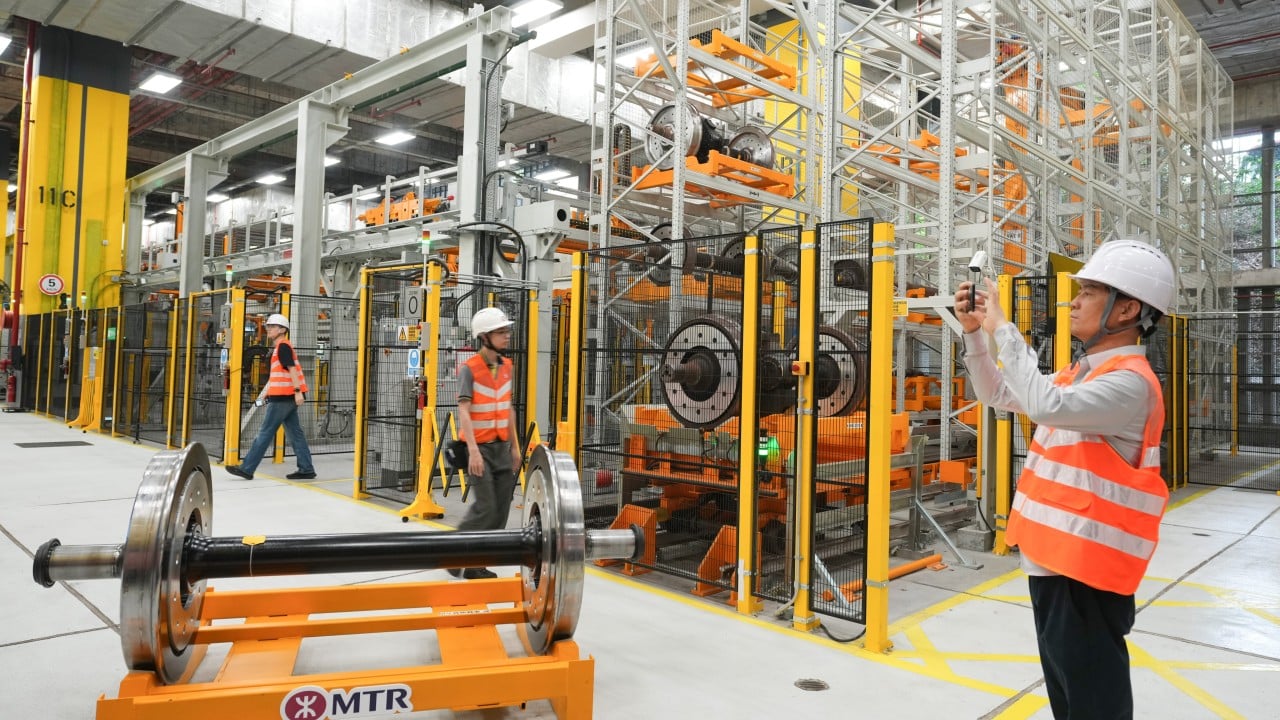
The new facility in Wong Chuk Hang doesn't just look different; it thinks differently. It is the first fully automated wheelset maintenance hub in the region. To understand the scale of this shift, you have to look at the numbers, but through the lens of time.
Efficiency has spiked by 80%.
That isn't just a corporate statistic. It means that a task which used to consume five hours of grueling labor now takes one. It means the "down time" for a train—the period it sits idle in a dark shed instead of moving people to work—has been slashed.
The centerpiece of this HK$300 million investment is a series of robotic arms and automated guided vehicles (AGVs) that move with a haunting, synchronized grace. In the old workshop, Pak-ho and his colleagues had to move these multi-ton steel components using overhead cranes and manual carts. It was slow. It was loud. It was dangerous.
Now, the AGVs glide across the floor, sensing their environment, delivering components to robotic workstations with millimeter precision. The robots perform "vision-based" inspections. They don't get tired. They don't have a bad morning because they didn't sleep well. They scan the steel using high-definition sensors to find flaws invisible to the human eye.
But this isn't a story about machines replacing people. It is a story about machines protecting them.
The Human Core of the Machine
There is a common fear that automation is a cold vacuum, sucking the soul out of industry. The reality on the shop floor tells a different story. By offloading the "3D" jobs—the Dirty, Dull, and Dangerous—the MTR has effectively extended the careers of its best engineers.
Pak-ho doesn't spend his night straining his back or inhaling metal dust anymore. Instead, he stands at a console. He has become a pilot of sorts. His expertise is still the final word, but his tools are now digital. He interprets the data the robots gather. He makes the high-level calls that require human judgment, intuition, and a decade of "feeling" how a train should behave.
The stakes are invisible until they aren't. We only notice maintenance when it fails. We notice it when a line is delayed, when a commute turns from twenty minutes into an hour of frustration. This new center is an insurance policy against that frustration. It ensures that the fleet is younger, fresher, and more reliable.
A Global Benchmark in a Local Shed
Hong Kong’s railway is often cited as the gold standard for global transit. Maintaining a 99.9% on-time rate while moving millions is a statistical miracle. But miracles are expensive and exhausting.
The HK$300 million spent here is a drop in the bucket compared to the economic cost of a city that grinds to a halt. By integrating smart sensing, big data, and robotics, the MTR is essentially performing open-heart surgery on a patient that never stops running.
The facility uses a "Digital Twin" system. This is a virtual map—a ghost version of the workshop—that allows managers to simulate workflows before they even touch a piece of steel. If a bottleneck is predicted in the virtual world, they fix it there first. It is a level of foresight that was once the stuff of science fiction.
Consider the environmental angle, too. Precision maintenance means parts last longer. Less waste, less raw steel consumption, and a smaller carbon footprint for every journey you take. The efficiency gain isn't just about speed; it's about the intelligence of the resource.
The Quiet Reality of Progress
We live in an age of flashy tech launches and shouting headlines. A wheelset maintenance center in Wong Chuk Hang doesn't usually make the front page. It isn't a new smartphone or a soaring skyscraper. It is a warehouse full of heavy metal and smart sensors.
Yet, this is where the future of the city is actually being secured.
The next time you are on the train, and you feel that smooth, almost silent glide as the carriage pulls away from the station, remember the robots in the dark. Remember the engineers who traded their wrenches for tablets. Remember that HK$300 million isn't just a price tag; it’s the cost of keeping a promise.
The promise is simple: the city will keep moving. The wheels will keep turning. And you won't even have to think about why.
The steel is resting now, but the work never stops.