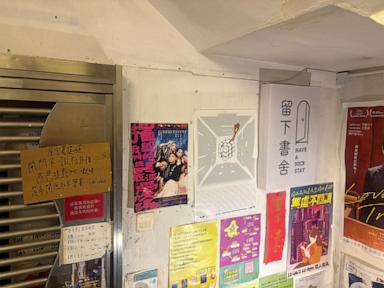
The humidity in Mong Kok always clings to you like a damp wool coat. Up on the second floor of a narrow commercial building, away from the neon glare of the streets below, the air inside the independent bookstore was different. It smelled of quiet things. Old paper, black tea, and the faint, dry scent of dust settling on wooden shelves.
For years, these second-floor bookstores were the secret lungs of Hong Kong. They were places where you could climb a creaking flight of stairs and step into a sanctuary of thoughts. On these shelves, poetry sat next to political theory, and memoirs of old revolutions rubbed shoulders with modern local histories.
Then came the afternoon of July 15, 2026.
The door did not merely open; it was occupied. Heavy boots crossed the threshold. Men with tactical vests and lanyard-bound badges filled the narrow aisles, blocking the light from the windows. The quiet was shattered by the sharp, metallic rip of packing tape and the heavy thud of cardboard boxes being loaded with paper.
A woman, a former journalist who had poured her life savings into this sanctuary, was led down the stairs. Her wrists were bound in cold metal. Below, on the crowded street, onlookers paused, their eyes reflecting the flashing blue lights of the police vans. Five people were taken away that day from two beloved independent bookstores, Have A Nice Stay and Greenfield Book Store.
The charge? Displaying and selling "items with seditious intent".
But the real terror of that afternoon did not lie in the handcuffs or the cardboard boxes. It lay in a chilling metaphor delivered the next morning.
The Poison in the Soup
Consider how we define safety.
On Thursday, inside the legislative building, the city’s security chief, Chris Tang, stood before a bank of microphones. He sought to make the arrests seem ordinary, even commonsensical.
"If you are a bookseller, you have a responsibility to ensure that the books you sell do not endanger national security," Tang said. He compared the responsibility of a shopkeeper to that of a restaurant owner: "It is equal to, for example, when you are selling food, you need to ensure the food won't cause a stomach ache and is not either poison or illegal".
At first glance, the analogy feels reasonable. No one wants to eat poison. We expect the state to regulate toxic chemicals.
But a book is not a bowl of soup.
If a soup contains arsenic, a laboratory can run a chemical analysis. The molecular structure of a toxin is objective, measurable, and dead. A book, however, contains words. Words do not have a fixed chemical weight. Their meaning shifts depending on who is reading them, when they are reading them, and who is currently in power.
To carry out the security chief’s mandate, a bookseller cannot simply run a test strip over a page. They must become a mind reader. They must anticipate not just what a book says, but how its words might be interpreted by a prosecutor years down the line.
The Trap of the Unseen Map
To understand the sheer exhaustion of running a bookstore in Hong Kong today, we have to look at the rules of the game. Or rather, the lack of them.
When reporters asked if the government would publish a list of banned books—a simple index of what is legal and what is "poison"—the security chief flatly refused. Such a list, he argued, would not be conducive to effective law enforcement.
Think about what that means.
Imagine you are driving down a winding mountain highway. The speed limit is strictly enforced, and the penalty for speeding is years in prison. But there are no speed limit signs. When you ask the police how fast you are allowed to go, they tell you that publishing a speed limit would only help speeders evade the law. They tell you that you must simply "know" what a safe speed is.
If you drive too fast, you will find out when you are pulled over in handcuffs.
This is what booksellers call "the elusive red line". It is a boundary that is nowhere and everywhere at once.
Consider the logistical nightmare this creates. A modest independent bookstore might hold five thousand titles. To guarantee that not a single page contains "seditious intent"—a term that has been expanded to include anything deemed to incite hatred against the government, the judiciary, or law enforcement—a shopkeeper would have to read every single line of every single book in their inventory. Every footnote. Every preface. Every translation of a foreign political biography.
They must do this without legal training, while also trying to pay rent in one of the most expensive real estate markets in the world.
"Our capacity is limited," Have A Nice Stay wrote in a heartbreaking social media post just a day before the raid. They had already decided to close their doors forever by August. "We cannot possibly review every book, let alone judge which ones are 'problematic'".
They chose surrender over the constant, stomach-churning fear of the knock on the door. But even surrender did not save them from the raid.
A History Written in Disappearing Ink
There was a time when Hong Kong was the literary safety valve for the entire region.
If you wanted to read banned memoirs of mainland political figures, or uncensored histories of the Cultural Revolution, you got on a plane, landed in Hong Kong, and headed straight to the "three-floor bookstores" of Causeway Bay or Mong Kok. The paper was cheap, the covers were sensational, and the intellectual freedom was absolute.
That world did not vanish overnight. It eroded, grain by grain.
First came the mysterious disappearances of mainland-focused booksellers in 2015. Then came the sweeping National Security Law imposed by Beijing in 2020, followed by Hong Kong’s own homegrown security legislation, known as Article 23, in 2024.
With each new law, the air in the bookstores grew thinner.
The owners of these shops are not radical agitators. They are lovers of print. They are people like Pong Yat-ming of Book Punch, who was arrested earlier this year for stocking a biography of Jimmy Lai. They are people who believe that a community is healthier when it can discuss its own past, its own wounds, and its own future.
When you criminalize the stocking of a book, you do not just punish the bookseller. You slowly starve the intellectual life of the city. People stop asking questions. They stop writing down their thoughts. They begin to censor their own bookshelves at home, quietly slipping titles into the trash bin late at night so their children won't be compromised.
The ultimate goal of an invisible red line is not actually to arrest everyone. The goal is to make everyone their own warden.
When the rules are intentionally vague, the safest option is to stay as far away from the line as possible. You don't just stop selling political memoirs; you stop selling sociology. You stop selling poetry that uses metaphors of darkness and light. You stock cookbooks, travel guides, and translation manuals.
The shelves become safe. And completely hollow.
The Last Lamp in the Window
On the evening after the raids, some of the remaining independent bookshops in Hong Kong stayed open. Their owners sat behind their counters, surrounded by the quiet hum of their air conditioners, looking out at the rain.
They know the risks now. The analogy of the poisoned food has made it clear that ignorance is no defense. If a book you sell is deemed toxic by the state, you are the one who served it.
We are watching the systematic dismantling of a literary culture that took decades to build. It is happening not with dramatic book burnings in public squares, but through the quiet administration of fear. It happens when a shop owner looks at a stack of new arrivals, feels a cold flutter in their chest, and decides it is safer to send them back to the distributor.
But ideas have a strange way of surviving. They do not need grand storefronts or official approval to linger. They pass from hand to hand in darkened hallways, in digital files shared across encrypted networks, and in the stubborn memories of those who remember what it felt like to climb those narrow wooden stairs and find exactly what they were looking for.
The doors of Have A Nice Stay will close for the last time in August. The shelves will be dismantled. The wooden floorboards will be swept clean. But the empty space left behind in Hong Kong’s heart will remain—a silent, haunting monument to the books that became too dangerous to read.