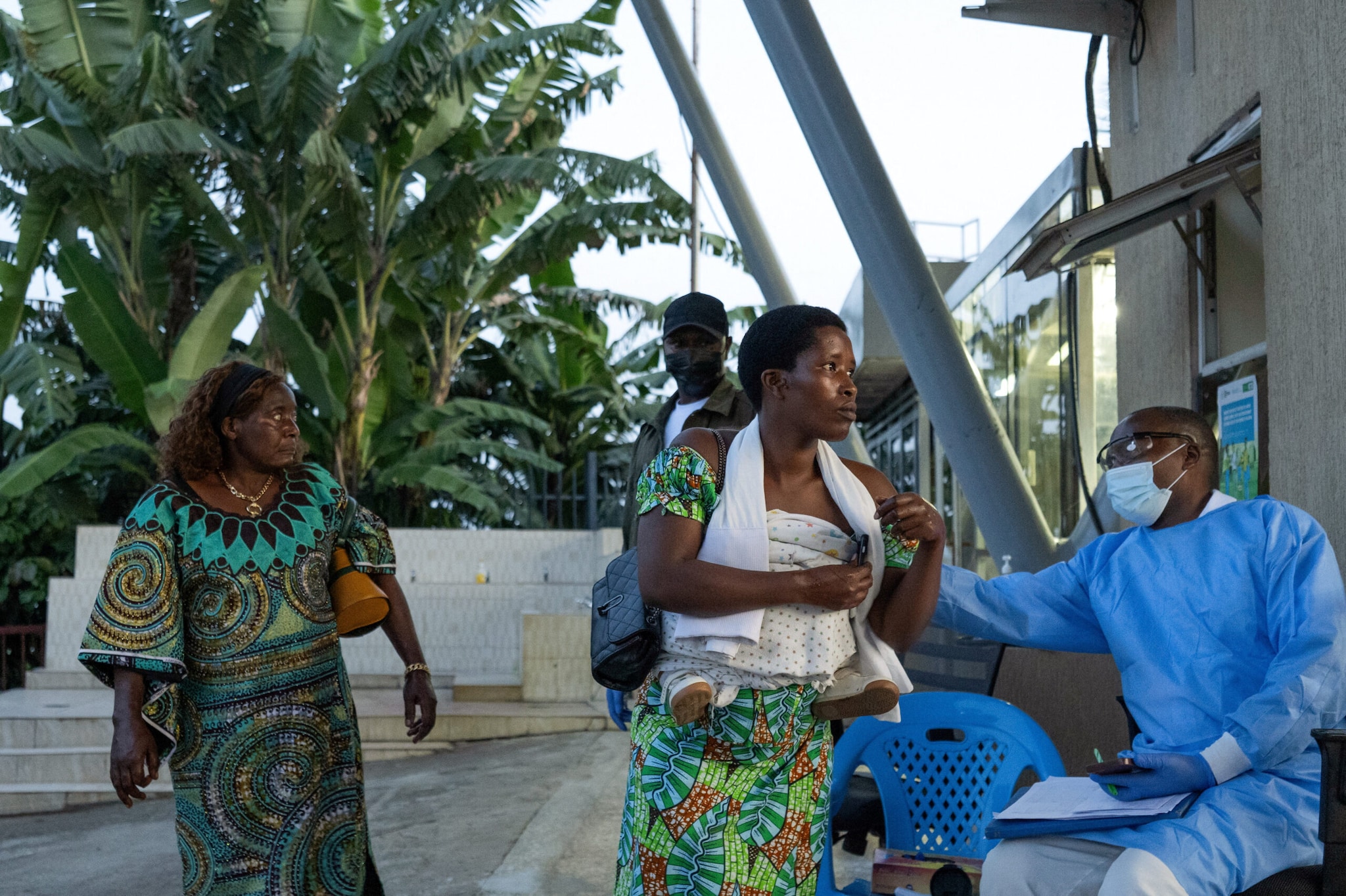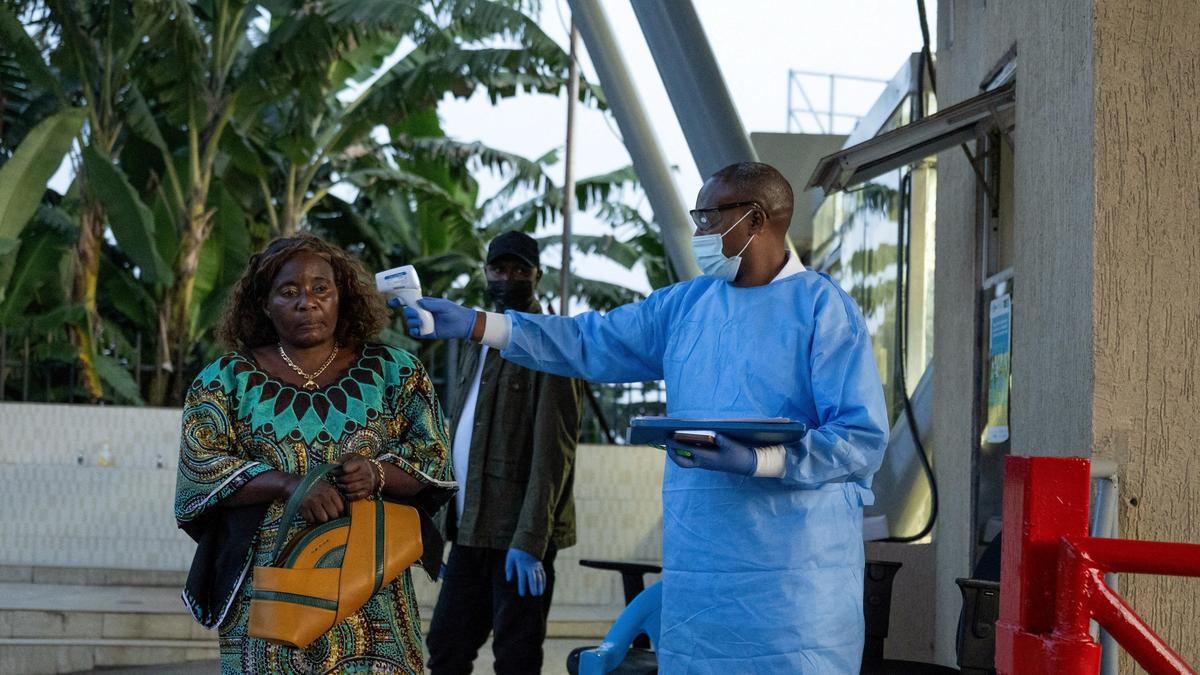
The dust in the isolation ward does not settle; it hangs in the shafts of midday heat, illuminated like tiny, golden embers. If you sit still enough, you can hear the rhythm of a continent holding its breath. It is a quiet sound. It sounds like the squeak of rubber boots on bleached concrete, the hiss of chlorine spray, and the ragged, shallow breathing of a child whose skin feels like liquid fire.
We think of global health crises in numbers. We look at charts, percentages, and red geographic heat maps flashing on television screens. But data is a defense mechanism. It allows us to look at horror from a safe distance. When the World Health Organization sound the alarm over the scale and speed of an Ebola outbreak, they are not talking about a abstract mathematical curve. They are talking about the terrifying reality of a virus that moves faster than the supply trucks, faster than the burial teams, and much faster than human grief.
To understand how an outbreak slips its leash, you have to stand in the red zone.
Imagine a young woman named Aminata. She is not a statistic; she is a mother in a remote forested village, three days' travel from the nearest paved road. Her husband came home from the gold mines with a headache that felt like a iron spike driven behind his eyes. Within forty-eight hours, he was bleeding from his gums. Aminata did what any human being reading these words would do. She did not call a hotline. She did not isolate him. She held his head in her lap, wiped the sweat from his forehead, and washed his soiled clothes with her bare hands.
Love, in the era of Ebola, is the ultimate vector.
The virus exploits our most deeply ingrained human instincts. It weaponizes compassion. When Aminata’s husband died, the village gathered to wash his body, a sacred ritual passed down through generations to ensure his spirit found peace. In that act of reverence, five more people were infected. By the time the district medical officer noticed the spike in sudden deaths, the virus had already boarded a wooden minibus taxi heading toward a trading hub of a hundred thousand people.
This is the speed that keeps epidemiologists awake at night. It is geometric progression wearing a human face.
The Friction of Distance
When an outbreak begins, the clock does not tick; it races. Yet everything required to stop it moves at the speed of molasses.
Consider the geography of containment. The World Health Organization warns that when an Ebola strain moves with unprecedented velocity, our traditional containment strategies begin to fracture. In a standard scenario, health workers use contact tracing. They find the infected person, list every single human being that person touched, and monitor them for twenty-one days. It is meticulous, exhausting detective work.
But what happens when the index case is a market trader who interacted with three hundred strangers in a bustling city center before collapsing?
The math breaks down. The detective work becomes impossible.
The physical reality of fighting a hemorrhagic fever in an underfunded health system is a lesson in brutal logistics. A single protective suit—the heavy yellow jumpsuit, the double gloves, the respirator, the goggles—transforms a human being into an astronaut. Inside that suit, the temperature rapidly climbs past a hundred degrees Fahrenheit. Sweat pools in your boots. Your goggles fog up within ten minutes. A doctor or nurse can only operate inside that plastic kiln for about two hours before dehydration causes their hands to shake.
Now multiply that by dozens of patients arriving every day. The supply chain becomes a gasping lung, struggling to pump oxygen to the front lines. If a shipment of chlorine is delayed by forty-eight hours because a bridge washed out in the rainy season, an entire hospital wing becomes an active biohazard zone.
The virus does not negotiate with bad infrastructure. It thrives on it.
The Architecture of Distrust
There is a temptation to view these outbreaks as purely medical failures, solvable by throwing enough money, vaccines, and foreign experts at the problem. That view is wrong. It is dangerously naive.
An outbreak is, at its core, a crisis of faith.
When outsiders arrive in white trucks, wearing suits that obscure their faces, speaking foreign languages, and demanding that families surrender their sick loved ones to concrete compounds where no one is allowed to visit, the natural human reaction is not gratitude. It is terror. Rumors spread faster than the disease itself. People whisper that the isolation centers are where the organs are harvested, or that the white suits are bringing the sickness to the villages to wipe them out.
If you think that sounds irrational, look closely at the history of the regions where these outbreaks typically ignite. These are places scarred by decades of civil conflict, corporate exploitation, and broken political promises. The local population has learned through bitter experience that when uniforms or official vehicles arrive from the capital city, trouble follows.
Why should they suddenly trust a government official telling them to abandon their burial traditions?
When trust evaporates, the sick go underground. They hide their symptoms. They flee into the forest or travel to distant relatives in neighboring provinces, carrying the invisible fire with them. A mother will smuggle her feverish child out the back window of a clinic if she believes entering that clinic means never seeing him alive again. Every hidden case is a new ember blown by the wind into dry brush.
The Global Echo
It is easy for someone sitting in a comfortable apartment in London, New York, or Tokyo to read about an African Ebola outbreak and view it as a distant tragedy. It feels like a story from another world, disconnected from the smooth, predictable rhythms of modern Western life.
That disconnection is an illusion. We live in an age where no destination is more than a twenty-four-hour flight away from any other. The forest villages where these viruses spill over from animals into humans are connected by a continuous chain of dirt roads, highways, and international runways to the heart of global commerce.
The World Health Organization’s anxiety is not merely about the localized suffering, though that suffering is immense. It is about the systemic vulnerability of our hyper-connected world. When a highly lethal pathogen begins to outrun containment protocols in one region, the global safety net stretches thin.
We often talk about health security as if it were a wall we build around our nations. In reality, it is a levee. If the levee breaches in one village, the entire valley floods.
The medics who volunteer to enter the red zones are not just saving lives in that specific province; they are holding the line for everyone, everywhere. They are the human shields against a biological wildfire. Yet they are often left to fight with inadequate tools, relying on courage where there should be bulletproof infrastructure.
The Cost of Looking Away
The pattern is tragically predictable. An outbreak hits the headlines. The international community panics. Pledges of aid pour in. Emergency meetings are convened in Geneva and Washington. Then, through the heroic, backbreaking work of local volunteers and international teams, the outbreak is brought under control.
The headlines fade. The cameras leave. The funding dries up.
The world returns to its state of comfortable amnesia, leaving the local clinics just as empty, the roads just as broken, and the health workers just as unprotected as they were before the nightmare began. We treat health crises as episodic disasters, like hurricanes or earthquakes, rather than predictable outcomes of chronic neglect.
Until we change that calculus, the speed and scale of these outbreaks will continue to escalate. The viruses are mutating, adapting, and finding new ways to bridge the gap between wildlife and human populations as logging and mining push deeper into pristine habitats. They are doing their job perfectly. We are failing at ours.
The sun begins to set outside the isolation ward, casting long, dark shadows across the courtyard. A nurse steps out of the high-risk zone, unpeeling her protective hood with trembling, exhausted fingers. Her face is creased with deep, red lines from the pressure of her goggles. She looks toward the horizon, where the dust from the road is rising again, signaling the arrival of another truck.
There are no more beds left in the ward. The world is still debating budgets, checking its watches, and issuing statements of concern, while on the ground, the red dirt is freshly turned, waiting for the next row of graves.