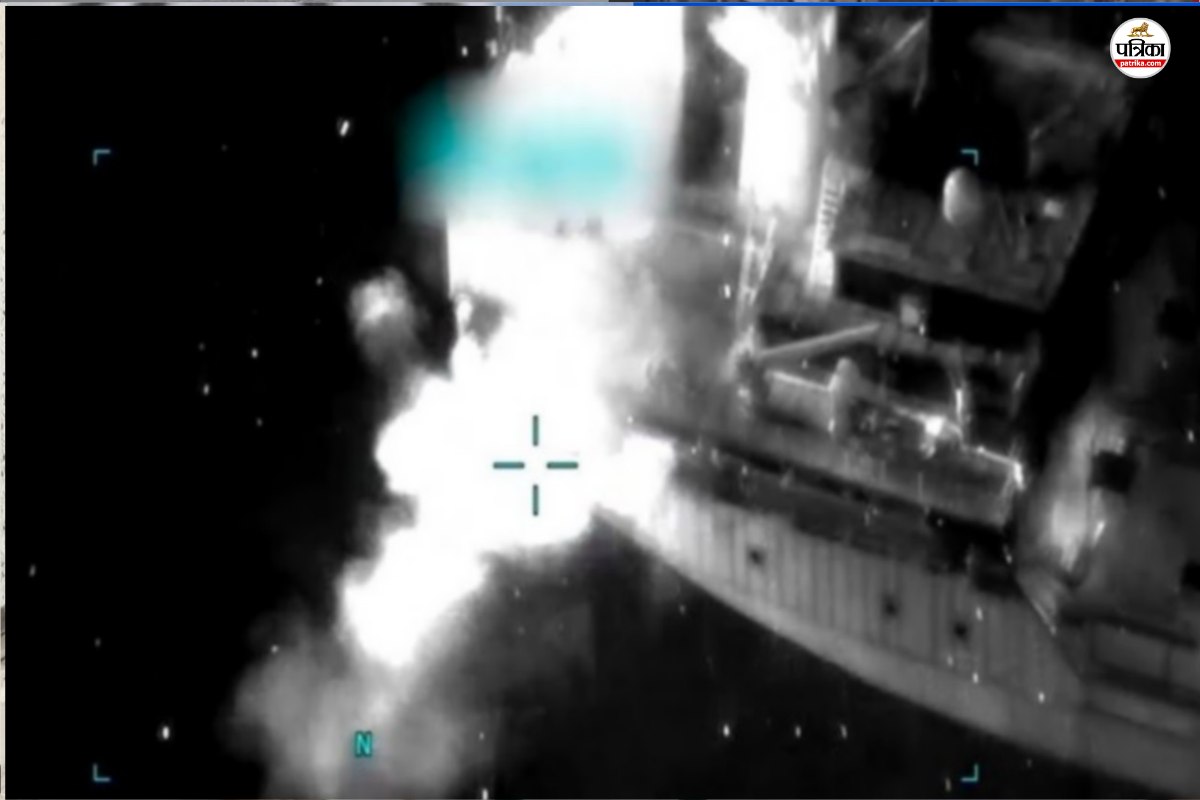
The air inside a ship’s engine room does not feel like ordinary air. It is a thick, deafening soup of pressurized diesel fumes, ambient heat, and the unrelenting, rhythmic thrum of steel pistons pounding away somewhere beneath your boots. When you are a seafarer traversing the narrow pinch points of the global economy, this subterranean chamber is your heartbeat.
Then the metal screams.
It did not happen in a vacuum. On June 11, 2026, the Guinea-Bissau-flagged bitumen tanker MT Jalveer was slicing through the dark waters of the Gulf of Oman, just off the coast of Shinas port. On board were twenty Indian seafarers. Men from places like Kerala, Punjab, and Tamil Nadu, who left their homes for months at a time to keep the world’s heavy industries moving. They were not combatants. They did not wear uniforms. Their currency was labor, not geopolitics.
But in the skies above, invisible to the naked eye but blindingly clear on radar, an American military aircraft was closing the distance. Two Hellfire missiles tore through the night sky. They did not strike the hull at random. They were precision-guided, aimed directly into the tanker’s engine room.
Fire. Smoke. Total darkness.
The engine died, and with it, the ship’s ability to move, to escape, or to defend itself. An urgent, cracking SOS call pierced the radio waves at Oman’s Shinas Port as a frantic crew member transmitted their exact coordinates through the smoke. The ship was dying in the water, a steel carcass burning in one of the most volatile maritime corridors on Earth.
The Mathematics of a Blockade
To understand why an American missile crossed paths with an Indian crew on a West African-flagged vessel, you have to look at the invisible lines drawn across the ocean. This was not an accident. The United States Central Command, operating out of its headquarters, stated plainly that the strike was part of an "impartially enforced blockade" against vessels moving Iranian oil and petrochemicals.
Consider the sheer scale of what is unfolding. Since the military friction flared between US-Israeli forces and Iran earlier this year, the Strait of Hormuz has transformed into a high-stakes chessboard. According to official data from Washington, since this specific blockade began on April 13, American forces have intercepted or redirected 135 ships that chose to comply with their orders. They allowed 42 humanitarian vessels to pass. But for those deemed "non-compliant"—those suspected of carrying Iranian crude or violating unilateral sanctions—the response has become increasingly kinetic.
The MT Jalveer was the ninth vessel to be forcefully disabled under this enforcement campaign.
The military logic is simple enough on paper. Cut off the oil, dry up the revenue, squeeze the adversary. But paper does not account for the human cargo. The blockade is being enforced without regard for the flag a ship flies, or the passports carried by the men sweating in the galley.
Three Ships in Four Days
The attack on the Jalveer was not an isolated flashpoint. It was the third time in less than ninety-six hours that commercial vessels crewed by Indian citizens were targeted by American forces in these waters.
Just three days earlier, the Palau-flagged MT Marivex was intercepted and disabled. The day after that, the MT Settebello was struck with precision munitions. While the twenty crew members of the Jalveer were ultimately rescued by the Royal Navy of Oman and brought ashore without physical injuries, others were not as fortunate. The strike on the Settebello left three Indian seafarers dead. Among them was Aditya Sharma, a twenty-three-year-old who, by all accounts of those who knew him, was never even supposed to be on that specific voyage.
This is where the grand strategies of superpower nations collide with the fragile reality of global labor. India provides roughly 320,000 seafarers to the global merchant navy—the second-largest cohort of mariners on the planet. Around 18,000 of them are working in the broader Gulf region at any given moment.
When a ship is registered in Guinea-Bissau or Palau, it operates under what the maritime industry calls a "flag of convenience." It is a bureaucratic shield used by global shipping corporations to navigate taxes and regulations. But when the Hellfire missiles leave the rail, that shield evaporates. The ship might belong to a shell company in a European tax haven, and the cargo might belong to a broker in the Middle East, but the bodies standing on the deck belong to families waiting by the phone in suburban Mumbai or rural Punjab.
The Diplomatic Friction
In New Delhi, the reaction was swift and uncharacteristically sharp. The Ministry of External Affairs summoned the US Charge d'Affaires, Jason Meeks, lodging a fierce diplomatic protest. It represents one of the most friction-filled diplomatic exchanges between New Delhi and Washington since the start of the current US administration.
The core of the dispute lies in a fundamental disagreement over international law. India's Shipping Ministry has made its position clear: Indian seafarers are bound by United Nations sanctions, which are multi-lateral and globally agreed upon. They are not, however, legally bound to police or adhere to the unilateral blockades enforced by individual nations. As one senior Indian maritime official observed during an inter-ministerial briefing, if every nation began enforcing its own arbitrary, unilateral blacklist with precision missiles, global commerce would cease to exist.
Yet, out in the Gulf of Oman, that legal distinction offers zero protection against a thermal-tracking missile. The MT Jalveer had actually received warning shots from American aircraft nearly a month prior, on May 15, forcing it to turn back. On June 11, the warnings stopped, and the firing began.
The tension comes at a delicate moment. World leaders, including Indian Prime Minister Narendra Modi and US President Donald Trump, are scheduled to meet at the G7 summit in Evian-les-Bains, France. The quiet corridors of the French resort will undoubtedly echo with the fallout from the burning engine rooms of the Gulf.
Left in the Dark
We often talk about global trade as if it is an automated mechanism. We track supply chains on digital maps, look at commodity price indexes, and complain when the cost of fuel or consumer goods ticks upward. It is easy to forget that the global economy is actually hauled across the oceans by real people who are just trying to earn a living.
The crew of the MT Jalveer are currently safe in Oman’s Shinas port, their physical wounds non-existent but their livelihoods shattered. Their ship remains disabled, a smoking testament to a war of economic attrition where the lines between combatant and bystander have been permanently blurred.
Think of the families who spent that Wednesday night refreshing news feeds, waiting for confirmation that their sons, husbands, and fathers were among the survivors pulled from the smoking wreckage. For those twenty families, the relief is profound. For three others, the phone call brought an entirely different kind of silence.
The geopolitical machinery will keep grinding. The blockade will continue, the statements will be issued from Florida and New Delhi, and the charts will be updated with new coordinates of disabled vessels. But out on the water, beneath the flight paths of high-altitude bombers and precision drones, the merchant sailors look up at the sky, wondering if the next shadow on the radar belongs to a commercial port or a missile with their name on it.


