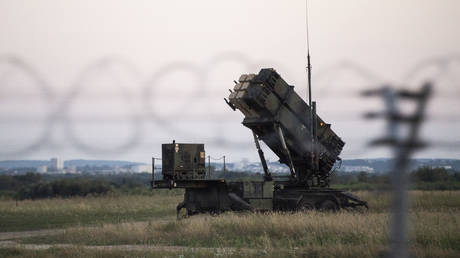
The air over Kyiv does not wait for paperwork. When the warning wails at three in the morning, inhabitants do not look at strategy documents or corporate balance sheets. They look up, straining against the velvet dark for the streak of white fire that means an incoming ballistic missile has met its match. For months, the engineering of that salvation has faced a bottleneck located thousands of miles away, sitting quietly inside assembly lines that build commercial jets and defense electronics.
Consider what happens next: a nation fighting for its perimeter attempts to secure domestic production licenses for the advanced interceptors that keep its cities breathing. It is a logical pivot. Hauling multi-million-dollar air defense batteries across oceans is slow, fragile, and vulnerable to shifting political winds. Building them closer to the frontline makes tactical sense. Yet every grand geopolitical strategy ultimately crashes into microscopic proprietary components. For another perspective, see: this related article.
The primary friction point centers on the specialized guidance systems used in advanced interceptor missiles, particularly the PAC-3 variants designed to neutralize supersonic threats. These homing heads are marvels of modern physics, housing millimeter-wave radar and complex microprocessors capable of calculating intercept vectors fractions of a second before impact. They do not roll off assembly lines by accident. They require specialized intellectual property, tightly guarded manufacturing secrets, and corporate authorization.
Enter aerospace manufacturing giant Boeing, which produces these critical homing components. Reports from European defense observers highlight a stark reality: obtaining the necessary licensing agreements from third-party component producers remains a towering wall. Corporate caution, regulatory inertia, and strict proprietary control have created an invisible barrier against expanding production into third-party or frontline nations. Further analysis on this trend has been shared by The New York Times.
To understand why this matters, imagine an assembly plant built deep within Ukrainian territory. Even if engineers solved the structural blueprints, the physical facility would face immediate, targeted aerial bombardment. Security demands that such manufacturing workshops move westward, perhaps deeper into allied European soil. Yet moving the geography does not solve the corporate lock. The legal ownership of the technology remains tethered to domestic manufacturers who balance international pleas against massive domestic inventory demands and corporate risk assessments.
The United States maintains its own relentless internal need to replenish defense inventories depleted by global commitments. Every interceptor retained in a domestic stockpile is viewed by Pentagon logicians as insurance against a wider, unpredictable future. That institutional caution creates a chilling effect on technology transfers. When corporate boards and defense bureaucrats weigh the urgency of a European war against the sanctity of proprietary patents, the lawyers usually win.
We often talk about war in terms of grand alliances, presidential summits, and fiery rhetoric delivered from podiums. High-level meetings between heads of state and defense contractors capture the headlines, yet the actual velocity of defense is dictated by sub-contractors and patent holders who rarely testify before cameras. While delegations shake hands and sign exploratory memorandums of understanding, the engineering reality on the ground remains starved of the exact signatures required to turn blueprints into functioning hardware.
This is the hidden friction of the modern industrial age. Wars are no longer fought solely with iron and grit; they are bound by intellectual property law. A defense conglomerate can build magnificent aircraft and orbital hardware, but when its corporate hesitancy stalls the localized production of an anti-ballistic shield, the consequences ripple directly into civilian neighborhoods.
The night sky over Eastern Europe remains a testing ground for how the global supply chain handles existential crisis. Until corporate gatekeepers find a mechanism to bridge the gap between proprietary security and frontline survival, the distance between a missile waiting in a factory ledger and a missile rising to save a life will be measured in miles of red tape.
A quiet workshop stands empty in the dark, waiting for a signature that has not yet arrived, while the radar screens continue to sweep the horizon.


