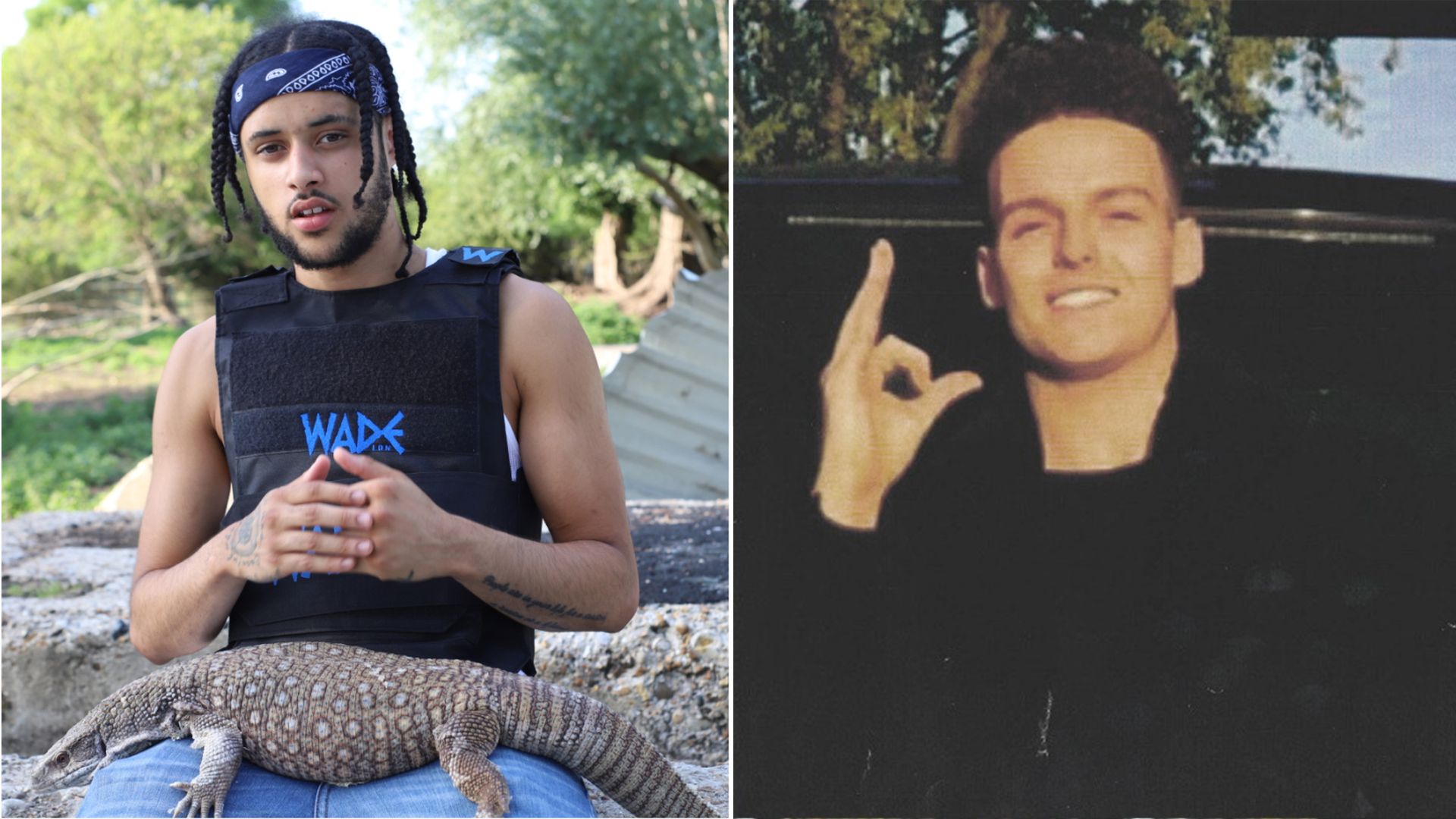
The convergence of the attention economy with hyper-localized gang rivalries has altered the risk profile of media production in urban environments. When creative spaces—such as a music video shoot—are utilized as proxy battlegrounds for digital and physical dominance, the operational vulnerabilities for creators, crew, and talent escalate exponentially. The conviction and life sentencing of a prominent London drill artist for the murder of a YouTube content creator during a music video production exposes a systemic failure to evaluate security threats in high-risk creative environments. This analysis deconstructs the structural factors, behavioral drivers, and legal implications behind this intersection of digital media and targeted violence.
The Triad of Vulnerability in Public Content Creation
The incident in question reveals a predictable friction point where the logistics of public filmmaking intersect with targeted criminal intent. The vulnerability of a media production can be mapped across three distinct operational axes.
Tactical Predictability and Open-Source Intelligence
Digital content creators frequently rely on real-time engagement to maximize algorithmic reach. This operational habit introduces a critical vulnerability: the generation of actionable, open-source intelligence (OSINT). In this specific case, the location of the video shoot—intended for a music video featuring an exotic snake—became public knowledge either through active social media broadcasting or localized situational exposure.
For targeted violence to occur, an aggressor requires three variables: motive, capability, and opportunity. By fixing a crew and talent to a static geographic point for multiple hours, a production team inadvertently removes the logistical friction for an attacker, solving the "opportunity" variable.
The Conflict Convergence Dynamic
The British music subgenre known as drill frequently utilizes lyrical content that documents, boasts about, or incites real-world violence between rival post-code factions. When an artist tied to these dynamics enters a public space to film content, the production itself ceases to be a mere commercial endeavor. It transforms into a high-value target.
The victim, a YouTuber facilitating the shoot, became collateral damage in a pre-existing feud. This demonstrates that in high-risk media environments, neutrality is not a shield; proximity to the primary target constitutes equal exposure to the threat vectors.
Proximate Execution Profiles
The execution of the attack—involving multiple vehicles, bladed weapons, and a rapid retreat—points to an organized, low-sophistication but high-intent operational profile. The attackers did not require advanced logistics; they relied entirely on speed, surprise, and the absolute lack of physical security countermeasures at the production site.
The Economics of Clout and the Escalation Matrix
To understand why a rising musical figure would risk a life sentence by executing a daytime homicide, one must analyze the incentive structures governing the subculture. The return on investment (ROI) in certain music ecosystems is driven by perceived authenticity.
[Perceived Street Authenticity] ──> [Increased Digital Engagement] ──> [Streaming Revenue]
               │                                                               ▲
               └─> [Requirement to Act on Verbal Threats] ─────────────────────┘
This creates a dangerous feedback loop where legal jeopardy becomes a byproduct of commercial branding:
- The Authenticity Premium: In mainstream media, reputation management focuses on risk mitigation. In the drill subgenre, reputation is built on risk acceptance. The financial viability of an artist is frequently tied to their perceived willingness to execute physical violence.
- The Lyrical Deadlock: Once an artist commits to a narrative of violence in their content, a structural expectation is established. Failure to respond to perceived disrespect from rivals diminishes the artist's cultural capital, directly impacting streaming metrics and commercial viability.
- The Disproportionate Retaliation Threshold: The threshold for violence is lowered by the immediacy of digital insults. A perceived slight on a platform like Instagram or Snapchat requires a physical manifestation of force to maintain the brand's integrity within its ecosystem.
Legal Repercussions and the Joint Enterprise Doctrine
The judicial response to this incident underscores the severe legal frameworks deployed by British courts to combat gang-related homicides. The imposition of a life sentence with a high minimum term reflects a systemic effort to create a deterrent effect within the creative community.
The Mechanism of Joint Enterprise
In cases involving multiple attackers, the prosecution does not always need to prove which specific individual dealt the fatal blow. Under the principle of secondary liability, if a group acts with a common purpose to cause serious harm or death, all participants face equal culpability under the law. The drill artist in question, regardless of whether he wielded the weapon or coordinated the logistics, faced the full weight of the murder charge due to demonstrable association and shared intent at the scene.
Digital Footprints as Forensic Evidence
The conviction relied heavily on digital forensics. Cellular triangulation, CCTV mapping, and social media data curation allowed investigators to reconstruct the timeline with mathematical precision. The very tools used to build the artists' public profiles—smartphones, geolocation, and digital communication—served as the primary mechanism for their legal dismantling.
Operational Risk Mitigation for High-Risk Media Productions
For producers, directors, and independent content creators operating within spaces adjacent to volatile subcultures, standard production insurance and basic permits are completely inadequate. Managing threat vectors requires a shift from standard entertainment logistics to a specialized security posture.
Comprehensive Talent Vetting
Prior to greenlighting a project involving independent talent or street-level artists, a rigorous risk assessment must be performed on the talent's active friction points. Producers must analyze:
- Current localized disputes or active rivalries tied to the talent's geographic origin.
- Recent digital escalations or threats exchanged on social media platforms within the past 90 days.
- The legal status and bail conditions of all featured individuals on the call sheet.
Closed-Set Protocol Implementation
Public spaces should be abandoned in favor of secure, private locations with controlled access points. If a public shoot is logistically non-negotiable, strict operational security (OPSEC) measures must be enforced:
- A total ban on real-time social media posting or geolocating by cast and crew during the shoot.
- Staggered arrival times and minimal on-site footprints to reduce the visual signature of the production.
- The employment of dedicated, close-protection personnel trained in counter-surveillance and crowd management, rather than standard event stewards.
The tragic outcome of this video shoot demonstrates that the boundary between digital posturing and physical violence has dissolved. When media production teams fail to recognize that they are stepping into an active conflict zone, they assume a level of risk that no commercial project can justify. Security, counter-surveillance, and strict operational protocol are the only mechanisms capable of decoupling creative expression from lethal outcomes. Producers must prioritize tactical security over aesthetic authenticity, or continue to face catastrophic operational failures.