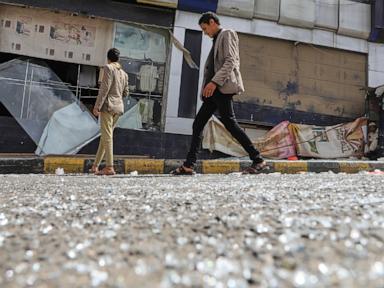
Overnight airstrikes in Yemen hit a gas station and an oil facility in Sanaa on November 10, 2026, killing at least one person, wounding nine others, and shattering windows across the sleeping capital. Wire services bundled that single casualty count into a routine Middle East news roundup, burying it beneath diplomatic sparring between Washington and Tehran. Treating those strikes as a minor footnote misses the real story. The attacks on Sanaa's fuel infrastructure represent a calculated shift in a conflict that roared back to life in July 2026 after four years of fragile truce.
Both sides have abandoned static trench warfare in favor of economic strangulation. When bombs fall on petrol stations and oil storage depots, the objective is not merely tactical suppression. It is systemic paralysis.
The Anatomy of an Economic Chokehold
Modern militaries do not march on their stomachs; they roll on refined diesel and aviation fuel. For the Houthi movement, which controls Sanaa and much of northern Yemen, fuel is the lifeblood of both battlefield logistics and domestic governance. By targeting fuel distribution networks inside the capital, the Saudi-led coalition and Yemen's internationally recognized government are executing a dual-purpose strategy.
First, destroying local storage capacity forces the Houthis to burn through strategic reserves needed to move ballistic missile launchers and troop reinforcements across rugged mountain terrain. Second, it weaponizes scarcity against the civilian population.
Consider the ripple effect on the ground. In Houthi-controlled territories, drivers are already grappling with contaminated petrol that ruins engines and drains household savings. In besieged cities like Taiz, fuel shortages have shut down water pumps, forcing families to rely on unsafe water sources. When an overnight raid obliterates a functioning gas station in Sanaa, lines stretch for miles by morning, transport costs spike overnight, and the price of basic food staples climbs beyond the reach of ordinary workers.
The Houthi-run health ministry blamed Saudi Arabia immediately after the November 10 explosions, reporting one dead and three wounded at the gas station alongside six wounded at the oil company. Coalition spokespeople neither confirmed nor denied the Sanaa fuel hits, instead announcing the interception of a Houthi drone over Saudi Arabia's Eastern Province. That silence is deliberate. Deniability keeps diplomatic friction manageable while the physical damage achieves the military aim.
How the 2022 Truce Collapsed Into Total Escalation
To understand why bombs are falling on Sanaa again, you have to look back at the summer of 2026. For more than four years, a United Nations-brokered truce had largely frozen the front lines. No Saudi-led air raids were recorded against the Houthis between March 2022 and July 2026. Diplomats in Riyadh and Western capitals convinced themselves that the war was winding down into a manageable stalemate.
They misread the regional chessboard.
As broader hostilities erupted between the United States, Israel, and Iran in 2026, the Yemeni theater became an active pressure valve for Tehran. In July, following an airstrike on Sanaa International Airport that the Houthis blamed on Riyadh, the group launched a massive ground offensive. By September, Houthi fighters had seized a strategic strip of the Red Sea coast near the Bab el-Mandeb Strait, capturing districts in Al-Hudaydah and Taiz governorates and placing themselves within roughly 60 kilometers of the southern port city of Aden.
Suddenly, the Houthis held the high ground overlooking one of the world's most vital maritime chokepoints.
Alarm bells rang in Riyadh and Washington. In response, Yemen's Presidential Leadership Council (PLC) rallied its fractured military factions—including the Southern Giants Brigades and tribal fighters—to launch a sweeping counteroffensive dubbed Operation Dawn of Yemen. Since that campaign began, government forces claim to have conducted tens of thousands of artillery, drone, and air operations across fronts in Marib, Al-Jawf, Al-Bayda, and Taiz.
The human toll has been staggering. United Nations figures cited in late November 2026 show more than 1,600 people killed and over 300,000 displaced since full-scale fighting resumed, with independent conflict monitors tracking even higher combined combatant and civilian fatalities.
The Tit-for-Tat Port War
The November 10 strikes on Sanaa's fuel facilities were not an isolated flare-up. They were the opening act of an escalating infrastructure war that has since expanded to the Red Sea coast and deep into the Saudi heartland.
By mid-November, the coalition intensified its air campaign, striking dozens of Houthi military workshops, ballistic missile production sites, and telecommunications facilities across Sanaa, Saada, and Hodeidah. On November 20 and again on November 24, coalition command issued public evacuation maps ordering civilians to clear out of Hodeidah port—the primary maritime lifeline for food and fuel entering northern Yemen—before striking port capabilities accused of facilitating Iranian weapons smuggling.
The Houthis answered with symmetrical economic warfare.
Rather than trading blow for blow exclusively on Yemeni soil, Houthi missile and drone units targeted the symbols and engines of Saudi economic power. Over a frantic two-week span in November 2026:
- Financial Centers Under Fire: Drones struck the King Abdullah Financial District in Riyadh twice in less than a week, damaging a prominent tower and injuring 11 people, including foreign workers from India, Nepal, and Egypt.
- Energy Infrastructure Targeted: Houthi forces claimed strikes on Saudi energy assets, including the massive Ras Tanura oil refinery and radar installations south of Riyadh, forcing Saudi air defenses into nightly interception battles.
- Maritime Threats: Following coalition warnings over Hodeidah, Houthi military spokesman Yahya Saree warned international shipping companies to evacuate Jeddah and all Saudi Red Sea ports immediately, threatening to turn the entire coastline into a live fire zone.
This is the strategic trap both sides now inhabit. Saudi Arabia wants to degrade Houthi military capacity without triggering a full-scale blockade that starves millions of Yemenis and draws international condemnation. The Houthis want to prove that every bomb dropped on Sanaa or Hodeidah carries an immediate, unacceptable financial cost for Riyadh's Vision 2030 economy.
The Washington-Tehran Shadow Over Sanaa
Standard news roundups often treat events in Yemen, Gaza, and Iran as separate bullet points. On the ground, those conflicts are tightly wired together.
Look at the rhetoric surrounding the November 10 Sanaa strikes. On the exact same day residents in Yemen were sweeping shattered glass off their floors, Iran's Revolutionary Guard broadcast footage of an underground "missile city," boasting that Tehran had lifted its self-imposed 2,000-kilometer range cap on ballistic missiles. Meanwhile, Iranian Supreme National Security Council official Mohsen Rezaei demanded Washington accept seven conditions to end the broader Iran conflict, even as U.S. President Donald Trump told reporters in Washington that the war with Iran was "militarily effectively over".
That disconnect between Washington's desire to declare victory and Tehran's determination to project regional reach is played out directly through the Houthis.
Even if direct U.S. airstrikes against Iran pause, Tehran retains a low-cost, high-impact lever on the Arabian Peninsula. Through technical advisors, smuggling networks, and shared drone blueprints, Iran enables the Houthis to tie down Saudi military assets and threaten global shipping lanes without Iranian forces firing a single shot. Conversely, the United States has largely avoided joining the renewed 2026 Saudi air campaign with direct strikes, limiting its role to intelligence sharing, arms sales, and military advice while Britain imposes targeted sanctions on Houthi officials.
For Yemeni government commanders on the ground, this creates a bitter reality. "We are not only fighting the Houthis," Yemeni Armed Forces spokesperson Maj. Gen. Majed Abdullah Al-Nuzaili said in late November. "We are fighting also the Iranian regime behind them".
The Fog of Casualty Counts and Information Warfare
Reporting on overnight strikes in Yemen requires navigating a dense fog of competing propaganda. When a blast hits an urban district in Sanaa or a highway in Lahij, verifiable facts are the first casualties.
Consider the stark discrepancy in numbers across the front lines. In the November 10 Sanaa raids, local health authorities controlled by the Houthis reported precise figures—one dead, nine wounded—within hours, yet independent journalists on the ground face severe restrictions that prevent verifying whether the struck facilities housed purely civilian fuel supplies or dual-use military depots.
Two weeks later, when an airstrike hit buses and trucks in Lahij governorate, killing 26 people, the information war went into overdrive. The Houthis blamed the Saudi air force for massacring travelers and used the incident to justify retaliatory strikes on Saudi oil facilities. Yemen's government forces countered that the Houthis themselves carried out the attack. Neither claim could be independently confirmed.
The same statistical inflation plagues battlefield reporting. Yemeni army press releases routinely claim hundreds of Houthi fighters killed or wounded in single 24-hour bursts of artillery and drone fire, alongside cumulative claims of tens of thousands of enemy combatants neutralized since July. Houthi media counters with footage of burning coalition armor and inflated claims of direct hits on Saudi skyscrapers and refineries that Riyadh insists were intercepted or caused only minor debris damage.
What remains undeniable is the trajectory of the violence. Every unverified casualty figure feeds the next cycle of retaliation.
The Unspoken Risk to Global Supply Chains
While headlines focus on dramatic explosions in capital cities, maritime insurers and shipping executives are watching the narrow waters off Yemen's coast.
The Bab el-Mandeb Strait connects the Red Sea to the Gulf of Aden and the Indian Ocean, serving as the southern gateway to Egypt's Suez Canal. By seizing coastal territory overlooking the strait in September 2026 and threatening major commercial ports like Jeddah and Hodeidah in November, the Houthis have placed global trade back into the crosshairs.
A sustained bombing campaign against Hodeidah does more than cripple Houthi supply lines; it risks triggering a humanitarian famine across northern Yemen, where millions depend on imported grain and fuel arriving through that single harbor. At the same time, if Houthi missiles manage to strike a commercial vessel or a major terminal in Jeddah, global shipping giants will once again reroute container ships around the Cape of Good Hope, adding weeks to transit times and reigniting inflationary pressure on global supply chains.
Egypt and Sudan recognized this danger on November 24, issuing a joint warning that Red Sea security belongs strictly to coastal states and rejecting further militarization of the waterway. Their warning went unheeded. Within hours, sirens were wailing over Riyadh and coalition jets were back in Yemeni airspace.
What the Wire Reports Miss
A one-paragraph brief noting that overnight strikes killed one person and wounded nine makes the violence in Yemen sound static, routine, and contained. It is none of those things.
Those strikes on Sanaa's gas stations and oil depots were stress tests in a widening war of attrition. Both the Saudi-led coalition and the Houthi movement are systematically probing the other's economic breaking point—testing how much fuel scarcity Sanaa can endure before civil order cracks, and how many drone alerts Riyadh's financial district can absorb before foreign investors pull back. Until external powers address the regional proxy architecture linking Tehran, Riyadh, and Sanaa, every quiet night in Yemen is merely a pause before the next fuel depot burns.