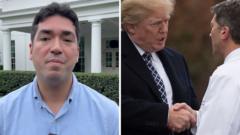
President Donald Trump arrives at Walter Reed National Military Medical Center on Tuesday for what the White House bills as a routine annual medical and dental assessment. He turns 80 years old next month. While the administration releases choreographed memos declaring the commander in chief to be in excellent health, this visit marks his fourth publicized medical evaluation in just 13 months. A legacy of selective transparency and aggressive image management makes it clear that the official medical reports tell only the story the White House wants told. The real diagnostic data remains locked behind executive privilege.
The presidency has always treated the health of its occupant as a matter of national security and political survival. For Trump, the stakes are uniquely personal. He has spent years weaponizing the physical and mental decline of his political opponents. Now, as the oldest person ever to occupy the Oval Office, he faces the same biological clock. The cracks in the armor are becoming visible.
The Frequency Problem
A standard presidential physical is a yearly event. Trump went to Walter Reed in April 2025. He returned in July 2025 after observers noted swelling in his lower limbs. By October 2025, he was back for a semi-annual checkup that quietly included advanced computed tomography (CT) scans of his heart and abdomen. Tuesday marks yet another trip down the Rockville Pike.
Four medical interventions in a little over a year do not equal a standard preventive routine. The White House medical unit, led by Navy Captain Sean Barbabella, consistently downplays the pacing. They attribute the visits to ordinary follow-ups. Independent medical experts see it differently.
Frequent advanced diagnostic imaging, particularly CT scans and MRIs on an asymptomatic patient, is rare in standard geriatric care. Trump himself acknowledged the strategic error of letting the public know about those scans during an interview last winter. He noted that the tests merely gave his critics ammunition. The question remains. Why order advanced internal imaging if the baseline health is truly flawless?
Bruises and Thin Blood
The physical changes in the president over the last year are matters of public record, captured on high-definition television and analyzed by forensic observers. The backs of Trump’s hands frequently feature deep purple contusions, sometimes obscured by cosmetic correctors. His lower legs show visible swelling that distends his trousers.
The White House provided an explanation. Press Secretary Karoline Leavitt stated the hand discoloration stems from minor soft tissue irritation brought on by frequent handshaking combined with daily aspirin use. Dr. Barbabella diagnosed the leg swelling as chronic venous insufficiency. This condition occurs when the valves in the veins of the legs weaken, allowing blood to pool instead of pumping efficiently back toward the heart.
[Normal Vein vs. Chronic Venous Insufficiency]
Normal: Valves keep blood flowing upward against gravity.
Insufficiency: Weakened valves allow blood to flow backward and pool, causing swelling.
The medical explanation is plausible. Chronic venous insufficiency is common in men over 70. It is generally manageable. However, the heavy use of aspirin raises secondary questions. Trump defended his regimen by stating he wants thin blood pouring through his heart to prevent blockages.
Cardiologists note that self-regulated, high-dose aspirin usage carries sharp risks for an octogenarian. It can cause internal gastrointestinal bleeding and severe skin fragility. The 2025 physical already noted a history of diverticulosis and a benign polyp removed during a previous colonoscopy. Thinning the blood while managing a vascular condition and a sensitive digestive tract is a delicate balancing act.
The Cognitive Shield
No aspect of the president's health receives more protection than his mental acuity. Trump regularly boasts about his performance on cognitive examinations, specifically referencing the Montreal Cognitive Assessment (MoCA), which he claimed to have aced multiple times. The White House reported a perfect 30 out of 30 score in his April 2025 release.
The MoCA is not an IQ test. It is a screening tool designed to detect early signs of dementia or mild cognitive impairment. It asks patients to identify animals, draw a clock, and repeat a short list of words. For a sitting president, passing a screening tool is the bare minimum requirement, not an indicator of superior executive function.
[Montreal Cognitive Assessment (MoCA) Overview]
* Purpose: Rapid screening tool for mild cognitive dysfunction.
* Tasks: Clock drawing, animal naming, short-term memory recall, attention tracking.
* Scoring: 26 and above is considered normal; 30 is a perfect baseline score.
Outside the controlled environment of Walter Reed, observers point to moments that challenge the official narrative. Critics note instances where Trump appeared to close his eyes for extended periods during high-level briefings, including a Cabinet meeting last December. The administration dismissed these instances as pauses or brief moments of reflection.
The political necessity of projecting absolute mental dominance prevents any nuanced discussion of how an 80-year-old brain processes the grueling, non-stop stress of the modern presidency.
The Long Tradition of Medical Secrecy
The lack of complete candor surrounding Trump's medical file is not anomalous. It is the continuation of a long, calculated tradition in American politics. The White House medical unit operates under a fundamental conflict of interest. The physician to the president is a military officer whose patient is also the commander in chief. Absolute medical transparency rarely survives that power dynamic.
History provides the template. Grover Cleveland hid a cancerous tumor in his jaw by undergoing surgery on a friend's yacht. Franklin D. Roosevelt's terminal cardiovascular disease was kept from the public during his 1944 re-election campaign. John F. Kennedy’s severe Addison’s disease and heavy reliance on a cocktail of painkillers were hidden behind a facade of youth and vigor.
Arthur Caplan, head of the Division of Medical Ethics at the NYU Grossman School of Medicine, has repeatedly noted that the public only learns what the White House wants it to learn. The flow of data is entirely controlled. When Trump’s medical team issues its inevitable post-exam statement on Tuesday night, the document will serve as a political shield just as much as a clinical summary.
The Birthday Spectacle
To counter the reality of his advancing years, Trump relies on counter-programming. He attempts to project raw vitality by filling his schedule with high-energy spectacles. For his upcoming 80th birthday on June 14, the White House is constructing an Ultimate Fighting Championship octagon on the south lawn to host a live combat sports event.
The imagery is deliberate. By surrounding himself with elite young fighters and blasting high-volume walkout music, the president aims to create an association with physical strength. He jokes about working out for a single minute a day while maintaining that he feels exactly the same as he did 50 years ago.
The human body does not respect political stagecraft. The bruising on his hands, the swelling in his legs, and the quiet escalations of diagnostic tests at Walter Reed paint a more grounded picture. As Trump steps into the medical center on Tuesday, the doctors will look past the bravado and look closely at the inevitable wear of eight decades of life. The public will get the summary, but the true chart remains classified.