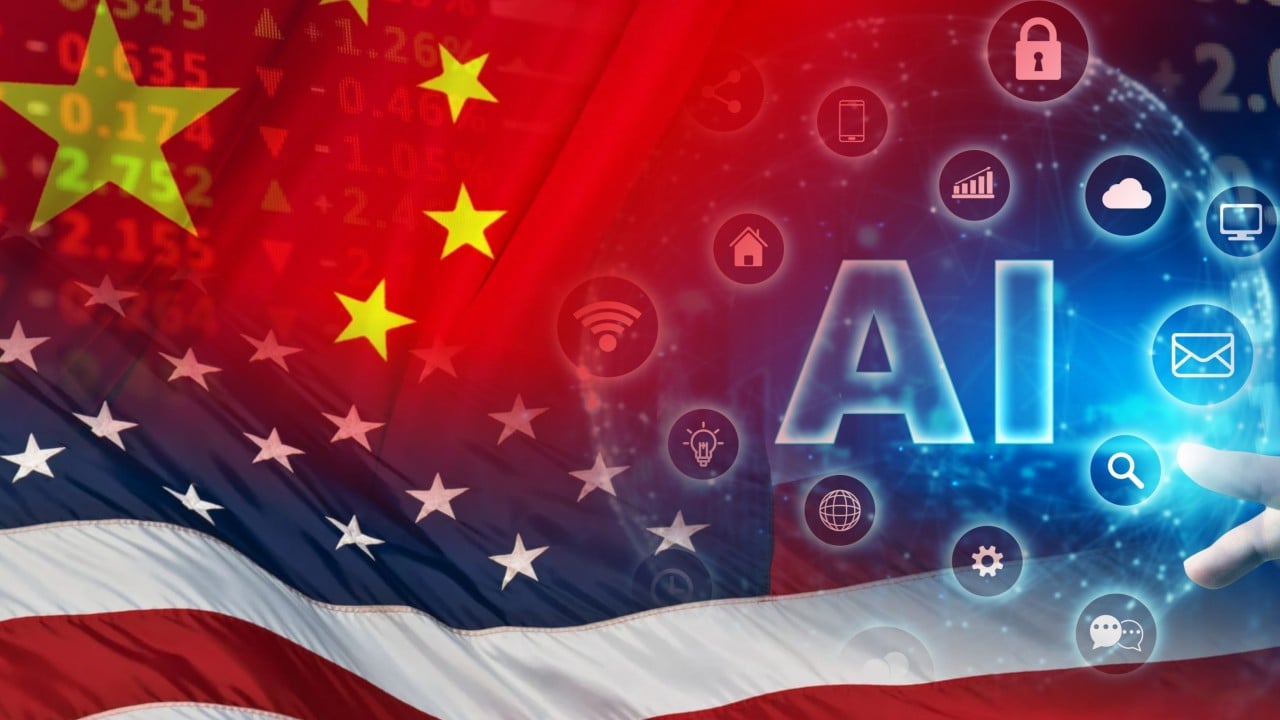
Financial institutions love a clean narrative. Wall Street analysts want to look at bilateral trade ledgers, shrug at the macro numbers, and declare that the ongoing decoupling between Washington and Beijing is manageable. They point to steady container ships, diversified supply chains, and traditional manufacturing figures to prove that commerce finds a way.
They are looking at the wrong ledger entirely.
US-China AI decoupling is not a shipping problem. It is a fundamental rewiring of global intelligence architecture, and treating export restrictions as a minor operational friction misses the structural earthquake underneath. While financial conglomerates draft comfortable notes about manageable trade flows, the regulatory and technological barriers being erected today guarantee that the two superpowers will never share a digital foundation again.
The Illusion of Trade Resilience
The baseline assumption from major financial advisories rests on a simple metric: raw trade volume. If physical goods and standard electronics continue to clear customs, the systemic risk must be containable. This perspective fundamentally misunderstands what artificial intelligence represents in modern geopolitical competition. AI is not another commodity class to be tariffed, taxed, or routed through third-party intermediaries.
Consider a hypothetical enterprise software ecosystem operating across both jurisdictions. Traditional trade policy assumes that components can be swapped or substituted when tariffs rise. Yet, when Washington chokes off access to extreme ultraviolet lithography machines and specialized accelerator clusters, the substitution mechanism breaks down.
You cannot simply reroute advanced silicon through a sympathetic port when the silicon itself is bound by extraterritorial design rules and software locks. The institutional view that trade remains manageable relies on lagging indicators. By the time customs data registers a permanent contraction in high-value digital exchange, the structural fracture has already hardened into concrete.
The Open-Weight Wild Card
The real volatility lives in code, not crates. Washington's anxiety has shifted dramatically toward open-weight models, a development that financial markets have been slow to price into asset valuations. When domestic laboratories in China began producing high-performing open-weight models that bypassed the immediate need for restricted hardware, the regulatory calculus changed overnight.
Washington lawmakers no longer view hardware export controls as a standalone solution. Instead, the focus has pivoted toward model extraction, distillation defense, and secondary sanctions designed to penalize foreign entities that manage to replicate frontier capabilities. This creates an escalating loop.
Every time US policy tightens around hardware, Beijing accelerates domestic substitution efforts. Capital floods local semiconductor foundries and memory manufacturers, turning state-backed startups into multi-billion-dollar public titans almost overnight. Financial analysts who dismiss these domestic investments as inefficient state-sponsored vanity projects ignore the sheer velocity of capital injection occurring behind closed capital accounts.
Capital Flows and Structural Divergence
The cost of capital tells the real story. While Western technology firms navigate high interest rates and cautious venture capital deployment, Chinese state-directed financing channels keep borrowing costs for strategic technology sectors aggressively compressed.
This monetary divergence means that domestic AI developers in Beijing operate under an entirely different financial physics than their Silicon Valley counterparts. They do not need immediate profitability to fund massive cluster training runs. They have state-backed liquidity that views sovereign computational autonomy as a non-negotiable security asset.
When a major domestic memory producer lists on the domestic exchange and surges hundreds of percent on day one, it signals a complete decoupling of market incentives. Wall Street models assume rational global actors optimizing for cost efficiency. The current reality is driven by sovereign actors optimizing for absolute self-reliance, regardless of the economic overhead.
The Architectural Fracture
The long-term consequence of this split is the creation of two entirely separate technological orbits. We are moving toward a bifurcated internet of intelligence where software developed in one ecosystem will be structurally incompatible, legally barred, or architecturally locked out of the other.
Compliance departments are already drowning in the complexity of multi-jurisdictional codebases. Intellectual property disputes involving model distillation are morphing into geopolitical flashpoints that threaten public listings and cross-border equity valuations.
The financial sector's insistence that trade will smooth over these ideological and technical contradictions is wishful thinking wrapped in spreadsheet formatting. Decoupling is no longer a risk factor being monitored for next quarter. It is the permanent baseline of the global economy, and the bill for ignoring it has only just begun to arrive.


:format(jpg)/f.elconfidencial.com%2Foriginal%2F5ea%2Fcd3%2F24d%2F5eacd324dfa70e3ad0e2939fda05b186.jpg)
