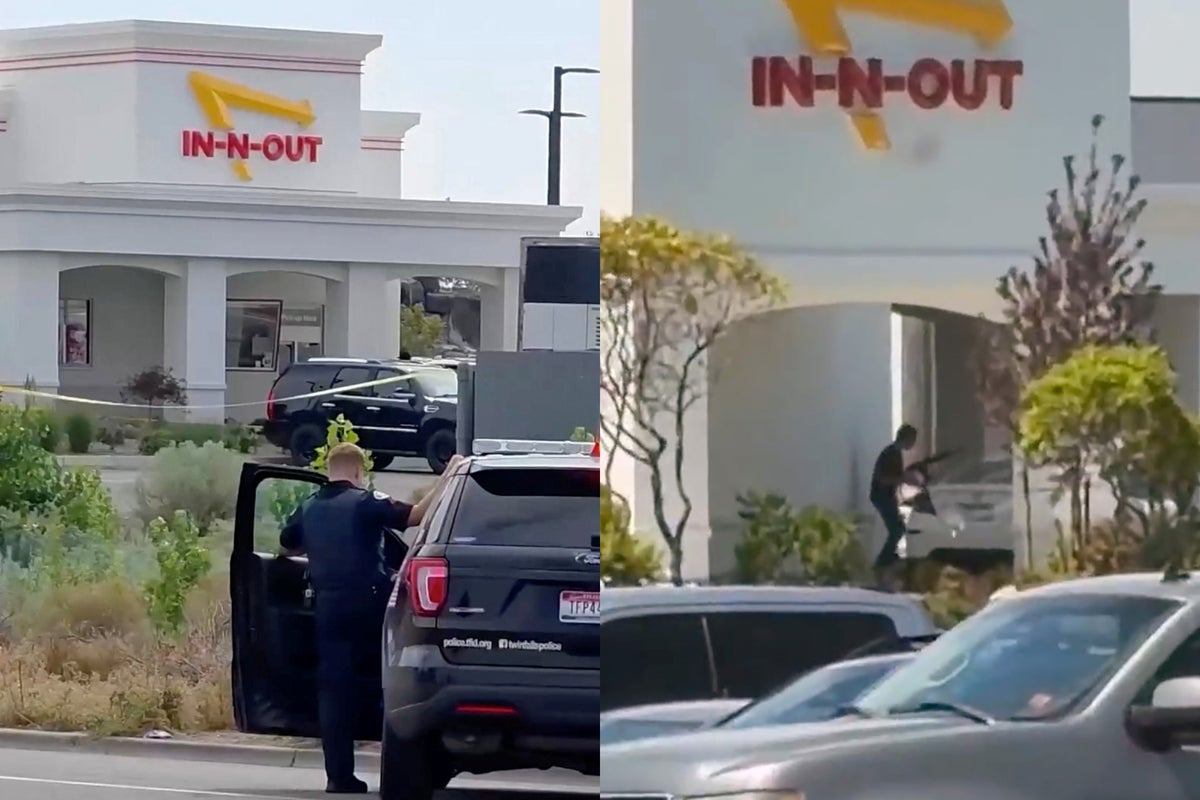
A newly opened fast-food restaurant on Blue Lakes Boulevard North in Twin Falls, Idaho, became the epicenter of sudden carnage when a gunman armed with an AR-15-style rifle opened fire, leaving at least three people dead and seven others wounded. The attack at the regional In-N-Out location, which had celebrated its grand opening merely a week prior, instantly shattered the quiet routine of a southern Idaho commercial hub. Local authorities confirmed that the suspected gunman was found dead near the scene, while investigators scrambled to piece together a motive behind an eruption of violence that left a community searching for answers.
Emergency responders rushed to the scene shortly before 2:30 p.m. as panic rippled through the busy shopping plaza. Witnesses described chaotic scenes of patrons fleeing across asphalt, employees dragging wounded co-workers out of the line of fire, and motorists scattering as the shooter manipulated a long gun near a white sedan parked in the drive-thru lane. St. Luke’s Magic Valley Medical Center immediately issued public advisories urging non-emergency visitors to stay away as victims poured into the emergency department, some presenting with critical trauma injuries.
The Anatomy of an Instant Crisis
Small-town infrastructure rarely absorbs mass casualty events without immediate fractures. Twin Falls, a regional center of roughly 56,000 residents located about 130 miles southeast of Boise, operates with local law enforcement resources scaled for routine municipal safety. When an active shooter incident erupts at a high-traffic commercial node, the initial response relies heavily on fragmented civilian actions, immediate bystander interventions, and rapid-response protocols from multi-agency partnerships.
Video footage captured by nearby motorists circulated rapidly across digital platforms, illustrating the chaotic nature of the engagement. Visual evidence reviewed by investigators showed a civilian stepping out of a vehicle in the drive-thru queue to engage the attacker with a handgun, a dynamic that complicated the tactical landscape for responding patrol officers. Police Chief Matthew Hicks noted during initial press briefings that while the immediate community threat had subsided with the death of the suspect, the timeline of events, the exact cause of the shooter's death, and the precise sequence of civilian intervention require extensive forensic reconstruction.
The Illusion of Geographic Immunity
Every regional tragedy reignites a familiar, painful dialogue regarding community vulnerability. High-profile incidents in non-metropolitan commercial centers systematically dismantle the psychological defense mechanism that geographic isolation equates to safety. When national chains expand into emerging regional markets, bringing dense foot traffic and long queues, they simultaneously introduce high-density gathering points into areas unaccustomed to urban-scale security challenges.
Elected officials face intense public scrutiny following such events. State leadership statements emphasizing regional safety frequently clash with the raw reality experienced by families whose weekend routines are permanently altered by sudden gunfire. The tension between open commercial accessibility and public safety measures exposes the deep structural vulnerabilities embedded in modern American civic life, where everyday locations double as potential tactical environments.
The Investigation Ahead
Law enforcement agencies, including the Federal Bureau of Investigation, are conducting comprehensive canvasses of local businesses, interviewing dozens of witnesses, and processing digital media evidence. Establishing the background of the shooter, identifying any prior indicators of intent, and auditing the acquisition path of the firearm remain primary investigative directives. As families await formal notifications from county coroners and medical staff manage the long-term prognoses of the injured, the community of Twin Falls confronts the arduous process of structural and emotional recovery.