The grand theater of state grief unfolding in Tehran is not a spontaneous eruption of national sorrow, but a high-stakes geopolitical gamble engineered by a fractured regime struggling for its very survival. As a six-day marathon funeral begins for Ayatollah Ali Khamenei, who was assassinated by a joint US-Israeli daylight airstrike on February 28, the Islamic Republic is deploying its final weapon of mass mobilization. The regime is attempting to spin the violent decapitation of its top leadership into an epic display of theological and political resistance.
Behind the wall-to-wall state media coverage and the carefully choreographed lines of mourners at the Grand Mosalla mosque, a much harsher reality persists. This multi-city spectacle across Iran and Iraq was delayed for months because the ensuing war made such massive gatherings a suicide mission for the ruling elite. Now, operating under a highly fragile 60-day ceasefire negotiated to reopen the Strait of Hormuz, the interim leadership council is rushing to use Khamenei’s corpse as a human shield against internal rebellion and external weakness.
The Mirage of Total Unity
State organizers claim millions will line the streets from Tehran to Mashhad, projecting an image of an unshakeable Islamic state. They have even timed the funeral to coincide with Muharram, invoking the historical martyrdom of Husayn ibn Ali to draw explicit parallels to Khamenei’s death. This is a calculated psychological operation. The regime needs the world, and specifically American negotiators sitting across the table in Qatar, to believe that the Iranian public stands shoulder-to-shoulder with the clerics.
The truth on the ground is dangerously polarized. When news of the February airstrike first broke, spontaneous celebrations erupted in cities like Isfahan, Shiraz, and parts of Tehran, with citizens setting off fireworks and filming the toppling of Khamenei's statues. Security forces responded by opening live fire on those celebrating. The authorities are terrified that the massive crowds gathered for the funeral could easily pivot into anti-regime riots, a scenario made more likely by the fact that the funeral coincides with the anniversary of a brutal 2025 crackdown against domestic protesters.
To mitigate this, the state has closed all government and private offices in the capital and forced commuters to leave personal vehicles at the city limits, effectively forcing reliance on state-monitored transit systems. They are manufacturing attendance because a low turnout would signal the absolute collapse of the regime's legitimacy.
A Ghost Successor in the Shadows
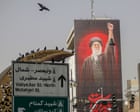
While billboards across Tehran display images of the late leader’s son, Mojtaba Khamenei, walking alongside his father to project an aura of hereditary continuity, the presumptive successor is notably absent from the funeral arrangements. Mojtaba was severely wounded in the exact same February 28 strike that killed his father, his wife, and his infant daughter. He remains hidden, issuing only sporadic written statements.
This absence exposes a massive power vacuum at the heart of the Iranian security state. The Islamic Revolutionary Guard Corps (IRGC) is currently refereeing a fierce, silent civil war between hardliners and pragmatists within the interim leadership. Speaker of the parliament Mohammad Bagher Ghalibaf has used the eve of the funeral to publicly demand "bloodshed" and vengeance, playing to the domestic hardline base. Meanwhile, Vice-President Mohammad Reza Aref is desperately trying to keep the 60-day ceasefire intact to prevent total economic collapse.
By taking the funeral procession into the Iraqi Shia holy cities of Najaf and Karbala, Iran is attempting to assert its continued dominance over the regional Shia axis. Yet this move highlights weakness rather than strength. Iraq’s agreement to host the procession was heavily contested internally, reflecting how much leverage Tehran lost the moment American precision munitions obliterated its high command.
The Nuclear Brinkmanship Ahead
The funeral is not merely an end of an era; it is the opening salvo of a far more dangerous phase of regional brinkmanship. Israeli Defense Minister Israel Katz issued a stark warning that Mojtaba Khamenei remains "marked for death" if he steps into power. This open threat has sent shockwaves through the conservative clerical establishment in Qom.
In response, hardline factions within the Supreme National Security Council are openly calling for a formal abandonment of Iran's long-standing fatwa against the possession of nuclear weapons. They argue that conventional deterrence failed catastrophically on February 28, and only a rapid breakout toward a nuclear warhead can protect the surviving leadership from future Western and Israeli daylight strikes.
The economic reality, however, offers a sobering counterweight to this rhetoric. The Iranian public is exhausted by hyperinflation, severe sanctions, and months of active warfare. The regime's decision to plaster Tehran with posters promising "a bright future" alongside grim religious messaging shows a acute awareness of this domestic friction. They know that glorifying a dead leader while the living starve is a recipe for revolution. The next six days will show whether the Islamic Republic can successfully weaponize its grief, or if the cracks in the fundamentalist facade are now too deep to hide.


