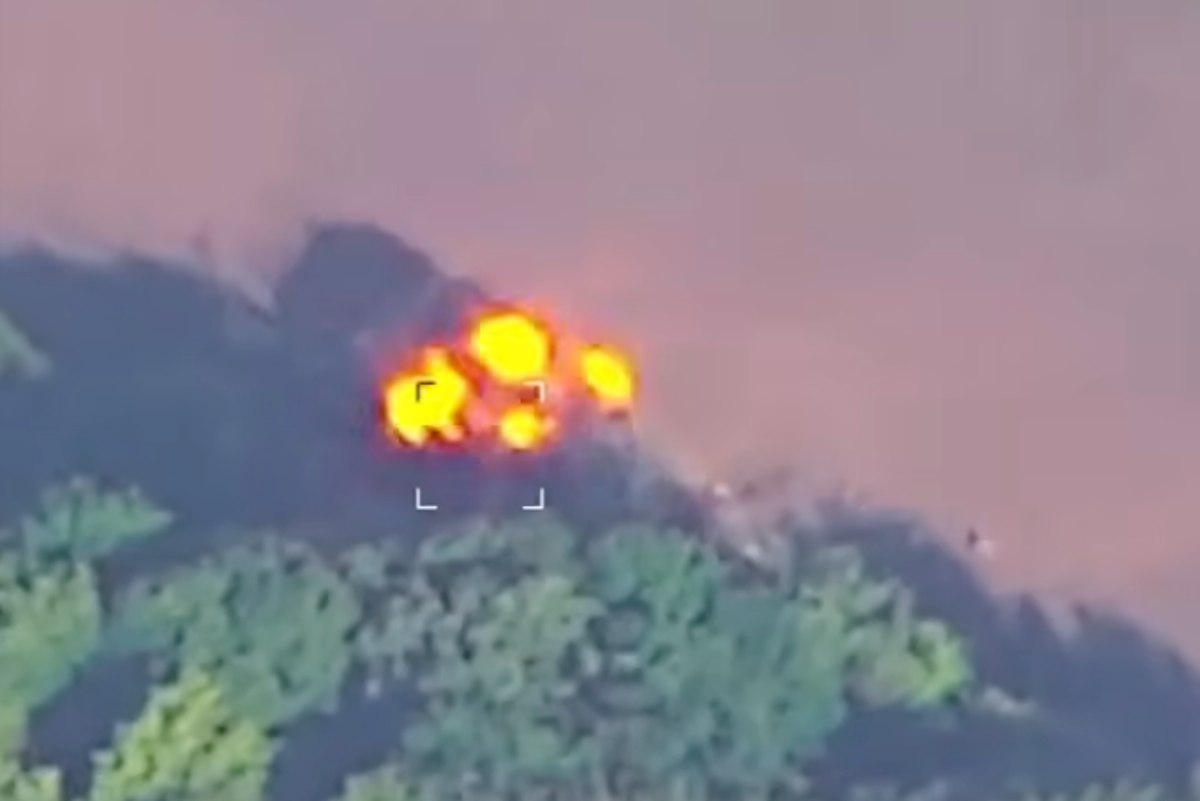
The operational architecture of modern air defense relies on a fragile hierarchy, where the loss of a single nerve center can blind an entire missile battalion. When Ukraine's 15th Separate Artillery Reconnaissance Brigade, known widely as the Black Forest Brigade, released footage documenting the precise destruction of a Russian S-300 command-and-control vehicle, military analysts observed more than just another tactical video. They witnessed the systematic dismantling of a layered defensive grid from the top down.
Targeting individual launchers offers immediate tactical relief, but neutralizing the central command node creates institutional paralysis. This engagement underscores a fundamental shift in how mechanized warfare handles electronic dominance, proving that high-end anti-aircraft batteries are only as effective as the mobile command infrastructure coordinating them.
Anatomy of a High-Value Kill
To understand the weight of this strike, one must examine the hardware itself. The targeted asset was identified as a 5K76 command-and-control vehicle, an indispensable component of the 5N83 command post configuration used across Soviet-designed S-300P and S-300PM networks.
Mounted on a high-mobility chassis, this vehicle performs a complex suite of calculations:
- Aggregating raw telemetry data from multiple surveillance radars.
- Synthesizing a unified, real-time picture of the contested airspace.
- Prioritizing incoming aerial threats based on velocity and trajectory.
- Transmitting firing solutions and tactical directives to subordinate launch units.
Without this mobile brain, the launchers deployed across a sector are reduced to isolated units. They lose the automated coordination required to manage multi-vector saturation attacks, forcing crews to rely on inferior local tracking modes or operate entirely blind.
The Evolution of Artillery Reconnaissance
The Black Forest Brigade did not stumble upon this command node by accident. Specialized artillery reconnaissance units have evolved past the traditional constraints of front-line spotting. Saturation of short-range drones at the immediate zero line has allowed specialized units to push their intelligence-gathering operations deeper behind enemy lines, hunting high-value electronics thirty to fifty kilometers into Russian-controlled territory.
Simultaneous deployment of multiple reconnaissance unmanned aerial vehicles ensures continuous tracking even if electronic countermeasures attempt to blind individual feeds. Once the mobile command post was pinned down, loitering munitions or precision-guided assets delivered the final blow.
The difficulty lies not merely in replacing the physical steel, but in the institutional knowledge lost with the vehicle. Advanced electronic suites require specialized manufacturing timelines, and trained command crews cannot be improvised overnight. When a command-and-control station burns, the local umbrella shatters for months, leaving supply lines, ammunition depots, and tactical aviation exposed to subsequent deep-strike packages.
The Broader Attrition Campaign
This specific strike feeds into a wider, methodical campaign by Ukrainian forces to systematically degrade Russian air defense integrity. Rather than engaging in a direct war of attrition along heavily fortified trenches, targeting the command and radar nodes of systems like the S-300, S-400, and Buk families creates cascading vulnerabilities.
Each destroyed command vehicle forces a difficult operational dilemma for opposing planners. They must choose between leaving sectors exposed or pulling remaining systems closer to the front lines, rendering them increasingly vulnerable to counter-battery fire and drone-directed artillery.
The smoke over the wreckage of the S-300 command center clears to reveal an unforgiving reality for modern integrated air defense networks. Mobility offers concealment, but concealment fails under persistent aerial observation, leaving the structural brains of complex missile systems exposed to precision destruction.