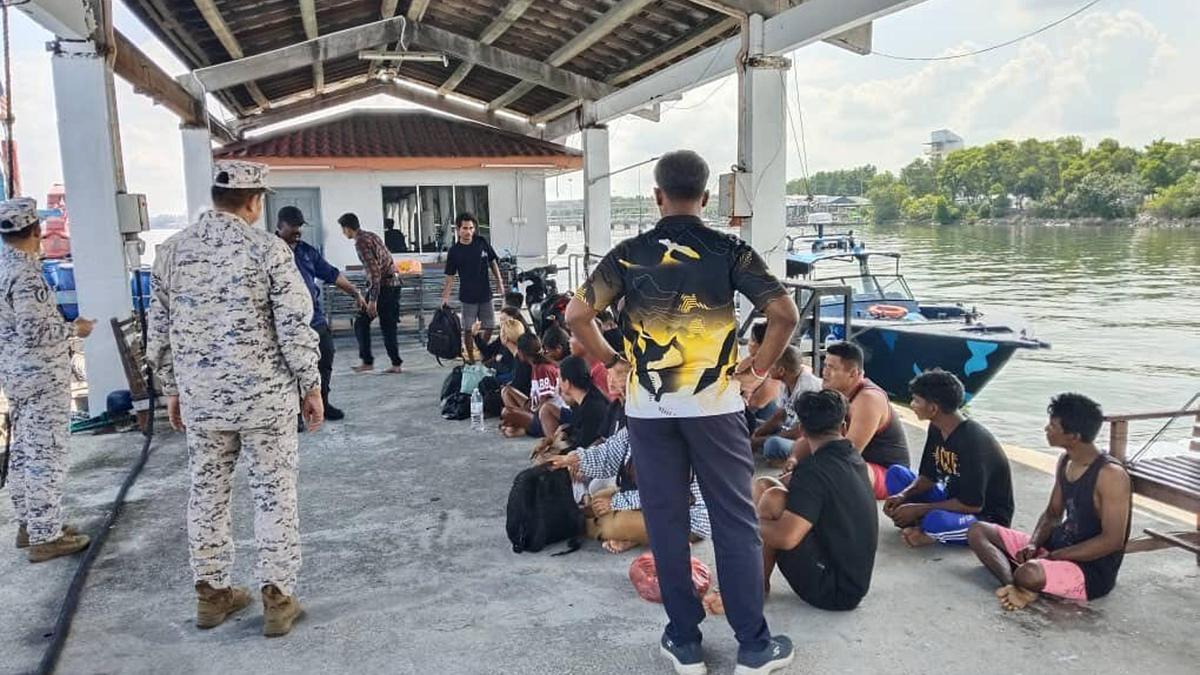
The Malaysian Maritime Enforcement Agency officially called off its six-day search and rescue operation off the coast of Pangkor Island, marking the end of another grim chapter in the world's busiest shipping lane. A wooden vessel packed with undocumented Indonesian laborers capsized, killing 16 people. Rescue teams pulled 23 survivors from the water, bringing the final passenger tally to 39—two more than initial manifest estimates indicated. While regional authorities process the survivors and coordinate body identifications, the incident underscores a systemic, compounding labor crisis that regular border enforcement completely fails to deter.
The tragedy unfolded roughly 8.2 nautical miles southwest of Pulau Pangkor. For six days, a joint task force comprising the Malaysian navy, marine police, and local fishing fleets scoured a 244-square-nautical-mile grid. The final bodies, recovered floating near Pulau Buloh, confirmed what veteran maritime patrol officers have long known. Manifests provided by surviving crew members are rarely accurate. Traffickers overload these unseaworthy vessels to maximize profit margins per crossing, leaving zero margin for error when unpredictable weather hits the Malacca Strait.
The Mathematical Math of Human Smuggling
To understand why these tragedies repeat with clockwork regularity, look at the underlying economics of Southeast Asian labor migration. The survivors of the Pangkor sinking originated from economically depressed pockets of Indonesia, including Aceh, Banten, and West Nusa Tenggara. In these provinces, formal employment is scarce, and wages remain stubbornly low.
Across the water, Malaysia presents a massive wage premium. The country relies heavily on foreign labor to sustain its construction, plantation agriculture, and manufacturing sectors. For an undocumented worker, the calculation is simple. They risk everything for a chance to earn three to four times their domestic earning capacity.
Trafficking syndicates exploit this economic asymmetry. A typical passage across the narrow strait costs between 2 million and 5 million Indonesian rupiah ($130 to $325 USD). To a subsistence farmer or underemployed laborer, this represents months of savings. The syndicates minimize their own operational overhead by utilizing aging, wooden fishing trawlers equipped with sub-standard engines and no navigation arrays.
Safety gear is nonexistent. Life jackets take up valuable physical space that could otherwise be occupied by paying passengers. When a vessel carrying nearly 40 people sits dangerously low in the water, a single rogue wave or engine failure transforms a routine crossing into a mass casualty event.
The Failure of Regional Enforcement Regimes
Law enforcement strategies in both Kuala Lumpur and Jakarta focus almost exclusively on interdiction and repatriation. This addresses the symptoms while ignoring the supply chain. The Malaysian Maritime Enforcement Agency maintains constant patrols, yet the sheer volume of maritime traffic in the Malacca Strait provides ideal radar camouflage for small smuggling craft.
"We ended the search at 7pm on Saturday after there were no new discoveries in the area," stated Perak MMEA Director Mohamad Shukri Khotob, outlining the standard six-day protocol.
This bureaucratic regularity highlights the core issue. Interdiction is treated as an administrative routine rather than a systemic failure of regional labor policy. When a boat sinks, a predictable choreography begins. Diplomatic statements are issued, consular offices coordinate body identification at local hospitals like Teluk Intan and Taiping, and the survivors are placed into detention centers awaiting deportation.
Weeks later, another boat sets sail from a secluded mangrove creek in Sumatra.
The structural flaw lies in the legal migration pipeline. Bureaucratic bottlenecks, high recruitment fees, and corrupt processing syndicates make the official path toward legal employment in Malaysia prohibitively expensive and excruciatingly slow for the poorest applicants. The unofficial maritime route, despite its lethal history, remains the faster, cheaper option.
The Supply Chain Blindsided by Exploitation
Malaysia's corporate sectors maintain a complex relationship with this informal labor pipeline. Major infrastructure projects and vast oil palm estates require a constant influx of low-wage physical labor. Tightened immigration quotas and crackdowns on formal work visas frequently squeeze the available labor pool, inadvertently driving up the demand for undocumented workers who operate outside the protection of local labor laws.
This creates a highly lucrative black market. Subcontractors routinely employ undocumented arrivals, shielding primary corporations from direct legal liability while benefiting from depressed labor costs. Because these workers cannot turn to local police or labor tribunals without facing immediate arrest and deportation, they possess zero leverage. They accept substandard housing, withheld wages, and hazardous working conditions.
The geopolitical response remains toothless. While Indonesia and Malaysia share intelligence and coordinate occasional joint naval sweeps, they have failed to establish a streamlined, low-cost legal framework that matches human supply with industrial demand. Until the financial incentives for human smuggling are dismantled through comprehensive visa reform and strict supply-chain auditing of employers, the Malacca Strait will remain an active graveyard for the region's desperate poor.
The Pangkor Island sinking is not an isolated maritime accident. It is the direct consequence of an economic ecosystem that treats human lives as disposable capital.