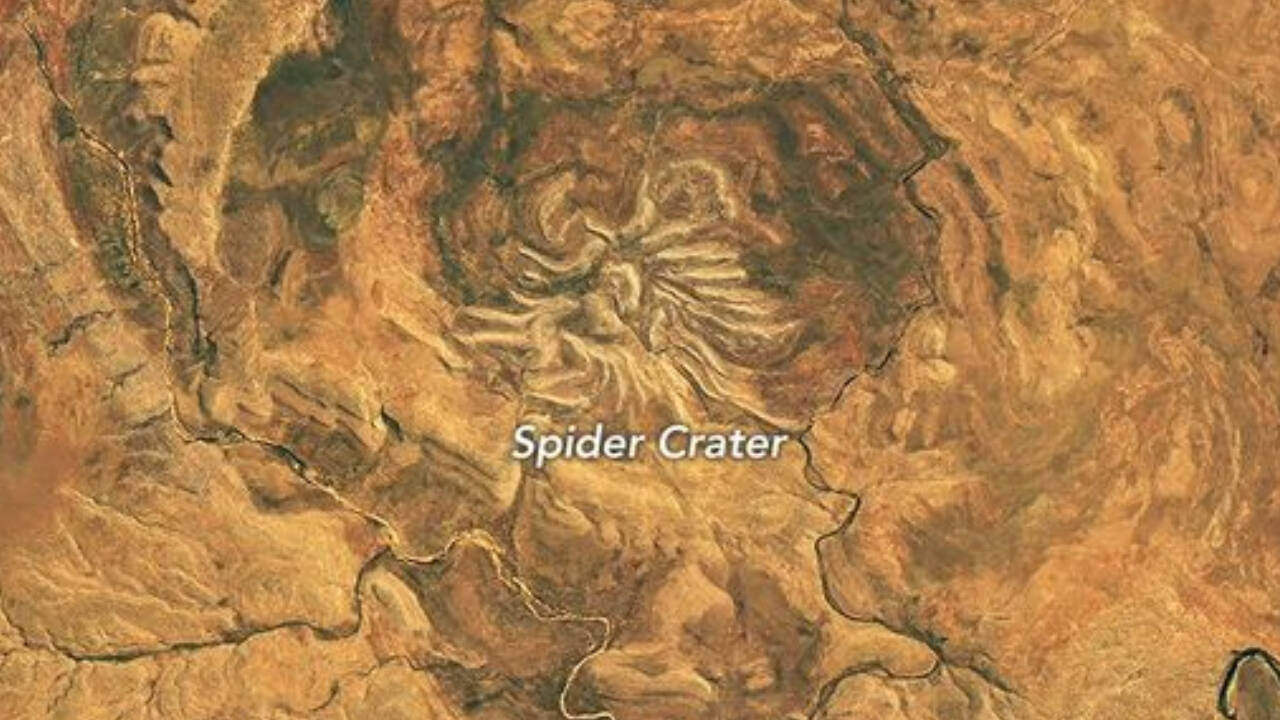
Orbital photography rarely looks like a trapdoor spider waiting in the dirt, yet Spider Crater in Western Australia pulls off that exact trick from hundreds of kilometers above Earth. Headlines love framing a NASA satellite image as a sudden cosmic reveal, turning ancient rock into viral shock value. The real story is messier, older, and far more contested among geologists who have spent decades arguing over whether a meteorite ever touched that ground.
To understand Spider Crater, you have to strip away the space-age gloss and look closely at what sits beneath the red soil of the Kimberley region. From orbit, radiating ridges and ridges-between-ridges fan out around a central depression, giving the feature its unmistakable arachnid silhouette. At roughly eleven to thirteen kilometers across depending on how a researcher defines its outer rim, the structure sits inside an ancient sedimentary basin where layers of sandstone and shale have been bent, broken, and eroded over hundreds of millions of years.
I have covered geological controversies long enough to know that a dramatic photograph is an invitation to investigate, not a verdict. Satellite sensors capture reflected light, elevation shifts, and mineral signatures across vast stretches of terrain. They do not hand you a signed confession from an asteroid. When a NASA satellite image lights up a spider-like web of ridges in remote Australia, it gives scientists a high-resolution map of fractures and folded beds, forcing a harder question about what mechanism carved them.
What Orbital Images Actually Show at Spider Crater
Look closely at the geometry of Spider Crater, and you see why casual readers jump straight to impact drama. Radial ridges extend outward from a central zone like legs stretching from a body, while circular or arcuate trends hint at ring-like deformation. On Earth, circular and radial patterns often catch the eye because human vision is wired to spot faces, animals, and familiar shapes in chaotic terrain.
Satellites operating in low Earth orbit—including instruments carried on Landsat missions and space station cameras—excel at showing regional context that a geologist walking through spinifex grass and scrub might miss for years. Standing on the ground inside an eroded basin of that scale can feel like standing inside a gentle bowl or a series of low, broken ridges. From space, the pattern locks together into a coherent structural map.
Yet pattern recognition is also where science can stumble if excitement outruns evidence. A radial pattern of ridges in ancient rock can come from a hypervelocity impact sending shockwaves outward and fracturing surrounding strata. It can also come from tectonic folding, differential erosion of tilted sedimentary layers, or subsurface diapirism and dome-like uplift that pushes overlying rock upward and splits it along radial joints.
In Spider Crater, the surface expression is deeply eroded. Hundreds of millions of years of wind, rain, shifting rivers, and weathering do not leave pristine craters behind like the sharp bowls you see on the Moon. They strip away loose ejecta blankets, wear down raised rims, and turn fractured rock layers into low ridges and valleys that only resemble a classic crater if the underlying structural geometry survives.
The Impact Hypothesis Versus Structural Skepticism
Whenever a circular or radial feature appears in ancient Australian rock, planetary geologists and structural geologists tend to split along sharp lines of evidence. Impact enthusiasts look for unmistakable signatures of extreme shock pressures that normal Earth processes—even violent mountain-building or volcanic eruptions—rarely produce. Skeptics look for conventional geology first, applying a strict burden of proof before adding another entry to Earth's confirmed crater ledger.
True shock metamorphism leaves telltale fingerprints in minerals, especially quartz. Under extreme pressures generated when a projectile slams into target rock at tens of kilometers per second, quartz grains can develop microscopic intersecting planes known as planar deformation features, or transform into high-pressure polymorphs like coesite and stishovite. Shatter cones—distinctive conical rock fractures with horsetail-like striations—are another classic field indicator when found in place rather than loose float.
Breccias, melt rocks, and uplifted central peaks or structural rings also matter, though erosion complicates every single one of them. If millions of years have Planed off the top kilometer of rock, a shallow impact scar can lose its bowl while keeping deeper roots, or an eroded structural dome can mimic a crater's ring-and-spoke layout. That ambiguity is precisely why Spider Crater has remained a subject of scientific debate rather than an open-and-shut textbook case.
Consider a hypothetical example to see how easy it is to misread an ancient scar from above. Suppose a field team spots a circular ring of resistant sandstone ridges surrounding a weathered core in an arid basin, and an orbital pass highlights radial gullies cutting down the flanks. Without microscopic thin-section work confirming shock features or unambiguous structural geometry tied to an impact event, calling that feature a confirmed meteorite crater based on shape alone would be premature.
In real-world geology, Spider Crater sits squarely inside that demanding evidentiary standard. Some researchers have evaluated it as a candidate or suspected impact structure, while others treat its origin as uncertain or disputed pending stronger diagnostic proof. The tension is healthy. Earth's catalog of confirmed impact structures is built on rigorous verification precisely because wishful thinking is cheap and bad classifications skew planetary impact rates.
Why Australia Keeps Surfacing Ancient Scars
There is a practical reason Western Australia shows up so often in discussions of ancient craters and mysterious geological structures. Much of the Australian continent sits on cratons—ancient, thick, relatively stable blocks of continental crust that have avoided the repeated subduction, continental collision, and wholesale recycling that erase surface features elsewhere.
Think of a craton like an old hard drive that has been read many times without being wiped clean every decade. While younger mountain belts rise, buckle, and get ground down by active plate boundaries, vast parts of Western Australia have remained geologically quiet for vast stretches of time. That longevity gives ancient rocks—and any structures imprinted on them—a fighting chance to persist.
Arid and semi-arid climates add another layer to the story. Sparse vegetation in parts of the outback means bare rock, regolith, and subtle tonal contrasts are less hidden by dense forest canopy than they would be in temperate or tropical zones. When satellites pass overhead, differences in rock composition, soil moisture, and ridge relief stand out cleanly.
Even so, longevity is not immortality. Even on an ancient craton, weathering and erosion never truly clock out. A structure that is hundreds of millions of years old has endured countless climatic shifts, river reconfigurations, and rockfalls. Interpreting what happened at Spider Crater requires separating what the rock originally experienced from what wind and water carved afterward.
How Satellite Hype Distorts Earth Science
There is a predictable media cycle whenever a space agency or satellite dataset yields a striking visual of a remote geological feature. A striking image goes up. The headline promises a "giant spider-shaped ancient crater" revealed by NASA. Within hours, readers assume a definitive scientific breakthrough just occurred, complete with settled age, settled cause, and dramatic cosmic finality.
That framing distorts how real science moves. Satellites are extraordinary reconnaissance tools, especially for mapping large structures across inaccessible terrain like northern Western Australia. They help geologists spot anomalies, plan expeditions, and measure spatial relationships at scales impossible from a single outcrop.
They do not replace boots on the ground, rock hammers, petrographic microscopes, or laboratory dating. You cannot see microscopic shock lamellae inside a quartz grain from orbit. You cannot measure argon or uranium-lead isotopic systems from a spaceborne camera hundreds of kilometers up.
When coverage blurs "satellite observation of a spider-like geological structure" into "NASA proves a giant ancient crater," it sets readers up for confusion when specialists point out ongoing debate or missing diagnostic evidence. Good journalism respects the reader enough to explain both the visual power of the orbital view and the limits of what a photograph alone can prove.
What Investigators Look for Next
If you want to separate genuine geological insight from surface-level spectacle on Spider Crater, focus on four concrete lines of inquiry that actually move the needle:
- Shocked mineral evidence: Detailed thin-section analysis of in-place target rocks to test for unambiguous shock features rather than relying on circular morphology alone.
- Structural mapping: Careful field and remote-sensing analysis of bedding dips, fault orientations, and concentric or radial fractures to distinguish impact deformation from regional folding or dome uplift.
- Stratigraphic constraints: Examining which rock units are deformed and which overlying layers sit undisturbed, which helps narrow down when the structure formed.
- Erosion modeling: Accounting for how much overlying rock has been removed over geological time so surface ridges are matched to their true structural depth.
Each step is slow, unglamorous, and essential. Fieldwork in remote parts of Western Australia takes serious logistics, heat tolerance, and patience, and lab follow-up often yields subtle clues rather than instant headlines.
Next time a dramatic NASA satellite image of Spider Crater crosses your screen, zoom past the spider shape and ask what the rock itself has proven—and where the evidence still leaves room for doubt.