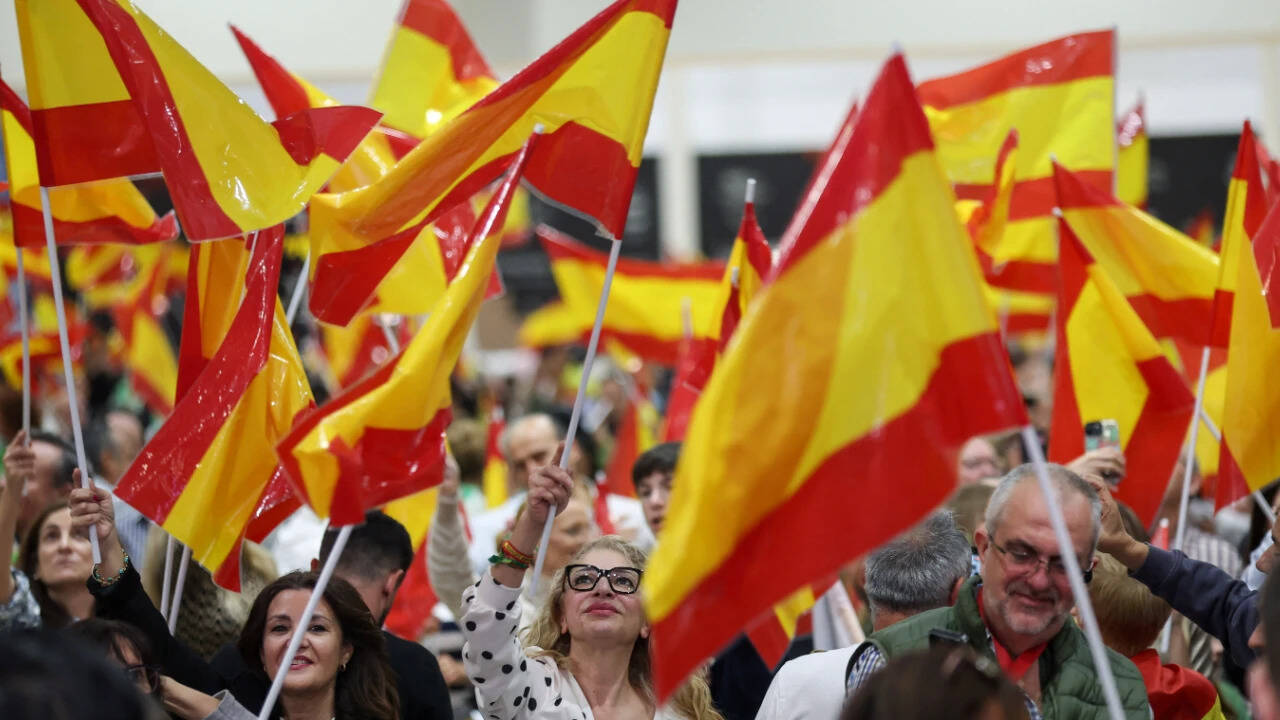
Spain’s political center of gravity is shifting violently to the right, and the math behind the polling points toward a governing majority for the conservative People's Party (PP) and the far-right Vox. While surface-level coverage frames this as a standard pendulum swing against Prime Minister Pedro Sánchez and his Spanish Socialist Workers' Party (PSOE), the reality on the ground is far more structural. Voters are not merely expressing fatigue with an incumbent administration; they are reacting to a collision of stagnant real wages, acute housing shortages, and deep-seated constitutional anxieties over regional separatism.
To understand how Spain arrived at this precipice, you have to look past the shouting matches in the Congress of Deputies in Madrid and examine the structural mechanics of the Spanish electoral system.
The Structural Math of the D'Hondt Method
Most international observers treat Spanish polling averages as a direct reflection of seats in parliament. That is a fundamental error. Spain does not use a pure proportional representation system; it uses the D'Hondt method across 52 multi-member constituencies, most of which correspond to the country’s provinces.
This system heavily rewards the first- and second-place parties in rural, sparsely populated provinces—regions often referred to as la España vaciada, or "emptied Spain." In provinces like Soria, Teruel, or Cuenca, which elect only two to four deputies each, smaller left-wing coalitions frequently fail to cross the effective threshold needed to win a single seat. Their votes are effectively discarded.
Consequently, when the political left splinters, it does not just lose vote share. It loses entire seats to the right without the conservative bloc necessarily gaining a single new voter.
Consider a hypothetical scenario in a small rural province electing three deputies. If the conservative PP wins 42 percent of the vote and the PSOE wins 33 percent, while two smaller left-wing factions split the remaining 25 percent evenly, the D'Hondt divisor allocates two seats to the PP and one to the PSOE. The 25 percent cast for the smaller left-wing parties yields zero representation. When the PSOE trails in national polls by even a narrow margin of four or five percentage points, this geographic distortion amplifies the deficit, turning a modest polling lead for the right into an outright parliamentary majority of 176 seats or more.
The Exhaustion of the Frankenstein Coalition
Since taking office in 2018, Pedro Sánchez has governed through an intricate, fragile web of alliances that his critics famously dubbed the "Frankenstein coalition." To pass budgets and survive confidence votes, the PSOE has relied on left-wing populists alongside Catalan and Basque separatist parties, including ERC, Junts, and EH Bildu.
For years, Sánchez demonstrated a remarkable ability to survive political crises that would have ended the careers of lesser tacticians. He framed his compromises—including controversial pardons and an amnesty law for figures involved in the 2017 Catalan independence push—as necessary medicine to cool separatist tensions and restore territorial peace in Catalonia.
By certain metrics, that gamble worked. Street protests in Barcelona subsided, and the regional government eventually swung back toward a pro-union Socialist administration. Yet the political cost across the rest of Spain has been severe.
Among working-class voters in traditional Socialist strongholds like Andalusia, Extremadura, and Castilla-La Mancha, the perception took root that Madrid was trading away national cohesion and fiscal resources to appease wealthy northern regions. When a government relies on parties whose explicit goal is to dismantle the state, every budgetary concession looks like ransom to voters outside those regions. The PP, led by Alberto Núñez Feijóo, has hammered this vulnerability relentlessly, turning regional grievances into a powerful national wedge issue.
The Pocketbook Disconnect
If you look strictly at macroeconomic headlines, Spain appears to be a European success story. Gross domestic product growth has consistently outpaced the Eurozone average, buoyed by record-breaking tourism numbers, strong service exports, and billions of euros in European Union post-pandemic recovery funds.
Voters do not live inside macroeconomic spreadsheets. They live in the grocery store and the rental market.
Inflation over the past several years eroded purchasing power faster than wage increases could compensate. While headline inflation eventually cooled, the cumulative price shock of basic staples—most notably olive oil, dairy, and electricity—left households feeling permanently poorer.
Simultaneously, Spain is experiencing a brutal housing crisis that disproportionately punishes young adults and urban workers. In cities like Madrid, Barcelona, Valencia, and Málaga, rents have surged to historic highs, driven by a chronic lack of new supply, an explosion in short-term tourist apartments, and stagnant youth wages. Millions of Spaniards in their twenties and thirties remain stuck living with their parents, unable to afford the down payment on a home or even a solo rental lease.
The PSOE government passed housing legislation aimed at capping rent increases in stressed areas, yet the policy backfired in key markets. Landlords pulled properties off the long-term rental market, further restricting supply and driving prices even higher. For a generation locked out of basic financial independence, promises of macroeconomic growth ring hollow. They are looking for an exit ramp from the status quo, and for many, that means punishing the party in power.
The Normalization of Vox and the Right-Wing Dilemma
A decade ago, Spain was viewed as an exception in Western Europe—a country immune to the rise of hard-right nationalism due to the lingering collective memory of Francisco Franco’s dictatorship, which ended in 1975. That exceptionalism evaporated with the rise of Vox.
Led by Santiago Abascal, Vox built its platform on aggressive Spanish nationalism, strict border controls, opposition to regional autonomy, and fierce pushback against progressive social policies regarding gender and climate change. Initially dismissed by Madrid’s political establishment as a temporary protest movement, Vox has solidified a durable floor of support, routinely polling between 11 and 15 percent.
This creates an acute strategic trap for Alberto Núñez Feijóo and the mainstream conservative PP.
Feijóo built his reputation as a moderate, technocratic administrator during his four terms as president of the northwestern region of Galicia. His ideal path to the Moncloa Palace involves absorbing center-right voters disillusioned with Sánchez, winning a large enough plurality to govern alone as a minority administration, and forcing Vox to support him from the outside without giving them cabinet ministries.
Vox has repeatedly refused to play along. Whenever the PP has fallen short of an absolute majority in regional elections—such as in Castilla y León, Valencia, and Aragón—Vox has demanded formal coalition agreements, vice presidencies, and control over culture, agriculture, and justice departments as the price for their votes.
Every time the PP signs a coalition deal with Vox at the regional level, it hands the PSOE a powerful campaign weapon. Sánchez’s strategists do not even need to attack Feijóo’s economic policies; they simply point to regional Vox ministers rolling back environmental regulations, cutting funding for domestic violence programs, or sparking culture wars over local festivals. The central question hanging over the next national election is not whether the right-wing bloc will win a majority of seats, but whether Feijóo can clear the bar without handing the keys of national ministries to Abascal.
The Collapse of the Left’s Secondary Engine
To understand why the Socialists are trailing so badly in the projected seat count, you also have to examine the implosion of the space to their left.
During the height of its power, the anti-austerity party Podemos acted as a vital secondary engine for the progressive bloc, mobilizing disaffected youth and urban activists who viewed the PSOE as too moderate. Over the past several years, that movement has fractured into bitter personal and ideological rivalries.
The creation of Sumar, a broad left-wing platform intended to unite over a dozen regional and national factions under one umbrella, failed to stop the bleeding. Endless internal purges, public feuds between former allies, and overlapping candidacies have alienated core progressive voters.
In Spain’s electoral system, enthusiasm is everything. Conservative voters tend to turn out reliably regardless of weather or political drama. Left-wing voters, by contrast, require emotional mobilization to show up at the ballot box. When the space to the left of the PSOE is consumed by infighting, millions of progressive voters simply stay home. Demobilization on the left is the silent engine driving the right-wing surge in the polls.
What a Right-Wing Majority Actually Means for Spain
If the PP and Vox secure the 176 seats required to form a government, the immediate consequences will reverberate far beyond Madrid.
Domestically, a conservative administration will move swiftly to dismantle signature legislative achievements of the Sánchez era. Expect immediate attempts to repeal the Democratic Memory Law, roll back taxes on banks and energy companies, lower inheritance and wealth taxes across PP-controlled regions, and toughen penalties for illegal property occupation—an issue known as okupación that dominates conservative media coverage despite representing a tiny fraction of overall housing stock.
The sharpest flashpoint, however, will be Catalonia and the Basque Country. A government dependent on Vox will take a hardline stance against regional nationalist parties. While that approach plays well in central and southern Spain, it risks reigniting the exact territorial friction that paralyzed the country in 2017. Stripping away concessions or challenging regional linguistic policies in Catalan and Basque schools could trigger massive street mobilization and institutional gridlock in Spain’s wealthiest economic engines.
On the European stage, Spain has served as one of the most reliable pro-integration, progressive anchors within the European Union under Sánchez, championing green energy transitions, migration reform, and joint European debt. A shift to a PP-Vox government would pull Spain closer to the conservative and nationalist camp in Brussels, altering the balance of power within the European Council on issues ranging from agricultural subsidies to climate targets and border enforcement.
The Unforgiving Verdict of the Ballot Box
Political dynasties in Spain rarely die from a single catastrophic scandal; they erode slowly through the accumulation of broken promises, coalition fatigue, and economic frustration. Pedro Sánchez has defied political gravity more times than any modern Spanish leader, surviving internal party coups, pandemic lockdowns, and razor-thin parliamentary margins.
Yet the structural headwinds facing the PSOE today are fundamentally different from the tactical crises of the past. You cannot spin your way out of a 30 percent spike in rent, nor can you easily re-energize an exhausted electoral base that feels taken for granted. Unless the Spanish left finds a way to reverse the deep cynicism among working-class and young voters before election day, the D'Hondt math will deliver a merciless verdict, handing the reins of Western Europe’s fourth-largest economy to a conservative bloc ready to redraw the country's political map.