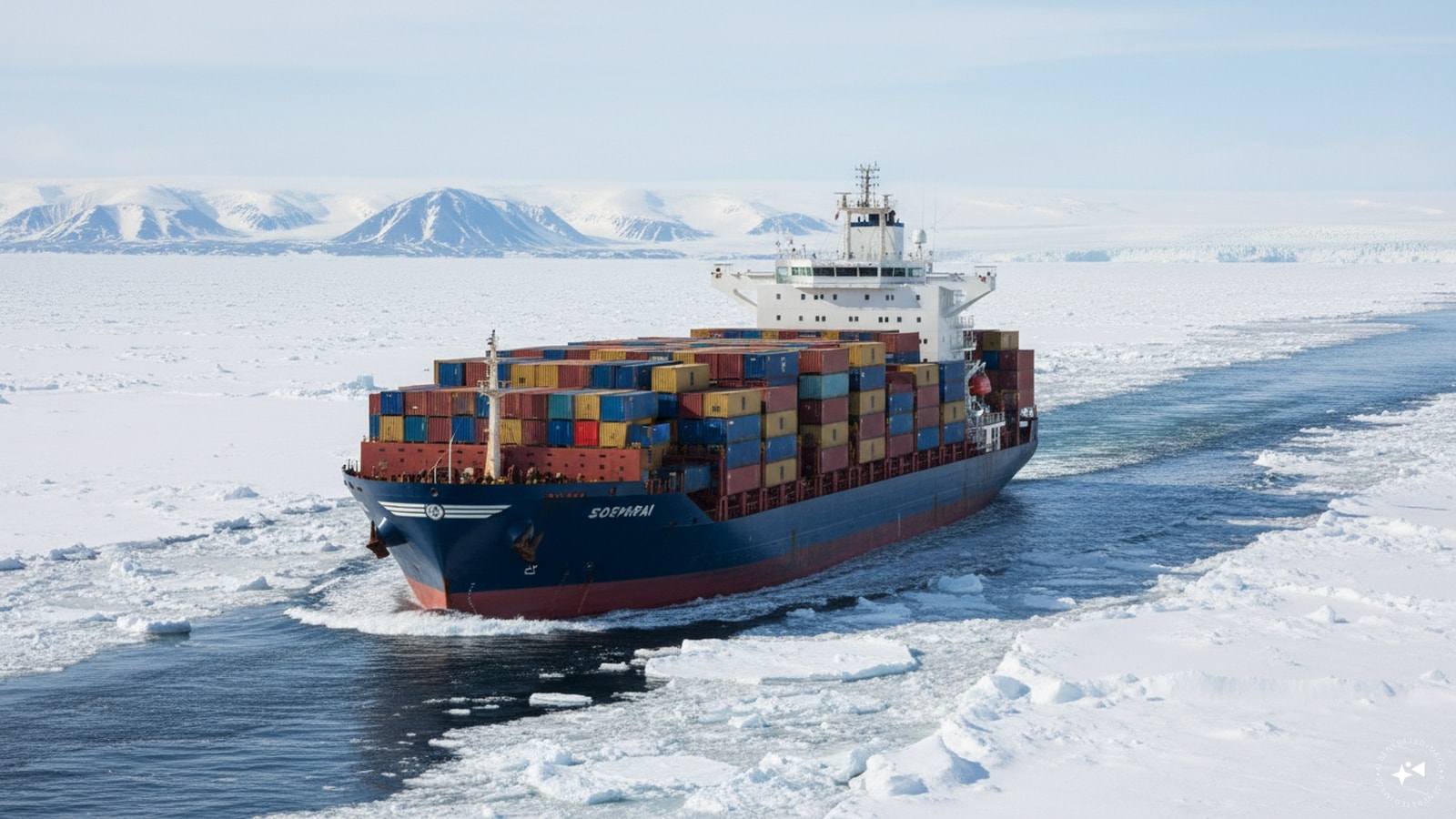
When the container vessel Panstar Acro slipped back into Busan port after a forty-nine-day round trip to Northern Europe, the champagne corks popped in government offices, but maritime veterans kept their calculators out. South Korea had just completed its inaugural commercial trial along Russia's Northern Sea Route, lopping roughly ten days off the traditional transit time through the Suez Canal. On paper, cutting the nautical distance between East Asia and Europe by thirty-five percent looks like a logistical triumph. On the water, the journey laid bare a bruising reality that corporate PR statements routinely gloss over.
The voyage was designed to prove that the melting polar ice cap could serve as a reliable commercial highway while Middle Eastern geopolitical conflicts choke traditional maritime corridors. Yet behind the official ribbon-cutting ceremonies lies a web of prohibitive insurance premiums, strict Russian regulatory hurdles, and unpredictable drift ice that turned segments of the test run into a tense waiting game.
The Arithmetic of the Ice
The core economic argument for the Northern Sea Route rests on simple geography. A cargo vessel sailing from Busan to Rotterdam via the Suez Canal typically covers roughly twenty thousand kilometers. Hauling those same containers across the top of Russia shrinks the journey down to about thirteen thousand kilometers. Less distance means lower fuel bills and faster inventory turns.
At least, that is how the theory functions in an empty spreadsheet.
When the Panstar Acro approached Wrangel Island late last August, the ship encountered stubborn drift ice that forced the captain to idle and maneuver back and forth for hours waiting for a navigable lead. Even with an ice-class hull, standard commercial container ships cannot simply plow through multi-year polar ice. Navigating the passage requires constant meteorological vigilance, slow steaming through restricted sectors, and dependence on specialized ice data. Every hour spent idling in sub-zero fog eats directly into the fuel savings promised by the shorter route.
Cargo utilization during the trial further exposed the commercial friction. The vessel hauled just over seven hundred laden containers packed with automotive parts, chemicals, and consumer goods supplied by domestic South Korean shippers. It attracted zero import cargo on the return leg, sailing back to Busan with nearly seventeen hundred empty metal boxes. Establishing a profitable shipping line requires steady, balanced trade flows in both directions. Right now, the Arctic corridor functions more like a one-way scientific experiment than a balanced trade artery.
The Geopolitical Minefield
Commercial viability is only half the equation. Any ship utilizing the Northern Sea Route must secure transit permits directly from Moscow and submit to strict operational oversight by Russian maritime agencies. For Seoul, threading this bureaucratic needle requires diplomatic tightrope walking.
Most major Western container lines have sworn off the route entirely. The combination of international sanctions, acute compliance risks, and the political toxicity of dealing with Russian port authorities keeps mainstream operators away. Furthermore, maritime insurers charge punishing premiums for hull and machinery coverage in polar waters where rescue infrastructure is practically nonexistent.
While Chinese operators have steadily accumulated experience along the Siberian coast over recent years, South Korea's entry into the space represents a calculated strategic shift. Busan wants to position itself as the premier logistics hub for cargo redistribution originating from the polar north. To incentivize domestic shipyards, Seoul has dangled financial subsidies for every domestically built ice-class vessel that rolls off the dry docks.
Building the ships is arguably the easy part. Operating them profitably while keeping insurance underwriters and risk compliance officers satisfied is an entirely different matter.
The Illusion of Year-Round Transit
Enthusiasts often speak of the Arctic shipping lane as a permanent replacement for southern chokepoints. This perspective ignores basic meteorology. The window for safe, unassisted navigation remains stubbornly narrow, restricted primarily to the peak late-summer months before refreezing accelerates across the high latitudes. For the remainder of the year, the route is locked in solid pack ice that requires heavy nuclear icebreaker escorts—services that carry steep fees and introduce another layer of operational vulnerability.
A shipping lane that shuts down for half the year cannot support modern, just-in-time global supply chains. Manufacturers demand predictability above all else. If a container line cannot guarantee delivery dates because a sudden wind shift packed ice against the coastline, supply chain managers will route their boxes through traditional waters every single time.
The Panstar Acro proved that a modern container ship can make the northern transit without mechanical disaster. It did not prove that commercial operators can turn a consistent profit doing so under current market conditions. Until insurance markets adapt, regulatory friction eases, and ice-class fleets scale efficiently, the Arctic shortcut will remain an elite tactical option for specialized cargo rather than the backbone of global trade.