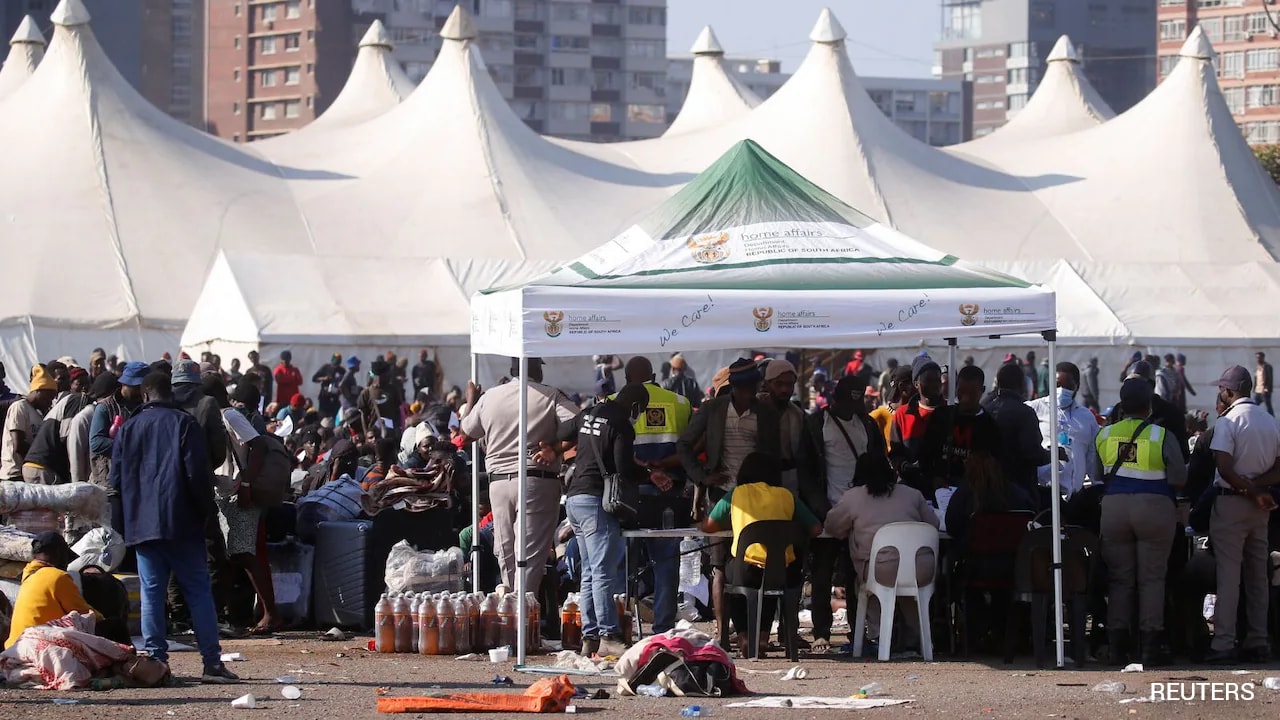
The anti-immigrant protests paralyzing South Africa are not driven by a sudden influx of foreign nationals, but by the spectacular, multi-decade collapse of state infrastructure and economic promise. For months, armed demonstrations organized by citizen-led groups like March and March and political entities like Operation Dudula have shut down commercial hubs and forced thousands of sub-Saharan migrants to flee. The standard narrative frames this as a chaotic eruption of cultural xenophobia. The reality is far more clinical. South African politicians and vigilante groups are actively using the country's shrinking resource pie to convert structural governance failures into a hyper-violent, xenophobic distraction.
By focusing purely on the anger in the streets, conventional analysis completely misses the mechanics of the crisis. The state has essentially outsourced its law enforcement to the mob, allowing civilian groups to patrol school gates, blockade hospitals, and audit passports. This strategy serves a dual purpose. It satisfies a desperate electorate’s demand for action while successfully deflecting blame from the multi-billion-rand corruption and administrative rot that actually destroyed the country's public services.
The Anatomy of a Scapegoat
The core accusation leveled by protest organizers is straightforward: undocumented foreigners are draining the national treasury, taking jobs, and breaking the healthcare system. On paper, the numbers tell a completely different story.
Data from the national statistics office indicates that there are roughly 3.1 million migrants in South Africa, accounting for about 4.1% of the total population. This is a noticeable decline from the 5.6% recorded a decade ago. For context, global migration hubs regularly absorb far higher ratios, with foreign-born residents making up 17% of the population in the United Kingdom and over 20% in Canada.
The economic argument against these migrants collapses under empirical scrutiny. A comprehensive World Bank assessment revealed that immigration in South Africa acts as an economic multiplier, generating approximately two local jobs for every single migrant employed. This happens because migrant entrepreneurs predominantly operate within the informal township economy, sourcing their inventory locally and renting space from South African landlords. They expand the consumer market rather than stealing from it.
The pressure on public clinics and schools is entirely real, but its origin has been deliberately misdiagnosed. Decades of chronic underinvestment, systemic mismanagement, and historic levels of public asset stripping have left local infrastructure hollowed out. Turning away a pregnant Zimbabwean woman or an undocumented child at a clinic gate does nothing to fix a broken supply chain that leaves hospitals without basic medicine. It does, however, provide a highly visible, immediate target for communities running out of patience with an absent state.
The Political Economy of Mob Rule
Xenophobia in South Africa is an institutionalized political currency, not a spontaneous working-class grievance. With critical local government elections approaching, political actors across the spectrum have realized that anti-migrant rhetoric offers an easy path to relevance.
The political calculus shifted dramatically after the ruling African National Congress lost its absolute parliamentary majority. In the vacuum left by a fracturing establishment, populist parties like the uMkhonto we Sizwe Party, ActionSA, and the Patriotic Alliance have aggressively leaned into nativist platforms. By promising to purge foreign nationals by arbitrary deadlines, these factions completely bypass the need to present complex, painful solutions for economic structural reform.
Hostility Trends: Percentage of South Africans Welcoming ZERO Immigrants
2020: 28%
2025: 42%
Source: Human Sciences Research Council (HSRC) National Survey
This rapid escalation in public hostility directly correlates with deep economic despair. South Africa currently suffers from an unemployment rate hovering around 33%, a figure that surges past 50% when narrowing the lens to young people locked out of the formal economy. When a society possesses the highest level of income inequality in the world, social cohesion cannot survive without a strong, functioning state. When that state fails to provide housing, safety, or electricity, the street corner becomes the border checkpoint.
The Collapse of Border Enforcement and the Rise of Indirect Rule
The emergence of groups like Operation Dudula represents something far more dangerous than simple vigilantism. It is a form of indirect rule by an incompetent state. When official police forces stand by and watch civilians conduct identity checks outside primary schools or neighborhood clinics, the government is tacitly validating the mob's authority.
This state abdication has triggered deep diplomatic fracturing across the continent. Nations including Nigeria, Ghana, Zimbabwe, and Malawi have initiated large-scale emergency evacuations to repatriate thousands of their citizens from South African cities. The long-term economic consequences of this isolation are severe. South Africa was once positioned as the financial and moral anchor of pan-African trade, benefiting immensely from continental cooperation and skilled cross-border migration. By letting its domestic politics turn inward and violent, the country is actively burning the very trade partnerships and regional alliances it requires to escape its current economic stagnation.
The current legal and security frameworks are completely unequipped to halt this drift. High court rulings explicitly ordering the state to protect vulnerable migrant communities from intimidation have been largely ignored by local police detachments. This executive silence functions as an open invitation for further disruption. As long as structural unemployment remains unaddressed and local political machinery treats human beings as campaign props, the border illusion will continue to dictate life on the ground, leaving South Africa trapped in an escalating cycle of manufactured crises.


