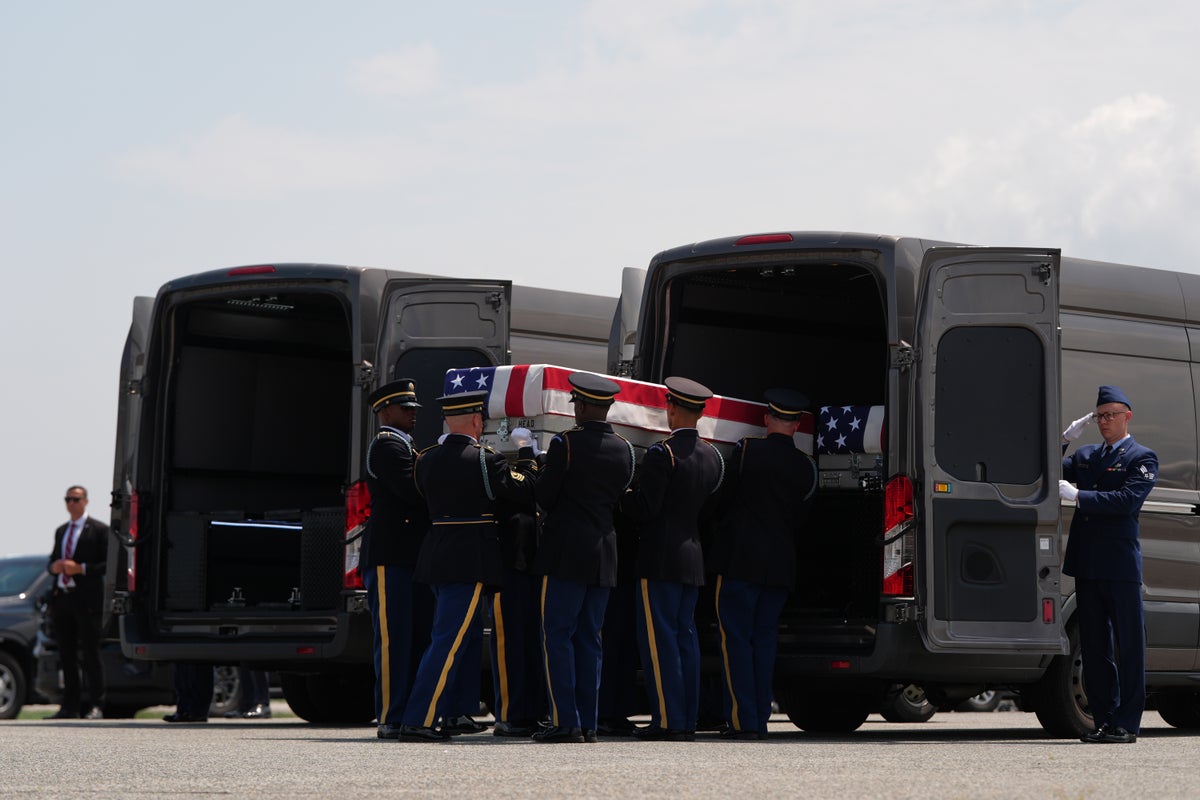
On July 22, 2026, President Donald Trump stood under the grey skies of Dover Air Force Base in Delaware to participate in the solemn ritual known as a dignified transfer. Beside Defense Secretary Pete Hegseth and General Dan Caine, Chairman of the Joint Chiefs of Staff, the commander in chief watched as six-person military carry teams moved four flag-draped transfer cases from the gray fuselage of a C-17 aircraft into waiting vehicles. The fallen service members—1st Lt. Tyler James Feehan, Pvt. Isabella Gonzales, Sgt. Angel S. Rampersad, and Sgt. Michael Emmanuel Swinton—were killed during recent drone and missile strikes in Jordan and Iraq. Their deaths bring the official American military casualty count to 18 since regional operations against Iranian targets escalated on February 28.
While media coverage often treats these events as brief photo opportunities, the tarmac at Dover represents the exact moment where geopolitical decisions clash with human sacrifice.
The Sacred Protocol on the Delaware Runway
A dignified transfer is not a military parade. It is not a photo call, and it is explicitly not designed for public fanfare. The Department of Defense maintains strict protocols for how the remains of fallen troops are returned to American soil, following a routine honed over decades of conflict.
The ritual happens in near-total silence. The only sounds across the flight line are the low hum of taxiing aircraft, the rhythmic click of spit-shined leather boots, and the sharp commands whispered by the officer leading the carry team. Six service members in dress uniforms lift each white-gloved handle of the transfer case. They move with deliberate, synchronized precision.
"For me, it's one of the hardest things to do as a president. But it has to be done," Trump remarked to reporters prior to arriving on the tarmac, noting that his message to the families gathered at the base was simple and unfiltered.
Behind the public salutes lies an intricate logistical machine operating around the clock at the Charles C. Carson Center for Mortuary Affairs. Located on the northern end of Dover Air Force Base, the facility is the primary mortuary for the United States Department of Defense. Every service member killed overseas passes through this terminal. Here, teams of specialists perform autopsies, verify identities through DNA and dental records, prepare the remains, and meticulous dress each uniform down to the exact placement of ribbons and rank insignia.
This ceremony marked the third time since March that the president has traveled to Delaware to meet incoming casualty flights. Each visit underscores a recurring dynamic in American warfighting. Policies designed in Washington offices eventually end up in silver cases on a windy runway in Delaware.
The Mechanics of the Dover Transfer
The protocol follows an unyielding sequence. Once a military transport plane lands and comes to a complete halt, the rear ramp lowers. A chaplain steps onto the plane to offer a private prayer over the remains before anyone touches the cases.
Outside, the carry team stands at rigid attention. When the order is given, they march slowly up the ramp. Each transfer case—made of heavy aluminum and draped tightly in a standard American flag—is lifted to waist level. The team carries the fallen individual down the ramp and steps into a specialized transport van parked feet away.
The president and military leaders stand several yards away in a straight line. As each case moves past, they render a hand salute. No speeches are delivered on the tarmac. No music is played. Once the transfer cases are secured inside the vehicles, the doors close, the carry team salutes, and the convoy drives slowly toward the mortuary facility.
The Human Cost Behind Strategic Headlines
Press releases from the Pentagon detail military units, theater operations, and tactical casualty reports. Yet the four individuals brought back to Delaware on Wednesday represented distinctly personal stories interrupted by conflict.
+--------------------------+-----+--------------------+-------------------------------+-------------------+
| Name                     | Age | Hometown           | Unit / Assignment             | Incident Location |
+--------------------------+-----+--------------------+-------------------------------+-------------------+
| 1st Lt. Tyler J. Feehan  | 25  | Ewa Beach, HI      | 32nd Army Air & Missile Def.  | Jordan            |
| Pvt. Isabella Gonzales   | 19  | Carrollton, TX     | 10th Army Air & Missile Def.  | Jordan            |
| Sgt. Angel S. Rampersad  | 28  | Ozone Park, NY     | 57th Air Defense Artillery    | Jordan            |
| Sgt. Michael E. Swinton  | 30  | Spring Lake, NC    | 55th Air Defense Artillery    | Iraq              |
+--------------------------+-----+--------------------+-------------------------------+-------------------+
1st Lt. Tyler James Feehan, 25, known to friends and family as "Tivo," was assigned to the 32nd Army Air and Missile Defense Command out of Fort Bragg, North Carolina. Posthumously promoted to captain and awarded the Bronze Star and Purple Heart, Feehan had been stationed near the Jordanian border when a barrage hit his installation. His family noted in a statement that he spent his short life constantly seeking adventure and serving others.
Pvt. Isabella Gonzales was just 19 years old. A resident of Carrollton, Texas, she had graduated high school only a year prior before enlisting in the U.S. Army. Assigned to the 10th Army Air and Missile Defense Command based in Ansbach, Germany, Gonzales was stationed at Muwaffaq Salti Air Base in Jordan when incoming fire struck the facility on July 17.
Sgt. Angel S. Rampersad, 28, from Ozone Park, New York, served alongside Gonzales in air defense support operations. Initially listed as missing in action following the Jordan strikes, military authorities later confirmed her death after forensic sweeps of the site were completed.
Sgt. Michael Emmanuel Swinton, 30, a father of two from Spring Lake, North Carolina, died in a separate incident in northern Iraq on July 19. Swinton was killed during a controlled detonation operation involving a downed enemy drone near Erbil Air Base. He was posthumously promoted to staff sergeant.
These four service members shared a common, high-risk specialty. They were all assigned to air defense networks operating in heavily targeted border sectors.
The Operational Strain on Air Defense Networks
The casualties in Jordan and Iraq highlight an increasing tactical reality in modern warfare. Air defense units are no longer stationed safely behind front lines. They are now the primary targets of saturated drone strikes and ballistic missile salvos.
U.S. Army Air Defense Artillery units operating across the Middle East face complex threat environments. Opposing forces routinely launch low-cost suicide drones alongside high-speed artillery rockets and ballistic missiles. The goal of these layered strikes is straightforward: overload the automated radars and defensive interceptors of systems like Patriot, THAAD, and short-range C-RAM networks.
When an incoming swarm consists of dozens of cheap drones flying below radar horizons, even advanced air defense umbrellas can experience localized gaps. During the July 17 attack on Muwaffaq Salti Air Base, several projectiles penetrated the defensive perimeter.
Military investigators are currently examining whether early warning systems failed or if defensive interceptors were simply overwhelmed by sheer volume. President Trump acknowledged these defensive challenges earlier in the week, noting that while American systems successfully intercept the vast majority of airborne threats, no defensive bubble is entirely impenetrable during prolonged multi-directional bombardments.
For soldiers operating radar trailers and missile launchers in remote forward bases, the pressure is continuous. Servicemen must maintain split-second readiness around the clock, knowing that a single missed target can result in direct hits on their living quarters and command posts.
Political Strategy Meets Private Grief
The arrival of casualties at Dover always creates a sharp political contrast. While Washington debates defense budgets, troop deployments, and foreign policy objectives, the center for fallen service members deals exclusively in immediate, personal loss.
Before stepping onto the flight line, President Trump held private meetings with the families of the four soldiers inside the base facilities. These meetings are unscripted and closed to press cameras. Family members are given the choice of whether they want political leaders present during the dignified transfer or if they prefer a completely private ceremony.
The public reaction to sustained foreign deployments often shifts around these moments. Historical data demonstrates that public support for overseas military operations remains steady during early phases but sensitive to steady streams of casualties.
U.S. Military Casualty Progression in Current Regional Conflict (2026)
----------------------------------------------------------------------
Late February: Operations Commence
March 7:       6 Fatalities (Kuwait Drone Attack)
March 18:      6 Fatalities (Iraq Air Refueling Crash)
July 18-21:    4 Fatalities (Jordan / Iraq Strikes)
Total To Date: 18 U.S. Service Members Killed
The administration has maintained that strikes against adversary infrastructure are essential to prevent long-term escalation and protect international shipping lanes. However, lawmakers on Capitol Hill have begun raising questions regarding force protection measures, air defense supply chains, and the long-term strategic end state in the region.
Senators Thom Tillis of North Carolina and Chris Coons of Delaware both joined the official delegation at Dover on Wednesday. Their presence reflected bipartisan recognition of the sacrifice, yet legislative debates over the authority and duration of military engagements continue to intensify in Congress.
The Long Road Home from the Mortuary Facility
When the dignified transfer concludes, the public visibility of the event ends. But for the military mortuary personnel and the grieving families, the process is far from over.
Inside the Carson Center, mortuary specialists work meticulously over several days to prepare each fallen soldier. Once all preparations are complete, the remains are escorted by a designated military officer back to the soldier's hometown or to National Cemeteries across the country, such as Arlington.
The families of 1st Lt. Feehan, Pvt. Gonzales, Sgt. Rampersad, and Sgt. Swinton will soon hold private services in Hawaii, Texas, New York, and North Carolina. The news cycle will inevitably move forward to cover legislative battles, economic developments, and presidential campaign stops. Yet inside military barracks from Fort Bragg to Ansbach, Germany, empty lockers and quiet roll calls will serve as daily reminders of the four soldiers who returned through Dover on a humid July afternoon.


