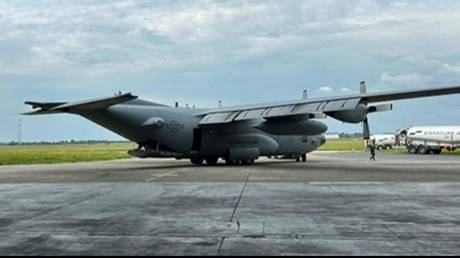
Federal prosecutors in Manhattan unsealed an indictment in November 2026 charging 48-year-old Irish national Daithi O’Corrain with destroying a $60 million U.S. Air National Guard C-130H Hercules at Ireland’s Shannon Airport. The incident occurred on April 11, 2026, when O’Corrain—also known as David Curran—allegedly breached the airport perimeter at 4:39 a.m., barricaded himself inside the parked transport plane for five hours, and systematically ruined its airframe using an axe, a drill, ball bearings, epoxy, and vials of liquid gallium. The attack rendered the aircraft permanently inoperable, exposing severe perimeter vulnerabilities at a critical transatlantic military transit hub and triggering overlapping criminal prosecutions across two jurisdictions.
Why an Axe Was Only a Distraction
Headlines fixated on the medieval image of a man taking an axe to a modern military transport. That framing misses the actual mechanics of the destruction. Aviation structural engineers know that an aluminum-skinned tactical transport built to survive combat flak does not die from a few chops to its fuselage. C-130 Hercules airframes are legendary for absorbing punishment and returning to service. Had O’Corrain only swung an axe at the exterior panels, Air Force depot crews would have patched the skin, replaced the damaged avionics, and had the tail back in the air within months.
The real killer in O’Corrain’s tool bag was chemistry. According to the Southern District of New York indictment, O’Corrain brought multiple capsules of gallium and a heat gun aboard the aircraft. Gallium is a soft metal that melts just above room temperature—around 85.6 degrees Fahrenheit—turning into a silvery liquid that behaves like mercury without the immediate vapor toxicity. When liquid gallium comes into contact with aluminum, it triggers a metallurgical phenomenon known as liquid metal embrittlement.
Gallium penetrates the grain boundaries of aluminum alloys within minutes. It strips away the metal’s structural integrity, turning high-strength aerospace aluminum into a brittle, crumbly substance that fractures under minimal stress. Once gallium infiltrates primary structural ribs, wing spars, or fuselage frames, depot technicians cannot simply weld over the damage or rivet on a doubler plate. You cannot guarantee that microscopic traces of the metal have not migrated deeper into the load-bearing skeleton. For an older C-130H—an airframe variant produced between the 1970s and 1990s that the U.S. Air Force has been gradually phasing out in favor of the newer C-130J—gallium contamination instantly turns an expensive repair into a constructive total loss.
Five Hours Unchecked on a Live Taxiway
The timeline laid out in federal court documents reads less like a spontaneous protest and more like a methodical industrial demolition. Prosecutors allege O’Corrain spent months preparing for the breach, researching C-130 construction schematics, tracking military flight movements via public aviation apps, and ordering gallium from an online distributor.
At roughly 4:39 a.m. local time on April 11, 2026, O’Corrain cut or bypassed the perimeter fencing at Shannon Airport in County Clare. He crossed the airfield to a taxiway where the Air National Guard C-130H sat parked overnight during an overseas assignment.
What happened next reveals an astonishing operational blind spot. O’Corrain forced open the locking mechanism on the rear crew door and stepped inside. Rather than rushing to smash a few visible screens before alarms sounded, he took the time to fortify his position. He pulled down the flight crew’s own hammocks to cover the fuselage windows, blocking outside visibility into the cargo hold while leaving the cockpit glass uncovered. Using tow straps, metal brackets, and self-tapping screws driven with an electric drill, he mechanically anchored the interior doors shut. To ensure rescue or security teams could not easily force the hatches from the outside, he poured a mixture of epoxy and steel ball bearings directly into the door tracks.
Inside that sealed workspace, O’Corrain worked uninterrupted for nearly five hours. He severed primary wire bundles and hydraulic lines. He smashed every single instrument gauge in the cockpit and punctured the environmental air ducts. He also crimped a liquid oxygen line—an action federal prosecutors noted could have triggered a catastrophic explosion inside the cabin.
Nobody noticed. Airport patrols did not spot him. Ground sensors did not trigger an intercept. The breach was only discovered around 9:40 a.m. when the American flight crew walked out to the taxiway to prep the aircraft for departure and saw a stranger staring back at them through the cockpit windshield.
Even after being spotted, O’Corrain did not surrender immediately. As the crew alerted Shannon Airport security, O’Corrain climbed out through an overhead roof hatch onto the top of the fuselage. Standing atop the wing and upper hull, he hacked at the exterior with his axe, pried open four overhead refueling caps, pulled out the protective mesh screens beneath them, and dumped ball bearings and unknown liquids straight into the fuel tanks. Irish Gardaí eventually arrived, rolled portable boarding stairs up to the wing, and arrested him on the roof beside his tool bag.
The Geopolitical Friction Behind Shannon Airport
To understand why a 48-year-old man spent months plotting to ruin a cargo plane in western Ireland, you have to look at the tarmac beneath it. Shannon Airport sits on the western edge of Europe, making it an ideal refueling stop for transatlantic aviation. Since the early 2000s, the Irish government has allowed the U.S. military to transit troops and equipment through Shannon under long-standing diplomatic arrangements.
Ireland, however, maintains an official policy of military neutrality. For more than two decades, the sight of American military transports and chartered troop carriers parked outside the terminal in County Clare has fueled fierce domestic political friction. By 2026, with U.S. aircraft heavily utilizing Shannon as a logistics bridge to Europe and the Middle East amid escalating regional conflicts involving Iran and Israel, opposition to the American presence had reached a boiling point.
The April 11 sabotage did not happen in a vacuum. Shannon Airport has suffered a string of security breaches over the preceding 18 months. Roughly two weeks after O’Corrain’s arrest, three activists breached the airfield and spray-painted a U.S. military aircraft. In November 2025, another trio was detained after driving a vehicle directly into a restricted zone where a U.S. military C-40 transport was parked. These incidents occurred despite heightened security protocols surrounding the facility, which also hosted Air Force One during President Donald Trump’s visit to Ireland in September 2026.
Historically, Irish anti-war protesters who damaged American aircraft at Shannon found unexpected leniency in local courts. In the mid-2000s, members of the Catholic Worker "Pitstop Ploughshares" group took hammers to a U.S. Navy C-40 at Shannon and were famously acquitted by a Dublin jury after arguing they acted to save lives in Iraq. While O’Corrain has made no public statements and authorities have not formally tied him to established protest networks, an online crowdfunding campaign raised nearly €9,000 for his defense, framing the sabotage as an "inspiring act of direct action".
Jurisdictional Tug-of-War and Extradition Hurdles
That history of local sympathy is precisely why the U.S. Department of Justice stepped in seven months after the incident. By unsealing a federal indictment in the Southern District of New York on November 17, 2026, American prosecutors signaled they are unwilling to leave the accountability for a $60 million loss solely in the hands of the Irish court system.
O’Corrain now faces a two-front legal battle:
- Irish Domestic Charges: In Ireland, prosecutors charged O’Corrain with trespassing on an airport taxiway and causing criminal damage to the perimeter fence and the aircraft. After initially being held without bail at Limerick Prison, he was subsequently released on bail while awaiting trial.
- U.S. Federal Charges: The Manhattan indictment charges O’Corrain with destruction of U.S. government property under Title 18, U.S. Code, Section 1361. The offense carries a statutory maximum penalty of 10 years in federal prison.
Bringing O’Corrain into a Manhattan courtroom, however, presents steep legal and diplomatic obstacles. He remains in Ireland and is not in U.S. custody. For Washington to prosecute him in New York, the Justice Department must submit a formal extradition request to Dublin under the U.S.-Ireland Extradition Treaty.
Extradition between the two nations is rarely swift, and cases carrying political overtones routinely trigger years of appellate litigation in the Irish High Court and Supreme Court. Defense attorneys in Ireland routinely challenge U.S. extradition requests by arguing that the underlying conduct constitutes a political offense—a traditional exemption in international extradition treaties—or by raising concerns over U.S. federal prison conditions. Furthermore, under the rule against double jeopardy and standard extradition protocols, Irish authorities typically insist on resolving their own domestic criminal proceedings before surrendering a citizen to a foreign power.
The Hard Truth About Airfield Security
Strip away the diplomatic friction and the courtroom maneuvering, and the Shannon incident exposes an uncomfortable operational reality for the Pentagon. Modern military logistics rely heavily on dual-use civilian airports. Moving troops and cargo across the Atlantic requires commercial-grade runways, civilian fuel farms, and diplomatic transit hubs like Shannon, Prestwick, and Leipzig.
Yet parking high-value military airframes on civilian aprons creates an acute security mismatch. Civilian airports are designed to screen passengers walking through terminals, not to defend dispersed taxiways against determined saboteurs carrying commercial chemicals and hardware-store tools. When a U.S. Air Force aircraft lands at a domestic base like Scott or Travis, it sits behind armed security forces, intrusion detection radar, and strict flight-line perimeter controls. When that same aircraft lands at a civilian transit hub overseas, it often relies on local airport police, chain-link fencing, and sporadic vehicle patrols.
A single intruder walked onto a live international airfield before dawn, spent five hours turning a $60 million strategic asset into scrap metal, and was only interrupted because the pilots showed up for work. Until the Pentagon either funds dedicated, round-the-clock armed ramp security for every military tail parked at civilian transit hubs or stops leaving aircraft unattended overnight in politically volatile airspace, a $20 bottle of liquid metal will remain capable of grounding a $60 million airframe.