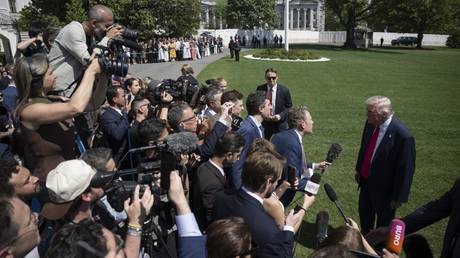
Security details do not improvise. When a former president faces explicit, state-sponsored assassination plots from a foreign power, every movement becomes a calculated exercise in operational security. Recent reports alleging that Donald Trump used journalists as physical decoys to evade Iranian threat vectors missed the fundamental mechanics of how high-threat protection details actually operate. The reality of modern counter-assassination protocols is far more clinical, systematic, and detached from theatrical distractions than public narratives suggest.
Intelligence agencies and protective services do not treat human lives as expendable shields. They build redundancies, compartmentalization, and deception operations into movement matrices to ensure principal survival. To understand what actually happened during these high-security transfers, we have to look past sensationalized media framing and examine the cold mathematics of threat mitigation.
The Anatomy of a High Threat Protective Detail
When the intelligence community confirms an active transnational assassination plot—such as the verified threats emanating from Tehran against American political figures—the operational baseline shifts instantly. Threat levels move from standard executive protection to maximum-tier counter-surveillance operations. Every variable is scrutinized. Every transit route is sanitized.
The United States Secret Service, alongside specialized military and intelligence assets, relies on strict protocols to minimize exposure windows. In these environments, operational security dictates that predictability equals vulnerability. If a hostile intelligence service or its proxy network can map a target's routine, the window for an attack opens wide.
Decoys are not a novel invention. They are a staple of statecraft and executive defense, dating back centuries. However, modern decoy tactics do not involve placing civilian journalists in the line of fire as unwitting human shields. That framing misunderstands the legal, ethical, and mechanical constraints under which federal protection details operate.
Instead, protective details use convoy choreography and electronic signature manipulation. Multiple identical vehicles, staggered departure times, decoy motorcades, and communications blackouts are standard operating procedure. If observers or hostile spotters lose track of which vehicle holds the principal, the protective detail has succeeded in its primary objective: disrupting the kill chain.
How Iran Threatens American Leadership
The animosity between Tehran and Washington did not begin yesterday. Since the 2020 strike that eliminated Islamic Revolutionary Guard Corps commander Qasem Soleimani, Iranian leadership has repeatedly vowed vengeance against American officials involved in the operation. Donald Trump sits at the very top of that targeted roster.
Federal law enforcement agencies have disrupted multiple plots on US soil tied to Iranian operatives attempting to hire local criminal elements for targeted killings. These are not phantom concerns. They are documented federal indictments involving foreign surveillance, encrypted communications, and substantial financial wire transfers.
When a threat originates from a sophisticated nation-state actor, protection details must account for advanced capabilities. We are talking about signals intelligence, persistent drone surveillance, and human intelligence networks capable of tracking local movements.
Against this backdrop, the margin for error disappears. A protective detail cannot rely solely on armor and firepower. They must rely on deception, speed, and information control.
Deconstructing the Decoy Narrative
The claim that journalists were exploited as decoys gained traction because it combined two sensational elements: a high-profile political figure and the shadowy world of intelligence tradecraft. Yet, seasoned security analysts know that mixing media personnel into a high-threat convoy violates core protection doctrines.
Journalists embedded with a campaign or a high-profile figure operate under accredited press pools. Their movements are tracked, scheduled, and coordinated. Purposefully steering media transport into an active ambush zone to act as a diversion would trigger catastrophic legal liabilities and professional fallout within federal command structures.
What likely occurred was a byproduct of compressed security staging. When a high-threat movement is initiated, press pools and motorcades often depart from adjacent zones or share secure perimeters to maintain efficiency. In a tightly controlled environment where every vehicle must move rapidly to clear a vulnerable static location, proximity can be misinterpreted as tactical integration.
Furthermore, the mechanics of a decoy operation require exact replication. A press van does not resemble an armored Suburban or a designated tactical transport. Hostile spotters looking for a specific target profile would easily distinguish a media vehicle from a principal transport.
The Technological Reality of Modern Surveillance
To grasp why physical decoys are largely obsolete, one must look at how modern intelligence works. Physical sightlines are secondary to electronic footprints.
A target emits a constant stream of digital data. Smartphones, encrypted communication devices, and even modern vehicle telemetry systems broadcast signals that can be intercepted or tracked. Counter-surveillance teams spend more time managing electronic signatures than they do worrying about visual spotters on street corners.
If a protective detail wants to obscure a movement, they manage devices, not bodies. They use burner equipment, alter electronic emissions, and execute sudden route changes based on real-time counter-surveillance feeds.
The idea that a journalist served as a physical decoy implies a primitive, analog approach to security that modern federal agencies simply do not practice. Precision engineering, secure communications, and multi-layered intelligence feeds dictate the rhythm of high-level protection.
The Broader Implications for Political Security
As geopolitical tensions remain volatile, the security paradigm for American leaders has permanently shifted. We have entered an era where domestic political figures require wartime-level security protocols during peacetime domestic events.
This creates immense logistical strain. The Secret Service faces well-documented resource constraints, budgetary pressures, and personnel fatigue. When agents must constantly recalibrate their posture against foreign state actors, the margin for error shrinks across the board.
The public debate should not focus on theatrical misunderstandings of convoy movements. It should focus on the unprecedented reality that former American presidents must campaign under the shadow of foreign assassination threats. That is the actual story. Everything else is noise.
Protective details will continue to adapt. They will use every tool in the playbook to ensure principals survive hostile environments. They will do so quietly, efficiently, and without the need for amateur theatrics. The system remains pressurized, and the threats show no sign of receding.