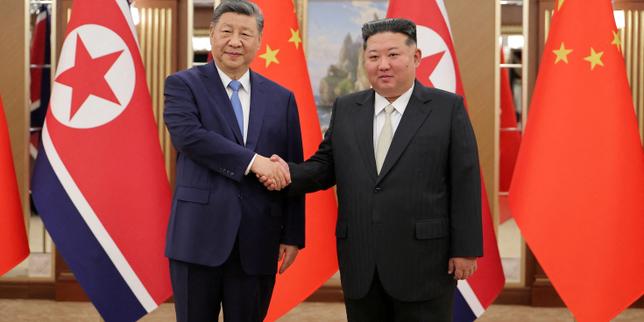
Chinese President Xi Jinping has landed in Pyongyang for his first state visit to North Korea since 2019, a highly calculated move designed to disrupt a booming military alliance between Kim Jong Un and Vladimir Putin. While public statements focus on trade, tourism, and mutual defense, the real agenda is defensive. Beijing is terrified of losing its exclusive grip on its northern buffer state. For decades, China operated as North Korea's sole economic lifeline, controlling over 90 percent of its trade. That leverage is evaporating as Moscow steps in with advanced military hardware in exchange for North Korean ammunition.
The Moscow Problem Upending Beijing's Buffer Zone
The optics in Pyongyang were flawless. Standard military bands, meticulously organized crowds waving plastic flowers, and a 21-gun salute greeted Xi and his wife, Peng Liyuan. Yet behind the orchestrated pageantry lies deep anxiety in the Chinese Communist Party.
Ever since the invasion of Ukraine, the geopolitical dynamics of Northeast Asia have shifted out of China's favor. Kim Jong Un found a desperate, well-armed partner in Vladimir Putin. Western intelligence reports indicate that Russia bypassed traditional United Nations sanctions by transferring critical technologies to Pyongyang, including components for nuclear submarines and Sukhoi Su-35 fighter jets.
This technological leap changes everything for Beijing. Historically, China preferred a stable but dependent North Korea. A rogue state that is too weak to collapse, but too isolated to defy Beijing, served as the perfect buffer against US forces stationed in South Korea. By providing Kim with an alternative patron, Moscow has shattered that dependency. Kim no longer has to beg Beijing for fuel and food; he can trade artillery shells directly for Russian military secrets.
The Limits of the Economic Lifeline
China tried to assert its economic dominance through sheer volume. In 2025, bilateral trade between Beijing and Pyongyang climbed to $2.8 billion, a 26 percent jump from the previous year. Customs data from April 2026 alone showed monthly trade figures hitting their highest levels since 2017.
But money cannot buy the kind of leverage it used to.
- Diminishing Returns on Aid: Food and consumer goods keep the North Korean population compliant, but they do not help Kim achieve his ultimate goal of a survivable, modern nuclear triad.
- The Sanctions Trap: Beijing remains wary of secondary US sanctions. Chinese banks cannot openly clear illegal transactions without risking access to the global financial system, limiting how far Xi can go to match Russia's illicit support.
- A Shift in Patronage: Moscow operates under so many Western sanctions that it has nothing left to lose. Putin can violate UN Security Council resolutions with impunity, offering Kim the exact military upgrades Beijing always withheld to avoid provoking Washington.
This creates a paradox for Chinese foreign policy. The more Russia builds up North Korea's military capabilities, the more Washington, Tokyo, and Seoul tighten their own trilateral security alliance. Japan and South Korea are rapidly expanding their military spending and intelligence sharing. This encirclement directly threatens China's broader ambitions in the East and South China Seas. Xi is in Pyongyang to clean up a mess generated by his own strategic partner in Moscow.
The Trump Factor and the Mediation Gambit
Xi's sudden trip to Pyongyang follows back-to-back summits in Beijing where he hosted both Vladimir Putin and US President Donald Trump. This sequencing is not accidental. Xi is positioning himself as the ultimate geopolitical power broker, attempting to sell a diplomatic alternative that Moscow cannot provide.
Russia wants a perpetually aggressive North Korea to distract American attention from Europe. China, conversely, wants predictability. By establishing a direct line between the recent Beijing-Washington talks and his current meetings with Kim, Xi is quietly offering Pyongyang a structured path toward diplomatic normalization and sanctions relief through US negotiations. It is a subtle message to Kim: Russia can give you weapons, but only China can broker a deal that ensures the long-term survival of your regime without triggering a catastrophic war.
This approach faces significant resistance from Pyongyang. Just twenty-four hours before Xi's visit was officially announced, North Korean state media pointedly broadcast images of Kim inspecting a high-capacity weapons-grade nuclear material facility. The timing was an explicit warning to the incoming Chinese delegation. Pyongyang has no intention of discussing denuclearization, regardless of how much economic aid Xi brings to the table.
The Redefined Alliance
The summit coincided with the build-up to the 65th anniversary of the 1961 Treaty of Friendship, Cooperation, and Mutual Assistance. This remains China's only formal mutual defense treaty with any nation. Yet the definition of "friendship" has fundamentally changed.
Xi offered a four-point plan during the meetings, focusing heavily on low-risk cooperation: tourism, education, agricultural construction, and healthcare. Notably absent from the public readouts was any mention of joint military exercises or advanced technology transfers. Beijing is trying to rebuild its influence on the cheap, relying on institutional ties and traditional trade while avoiding the legal and military risks that Moscow embraces.
It is a strategy built on shaky ground. Kim Jong Un has already demonstrated that his allegiance belongs to whoever offers the highest bid for his military assets. For decades, analysts viewed the relationship between Beijing and Pyongyang as one of ideological solidarity, often described as being as close as "lips and teeth." Today, that relationship looks entirely transactional. Xi Jinping is discovering that a nuclear-armed neighbor with an alternative superpower patron is exceptionally difficult to manage. The Pyongyang summit is not a victory lap for Chinese diplomacy; it is an urgent damage-control mission.