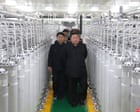
North Korea has constructed a major new uranium enrichment facility at its primary Yongbyon nuclear complex, a development confirmed by the International Atomic Energy Agency that significantly accelerates Pyongyang's weapons-grade material output. Open-source satellite intelligence and state media imagery analyzed by international watchdogs indicate the two-story building can house up to 28 centrifuge cascades. This expansion scales up annual production of highly enriched uranium by roughly 85 kilograms, pushing the state closer to its stated goal of rapidly expanding its nuclear warhead inventory.
Satellite surveillance has evolved, but so has the art of industrial concealment. Decades of sanctions were supposed to choke this infrastructure. Instead, they forced an aggressive domestic localization of dual-use manufacturing.
The Mechanics of a Centrifuge Cascade
To understand why this new Yongbyon facility matters, one must look past the bureaucratic language of UN reports and examine the physics of enrichment. A single gas centrifuge is a hollow cylinder spinning at supersonic speeds, separating uranium isotopes by mass. By itself, it is inefficient. Linked together in series—a configuration known as a cascade—hundreds or thousands of these machines progressively increase the concentration of Uranium-235.
Reaching weapons-grade purity requires passing uranium hexafluoride gas through multiple stages until the fissile concentration exceeds ninety percent. The newly identified building at Yongbyon accommodates twenty-eight of these interconnected lines.
Independent nonproliferation analysts estimate that a layout of this magnitude houses roughly 4,500 individual centrifuges. Operating continuously, this single workshop yields enough material annually for three to four additional nuclear warheads. Multiply that output across concurrent expansions at secondary sites like Kangson, and the cumulative national output begins to compound exponentially.
How State Media Exposed the Site
Intelligence agencies no longer rely solely on secretive human sources or fuzzy overhead shots. Sometimes, the clearest window into a clandestine weapons program comes from the target's own public relations apparatus.
When state media published photographs of leader Kim Jong Un inspecting a newly minted nuclear material production plant, technical analysts immediately went to work. The background details in those photographs proved invaluable. By matching interior structural columns, ceiling heights, and equipment footprints with commercial satellite data gathered during the building's construction phase between late 2024 and mid-2025, outside experts geolocated and classified the facility with high confidence.
It is a curious paradox of modern authoritarian statecraft. To project domestic strength and motivate the local populace, the regime must publicize its technological achievements. In doing so, it hands foreign intelligence analysts the exact blueprints of its industrial scaling.
Yet, knowing where a plant is located and what it looks like inside does little to stop its operation. IAEA inspectors have been barred from North Korean soil since 2009. International monitoring is a remote-control affair, dependent on photons captured by orbiting satellites and algorithms parsing pixel shifts.
The Limits of Deterrence and Sanctions
Decades of global policy toward Pyongyang's nuclear ambitions have rested on a foundational premise that economic isolation would eventually force a strategic compromise. That premise is broken.
Sanctions compliance has eroded significantly. Geopolitical realignments have provided North Korea with crucial economic lifelines and technological exchanges, insulating the regime from the full weight of international isolation. When a state secures alternative revenue streams and bilateral military cooperation, the coercive power of a trade embargo evaporates.
The expansion at Yongbyon is not an isolated tactical maneuver. It is part of a structural overhaul designed to make dismantling the nuclear program technically impossible through conventional diplomatic leverage. Even if a future negotiation framework managed to freeze activity at Yongbyon, secondary decentralized facilities operating in the shadows would maintain the pipeline.
We are moving past the era where a single plutonium reactor defined the threat. Plutonium production requires visible, heavy-water infrastructure that leaves distinct thermal signatures. Uranium enrichment is inherently more insidious. Centrifuges can be hidden in ordinary-looking industrial footprints, tucked into mountain redoubts, or buried deep beneath reinforced concrete.
The discovery of this second enrichment building at Yongbyon confirms that Pyongyang is diversifying its risk. By spreading production across multiple geography-independent nodes, the regime ensures that a hypothetical pre-emptive strike or targeted sabotage campaign cannot easily neutralize its enrichment capacity.
Intelligence analysts are left playing a perpetual game of catch-up. Every time commercial imagery reveals a new roof or a freshly paved access road, the baseline calculations for regional security have to be rewritten. The infrastructure of annihilation grows quietly, brick by brick, spin by calibrated spin.


