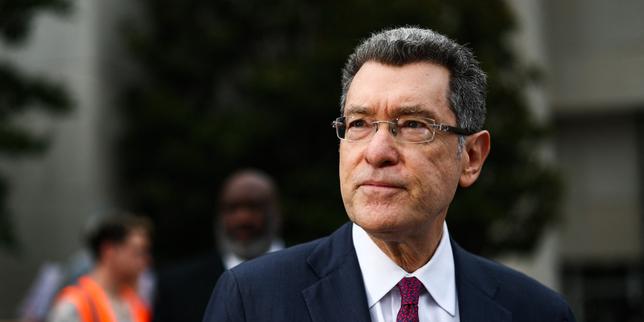
Norman Eisen has spent the better part of a decade turning federal courtrooms into the primary firewall against executive overreach in the United States. While political pundits focus on cable news sparring and congressional gridlock, Eisen and a network of constitutional litigators have built a rapid-response legal infrastructure designed to stall, dismantle, and reverse controversial executive actions before they permanently alter American governance. His central thesis is blunt. Lawyers, operating through injunction motions, ethics complaints, and subpoena battles, have functioned as the frontline defense of the American republic.
The story of how a former ethics czar became the most persistent legal adversary of Donald Trump is not a tale of partisan cable-news theater. It is a study in institutional warfare. When executive orders fly out of the Oval Office at breakneck speed, the traditional legislative check often moves too slowly to matter. Courts move on filings, standing, and statutory authority. Eisen understood early on that opposing a populist administration required abandoning polite Washington norms in favor of relentless, multi-front litigation.
The Architecture of Rapid-Response Litigation
Most observers view lawsuits against the federal government as slow, grinding affairs that take years to reach the Supreme Court. Eisen helped pioneer a different model. By combining nonprofit advocacy groups, veteran appellate lawyers, and former government insiders, his network treats litigation like an emergency room triage unit.
When an executive action drops, teams dissect its statutory foundation within hours. They look for violations of the Administrative Procedure Act (APA), a 1946 federal statute that requires agencies to follow strict procedural rules and provide reasoned explanations before changing policy. Time and again, administrations eager to deliver immediate campaign promises cut corners on the APA. Eisen’s teams exploit those shortcuts with surgical precision.
Consider the mechanics of a temporary restraining order (TRO) or a preliminary injunction. If plaintiffs can prove that an executive order causes immediate, irreparable harm and is likely to fail on its legal merits, a single federal district judge can freeze the policy nationwide before it takes effect. This procedural weapon became the defining feature of legal resistance during the first Trump term and returned as an immediate battleground when Trump retook the White House.
Why Standing Matters More Than Outrage
Public outrage carries zero weight in a federal courtroom. To bring a case, a plaintiff must establish Article III standing, proving they have suffered a concrete, particularized injury directly traceable to the government's action.
Eisen’s organizations, including Citizens for Responsibility and Ethics in Washington (CREW) and later State Democracy Defenders Fund, spent enormous energy identifying the exact right plaintiffs. A taxpayer offended by a policy cannot sue. A business losing revenue due to a specific regulatory shift, a state attorney general facing administrative costs, or a civil servant unlawfully stripped of statutory protections can. Finding those plaintiffs quickly is half the battle.
From "Mr. No" to Constitutional Litigator
To understand Eisen’s tactical mindset, you have to look at his tenure in the Obama White House. Serving as Special Counsel to the President for Ethics and Government Reform from 2009 to 2011, he earned the nickname "Mr. No" inside the West Wing. His job was to enforce strict lobbying bans, vet appointees, and police conflicts of interest before scandals could erupt.
That background gave him an encyclopedic familiarity with the obscure statutes governing executive branch conduct. When Donald Trump entered the White House in 2017 without divesting from his global business empire, Eisen immediately spotted an opening that many mainstream constitutional scholars initially dismissed as unenforceable.
The Emoluments Clauses of the U.S. Constitution—specifically the Foreign Emoluments Clause in Article I, Section 9, and the Domestic Emoluments Clause in Article II, Section 1—had rarely been litigated in over two centuries. Eisen and a team of constitutional scholars dusted them off, arguing that foreign and state governments booking rooms at the Trump International Hotel in Washington constituted unconstitutional payments to the president.
Those emoluments lawsuits never reached a final judgment on the merits; the Supreme Court eventually dismissed them as moot after Trump left office in January 2021. Critics pointed to that outcome as proof that the strategy was overreach. Eisen viewed it differently. For nearly four years, those cases forced the administration onto the defensive, generated relentless judicial scrutiny, and established legal theories that remain active ammunition in modern ethics litigation.
The Impeachment Playbook and Institutional Memory
Eisen’s role shifted from outside litigator to inside prosecutor in 2019, when the House Judiciary Committee hired him as special counsel during Trump’s first impeachment. Working alongside Barry Berke, Eisen helped draft the articles of impeachment and manage the evidentiary record surrounding the pressure campaign on Ukraine.
That experience exposed a critical vulnerability in how Congress checks the executive branch. Legislative subpoenas are easily stalled in court for months or years, running out the clock on a two-year congressional term. When an administration refuses to cooperate, the House of Representatives lacks an efficient, self-executing enforcement mechanism.
Recognizing that bottleneck, Eisen pivoted back to the private and nonprofit sectors after the impeachment trials. If Congress could not move fast enough to enforce accountability, private litigants, state prosecutors, and civil rights groups would have to carry the load. He co-founded the States United Democracy Center to protect election administration and later launched State Democracy Defenders Action to coordinate legal defenses for targeted officials, journalists, and civil servants.
The Civil Service as a Constitutional Buffer
One of the most intense legal battlegrounds involves the federal workforce itself. Efforts to reclassify tens of thousands of career civil servants into political appointees—commonly known as Schedule F—strike at the heart of the modern administrative state.
Eisen’s legal network views civil service protections not as bureaucratic red tape, but as a structural check against authoritarian consolidation. Career scientists, intelligence analysts, and Justice Department attorneys take an oath to the Constitution, not to an individual president. Stripping their job protections allows a White House to purge independent voices and replace them with loyalists willing to execute legally dubious orders. Litigating against those reclassifications requires deep dives into the Civil Service Reform Act of 1978, turning mundane employment law into a frontline constitutional fight.
The Counter-Argument Is Lawfare Corroding the Judiciary?
A serious analysis of Eisen’s career cannot ignore the fierce counter-argument mounted by conservatives, legal realists, and even some moderate institutionalists. Critics argue that the relentless wave of litigation led by figures like Eisen amounts to "lawfare"—the weaponization of the courts to achieve political victories that Democrats failed to win at the ballot box.
There is substance to this critique. When nearly every major policy initiative of an elected president is immediately met with dozens of lawsuits filed in carefully selected judicial districts, the boundary between law and politics blurs. Critics point to judge-shopping—filing suits in specific divisions where a sympathetic judge is virtually guaranteed to hear the case—as a practice that undermines public faith in an impartial judiciary. Both progressive and conservative litigators engage in this tactic, creating a tit-for-tat cycle where national policy swings wildly based on which district court issued the latest injunction.
Furthermore, over-reliance on the courts carries a distinct political hazard. It encourages voters and lawmakers to treat judges as ultimate political arbiters rather than interpreters of law. When legal challenges fail, or when a conservative Supreme Court overturns lower-court injunctions, the public backlash lands squarely on the judiciary itself, eroding the institutional legitimacy that Eisen claims to defend.
The Limits of the Courtroom Shield
Even within pro-democracy circles, strategists acknowledge that litigation is a delaying tactic, not a permanent cure. A court can strike down an unlawful executive order, force an agency to redo a regulatory review, or block an improper appointment. A court cannot manufacture a political consensus, pass durable legislation, or persuade voters.
If an administration is willing to push the boundaries of compliance—testing how slowly it can obey a judicial order without triggering contempt proceedings—the power of the courts reaches its limit. Alexander Hamilton famously noted in Federalist No. 78 that the judiciary holds neither the sword nor the purse, relying entirely on the executive branch to enforce its judgments. Eisen’s entire strategy rests on the assumption that institutional norms remain strong enough that the executive branch will ultimately respect a final court order.
How the Legal Resistance Operates Behind the Scenes
To understand why Eisen’s network remains effective despite these structural limits, you have to look at its operational discipline. Unlike traditional law firms that bill by the hour and operate in silos, the coalition Eisen helps orchestrate functions as an open-source intelligence and litigation hub.
- Pre-drafted Complaints: Legal teams do not wait for an executive order to be signed before writing briefs. Based on campaign speeches, transition memos, and policy blueprints, lawyers draft complaints months in advance, leaving blanks only for the final date and executive order number.
- Coalition Coordination: Rather than filing twenty disorganized lawsuits that muddy the legal waters, groups coordinate behind the scenes to decide which plaintiffs have the strongest standing and which legal theories have the best chance of surviving appellate review.
- Public Narrative Integration: Eisen understands that judicial decisions do not happen in a vacuum. Every major filing is paired with clear, accessible public explanations aimed at journalists and legal commentators, ensuring that complex procedural victories translate into public understanding.
This model turns legal defense into an active, anticipatory discipline. When the government acts, the response is immediate, coordinated, and grounded in months of preparation.
The Reality of the Long Game
Norman Eisen’s assertion that lawyers have saved the republic thus far is both a rallying cry and a warning. The legal system has absorbed tremendous shockwaves over the past decade, bending under the weight of unprecedented constitutional stress tests without completely snapping. Injunctions have halted abrupt policy shifts, courts have rejected baseless election challenges, and career officials have found backing when pressured to bend the law.
Yet a firewall is only designed to slow a fire down until reinforcements arrive. Litigation buys time. It forces transparency through discovery, compels the government to justify its actions on the record, and preserves the status quo while the broader political system decides its direction. Whether that time is used to rebuild durable democratic norms or simply consumed by the next cycle of partisan escalation remains an open question that no courtroom brief can answer.