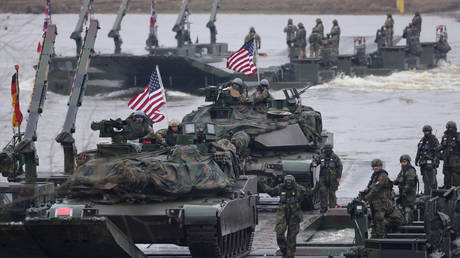
The Pentagon has abruptly canceled the scheduled deployment of 4,000 U.S. Army troops to Poland, slashing American combat power in the country by nearly half. The decision, executed via a quiet Department of Defense memo, ordered the 2nd Armored Brigade Combat Team, 1st Cavalry Division—the storied "Black Jack" brigade out of Fort Hood, Texas—to halt its transit into Europe immediately. Advanced teams already on the ground in Poland have been ordered back to the United States, leaving heavy armor and military hardware stranded mid-transit.
While the administration frames this as a routine operational realignment, the reality on the ground points to a fractured transatlantic alliance and severe domestic budget constraints.
By pulling back the brigade, Washington is drawing down its force posture in Europe to pre-2022 levels. The decision follows a previous announcement to withdraw 5,000 troops from Germany, creating a massive vacuum on NATO's eastern flank. On paper, officials claim this is the result of a comprehensive review of theater requirements. Behind closed doors, the cancelation is driven by political fallout from the ongoing war in Iran and a staggering multi-billion-dollar deficit in the U.S. Army's operational budget.
The Invisible Budget Bleed
The Pentagon cannot afford its current global footprint. Congress is facing a quiet but catastrophic reality. The U.S. Army is currently staring down an operational budget shortfall estimated between $4 billion and $6 billion. Extended domestic missions have drained coffers. National Guard deployments to Washington, D.C., and continuous operations along the U.S.-Mexico border have burned through reserve funds originally earmarked for overseas deterrence.
Military operations require ready cash. When a single tank brigade prepares for a nine-month rotation, the logistical tail costs hundreds of millions of dollars before the main body of troops even boards a transport plane. By freezing the Black Jack brigade at its home station, the Pentagon claws back instant cash. It is a desperate accounting maneuver masquerading as strategic foresight.
Lawmakers on Capitol Hill are furious. Senior members of the House and Senate Armed Services Committees have publicly stated they were completely blindsided by the decision. The Pentagon failed to notify Congress before issuing the stop-movement order, a move that potentially violates the National Defense Authorization Act. Last year, bipartisan majorities passed strict legal reporting requirements to prevent the administration from dropping troop levels in Europe below 76,000 without formal consultation. The Pentagon chose to bypass those safeguards entirely.
The Transatlantic Spat Over Iran
The operational drawdown cannot be decoupled from the raw political friction between Washington and its European allies. The White House has grown increasingly hostile toward traditional European partners over their refusal to participate in the U.S. military campaign against Iran.
President Donald Trump has repeatedly lambasted NATO members for wanting American security guarantees on the eastern flank while offering zero support for American priorities in the Middle East. Germany has been the primary target of this anger. When German Chancellor Friedrich Merz criticized Washington's handling of the Iran conflict, the administration retaliated by announcing the pullout of 5,000 troops from German bases.
Poland was supposed to be the exception. The Polish government has consistently spent over 4% of its GDP on defense, far exceeding the NATO baseline. Warsaw has positioned itself as Washington's most reliable partner in Europe. Yet, this sudden cancellation shows that even compliance does not guarantee immunity from Washington's transactional foreign policy.
Warsaw Caught Off Guard
Publicly, Polish officials are scrambling to project total confidence. Polish Prime Minister Donald Tusk and Defense Minister Władysław Kosiniak-Kamysz have issued statements assuring the public that the bilateral alliance remains durable and that the decision is purely logistical.
Privately, the mood in Warsaw is one of deep betrayal. The Polish Ministry of Defense was not given a heads-up. The advanced echelon of the 1st Cavalry Division was already on Polish soil, preparing the hand-off from the outgoing 3rd Armored Brigade Combat Team. To have a frontline tank formation canceled while its equipment is literally sitting on European docks is an unprecedented logistical embarrassment.
Senior military commanders understand the messaging this sends. An armored brigade is the ultimate expression of American ground combat power. Canceling its deployment sends a clear signal to adversaries that Washington is overextended and willing to sacrifice European deterrence to plug financial and political holes elsewhere.
The Myth of Smooth Rotations
The Pentagon's official stance is that rotational forces are not central to the alliance's long-term defense plans. They argue that temporary deployments can be scaled up or down based on conditions. This is a flawed premise that ignores the friction of modern warfare.
A rotational defense strategy relies entirely on predictability. Host nations build infrastructure, align logistics, and synchronize training schedules around these specific nine-month windows. When a major combat unit is deleted from the rotation schedule without warning, it breaks the entire chain. Partner forces in the Baltic states and Poland are left with gaps in their defensive exercises and no immediate American armor to fill the void. Canadian and German forces remain on the ground, but they lack the heavy, sustained breakthrough capabilities that a U.S. armored brigade brings to the theater.
The strategic consequences will outlast the current fiscal year. By shrinking the American footprint back to pre-2022 levels, Washington is actively testing Europe's ability to defend itself. If European capitals want a permanent American shield, they will have to fund it themselves or align completely with Washington's global military campaigns. The era of unconditional American deterrence in Europe has come to an end.