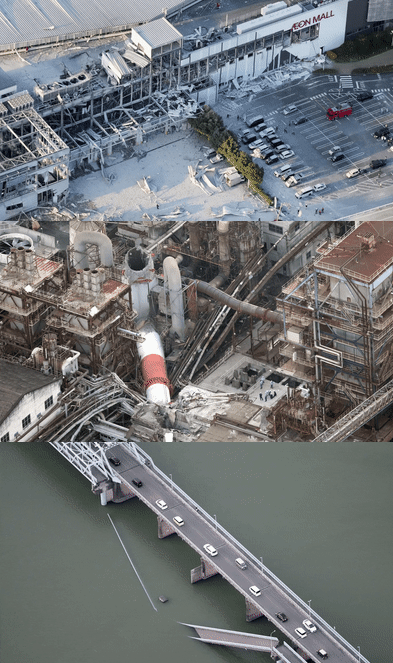
A magnitude 7.1 earthquake struck Japan's Kumamoto Prefecture on Tuesday, triggering a catastrophic structural collapse and secondary explosion at the Aeon Mall in Kashima Town that left multiple people trapped and several feared dead. Emergency services responded to widespread infrastructure failures across the southern island of Kyushu, including severe damage to regional highways, railway suspensions on the Kyushu Shinkansen line, and partial collapses at the historic Kumamoto Castle. As search and rescue teams navigate heavy aftershocks and localized fires, the incident exposes critical questions regarding post-earthquake secondary hazards in commercial mega-structures.
The immediate timeline of the disaster highlights a compounding sequence of events. Following the initial shallow tremor, standard evacuation protocols successfully cleared thousands of shoppers and staff from the complex. Yet, an explosion tore through the second floor shortly afterward, blowing out exterior walls and exposing twisted steel frameworks to the surrounding parking lots. While preliminary government reports pointed toward potential gas leaks induced by ground displacement, forensic investigators have yet to confirm the exact ignition source. Meanwhile, you can explore other stories here: The Long Shadow of Accountability Across Borders.
The Anatomy of Secondary Industrial Failures
Earthquakes rarely act as isolated physical phenomena. Ground acceleration creates stress waves that travel through subterranean utility lines, commercial gas mains, and high-voltage electrical grids. When a shallow inland fault ruptures with a high seismic intensity rating, the secondary threats often outpace the initial kinetic shock.
Commercial complexes of this scale rely on dense networks of internal infrastructure. Piping for commercial kitchens, climate control systems, and localized energy reserves sit in close proximity to load-bearing pillars. When a structure undergoes violent lateral shaking, rigid pipes can shear even if the primary concrete frame holds. To understand the bigger picture, check out the recent analysis by NPR.
This dynamic transforms modern retail spaces into complex hazard zones. The blast at the Kumamoto facility underscores a persistent vulnerability in contemporary urban architecture. Buildings are engineered to withstand primary vertical and horizontal loads during a quake, but the interaction between structural shifting and internal fuel or chemical lines remains a formidable engineering hurdle.
Historical Precedents in the Region
Kumamoto is no stranger to seismic devastation. Exactly a decade prior, a series of destructive tremors struck the same prefecture, causing widespread structural failures and claiming hundreds of lives. That historical context shaped modern regional building codes, pushing local authorities to retrofit public spaces and reinforce historical landmarks like Kumamoto Castle.
Despite these rigorous updates, the sheer energy release of a magnitude 7.1 event pushes infrastructure to its absolute limit. Older structures weathered the blow with varying degrees of resilience, while newer commercial developments faced intense localized stress concentrations. The partial collapse of the regional shopping center demonstrates that even modern facilities face severe risks when ground displacement triggers secondary chemical or thermal reactions.
Emergency Response Under Seismic Duress
Rescue operations face immense friction in the immediate aftermath of a major earthquake. Road networks across Kumamoto Prefecture suffered significant cracking and overpass damage, severely limiting the mobility of first responders. Railway operations ground to a complete halt, and regional airports suspended runway access to check for structural fissures.
Deploying hundreds of Self-Defense Forces personnel into the affected zone requires navigating fragmented communication channels and localized power outages. Mobile network disruptions and downed electrical lines complicate coordination between municipal fire departments and specialized urban search and rescue units. First responders must balance the urgency of extracting trapped individuals from unstable rubble with the constant threat of damaging aftershocks.
The path toward recovery for Kashima Town and the broader Kumamoto region will demand exhaustive forensic analysis of why the secondary blast occurred. As engineering boards review the wreckage of the prefecture's largest retail hub, the lessons learned from this disaster will inevitably rewrite safety standards for commercial architecture across seismically active zones worldwide.


