The John F. Kennedy Center for the Performing Arts is running out of cash, and its handpicked board of trustees insists there is only one cure. Put Donald Trump’s name back on the marble facade, or watch America’s premier cultural institution file for bankruptcy.
That stark ultimatum, surfaced in internal board resolutions and federal court filings, turns a 55-year-old public-private arts model upside down. On paper, the argument looks like a straightforward fundraising pitch. In practice, financial records, court dockets, and congressional oversight documents reveal a far messier reality. The crisis along the Potomac is not the result of a missing nameplate. It is the predictable consequence of a political takeover that gutted ticket revenue, scared off legacy philanthropists, and tied a $257 million federal renovation to a single man's branding demands.
The Anatomy of a Manufactured Ultimatum
To understand how a national monument arrived at the brink of insolvency, look at the timeline of events rather than the press releases.
When Trump installed himself as chairman of the Kennedy Center board in February 2025 and replaced its bipartisan trustees with loyalists, the institution operated on a delicate financial equilibrium. Like most major performing arts centers in the United States, the Kennedy Center relies on a dual-engine budget. Congress appropriates federal funds strictly for building operations, maintenance, and security—a figure sitting at $257 million for capital and facility support. Every single dollar spent on programming, artist fees, the National Symphony Orchestra, and administrative salaries must come from earned ticket revenue and private philanthropy.
That second engine stalled almost immediately.
Following the board's anti-woke programming overhaul, high-profile touring productions and headline performers began pulling out. The producers of Hamilton canceled a scheduled run, setting off a wave of withdrawals across theater, dance, and classical music. By the time the board voted in December 2025 to unilaterally rebrand the venue as the "Donald J. Trump and John F. Kennedy Memorial Center for the Performing Arts," box office receipts were already sliding.
Then came the cliff. Internal budget documents later revealed that putting Trump’s name on the building did not trigger a golden age of conservative philanthropy. Instead, contributed revenue dropped by 25 percent, ticket sales plummeted, and the center fell $100 million short of its revenue projections, staring down a $23 million operating deficit.
What the Financial Ledger Actually Shows
The board's narrative relies on a simple cause-and-effect claim. In resolutions drafted ahead of an emergency September 2026 board meeting, trustees warned of "certain fiscal collapse" within weeks unless the venue closed its main building and secured financial backing from Trump and his donor network. Their condition was explicit. Without "appropriate recognition" on the exterior of the building, they argued, Trump would withhold his fundraising muscle and construction oversight.
| Financial and Operational Metric | Pre-Takeover Baseline | Post-Rebrand Reality (2025–2026) |
|---|---|---|
| Earned Ticket Revenue | Steady sell-outs across Broadway and symphony runs | Missed budget targets by 70 percent |
| Private Philanthropy | Broad bipartisan corporate and individual base | Contributed revenue down 25 percent |
| Operating Balance | Self-sustaining programming budget | Projected $23 million deficit; weeks from insolvency |
| Capital Renovations | Congressionally appropriated maintenance | Frozen by presidential decree pending court appeals |
Numbers do not lie, even when lawyers try to spin them.
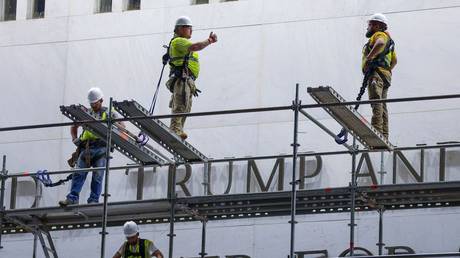
In June 2026, U.S. District Judge Christopher Cooper forced the board to strip Trump’s name from the exterior marble, ruling that only Congress holds the statutory authority to rename a federal memorial established by law. Workers took the lettering down. When the board attempted a workaround—proposing a massive inscription reading "Restored and Renovated by President Donald J. Trump" directly beneath Kennedy's name alongside a newly christened "President Donald J. Trump Plaza"—Judge Cooper blocked that maneuver too, noting pointedly from the bench that "the government plays word games".
The board's response was to declare an immediate financial and structural emergency. Within minutes of Cooper's September 2026 ruling keeping the name off the facade, trustees voted to shutter the main building immediately. Trump followed with a public declaration that the long-planned renovation would not begin unless the D.C. Circuit or the U.S. Supreme Court overturned the naming ban.
The Structural Safety Argument Under Scrutiny
When financial arguments falter in federal court, administrations turn to physical safety. Alongside the bankruptcy warnings, Kennedy Center administrators told the board and the court that the 1971 building had become physically unsafe due to "decades of neglect and deferred maintenance".
Commerce Secretary Howard Lutnick stepped into the fray to bolster the case, arguing that conventional government contracting would push renovation costs to $400 million or $500 million, whereas Trump—acting as de facto construction manager—could complete the job for the appropriated $257 million.
A closer look at the paper trail exposes serious cracks in this safety rationale.
- Consultant Disclaimers: Independent engineering and safety consultants hired to inspect the facility expressly disclaimed reaching the opinion that the building required immediate closure for public safety.
- Whistleblower Revelations: A July 2026 whistleblower complaint filed with Congress detailed how current leadership rushed through shoddy, unpermitted construction work ahead of high-profile political events, creating new hazards that internal staff warned would have to be torn out and redone.
- Procurement Red Flags: A Senate committee investigation uncovered patterns of no-bid contracts and vendor favoritism under the new regime, draining cash reserves while producing substandard repairs.
- Demolition Threats: On the very evening lawyers argued in court that the building needed urgent preservation, photographs surfaced of Trump aboard Air Force One reviewing a poster emblazoned with the words "Kennedy Center DEMOLISHED," prompting Judge Cooper to issue an emergency order requiring 30 days' notice before any demolition work could begin.
You cannot claim to be saving a landmark from structural ruin while simultaneously threatening to cancel its repairs—or flatten it entirely—if you do not get your name carved into the stone.
Governance Conflicts Behind Closed Doors
While the public battle raged over exterior signage, quiet operational shifts inside the building raised equally troubling questions about how the institution is being run.
Richard Grenell, installed by Trump as president of the Kennedy Center in February 2025, took the job for zero salary according to federal tax filings. Three months later, in May 2025, Grenell joined the board of directors of Live Nation Entertainment—the parent company of Ticketmaster—collecting $260,205 in compensation and stock grants during his first year.
Shortly thereafter, the Kennedy Center announced plans to abandon Tessitura, the industry-standard nonprofit ticketing and customer-intelligence platform used by major symphonies and theaters worldwide, in favor of Ticketmaster.
Why the Ticketing Switch Matters
To an outsider, changing a box-office vendor sounds like routine back-office plumbing. To anyone who has ever run a performing arts organization, it is a seismic financial decision.
Nonprofit arts institutions survive on data. Systems like Tessitura allow a venue to track donor behavior, cross-pollinate audiences between the ballet and the symphony, and retain full ownership of patron contact lists without paying exorbitant third-party service fees. Handing ticketing over to a commercial giant like Ticketmaster alters fee structures and shifts leverage away from the venue.
Kennedy Center spokespeople claimed the evaluation began in early 2024 under the previous administration. Former senior ticketing executives directly contradicted that account, stating on the record that Ticketmaster was never under serious consideration and that internal leadership had actively opposed the move. Government ethics experts noted that sitting on Live Nation's board while leading an institution switching its business to Ticketmaster represents a textbook fiduciary conflict.
The Legal Trap of a Living Memorial
The core legal obstacle facing the board is not a technicality. It is written into federal statute.
When Congress passed the John F. Kennedy Center Act in 1964, months after the president's assassination, lawmakers designated the building as the sole national memorial to Kennedy in the nation's capital. Unlike a commercial sports arena or a private university library, naming rights at the Kennedy Center are not an asset the board can sell to the highest bidder, nor can a sitting president bestow them upon himself through a board vote.
Judge Cooper's rulings drew a bright constitutional line. By attempting to tie federal renovation funds and emergency solvency to a naming demand that violates federal law, the board effectively took a public monument hostage.
Meanwhile, the center's independent financial audit for the first year of Trump's chairmanship sat months overdue, leaving lawmakers and the public without a verified accounting of where the remaining cash went. Democratic senators responded by introducing the Stop Executive Renaming for Vanity and Ego (SERVE) Act to explicitly reinforce the ban on naming federal property after sitting presidents.
Who Pays the Price When the Curtain Drops
Strip away the court filings, the political theater, and the branding disputes, and you are left with a stark economic reality. A cultural institution cannot survive by alienating its core audience while failing to replace them with a viable alternative.
Even the board's September 2026 closure resolution acknowledged the collateral damage. Trustees scrambled to carve out exceptions to keep the REACH—the center's modern expansion wing—open, alongside off-site life support for the National Symphony Orchestra, the Kennedy Center Honors, and the Mark Twain Prize. They had little choice. Shutting down every square foot of the complex would have violated the congressional mandate requiring the living memorial to remain open and accessible to the public.
Yet an arts center without stages, without touring companies, and without a functioning main house is a shell. Stagehands, ushers, box-office staff, costume designers, and local hospitality businesses across Foggy Bottom bear the immediate financial brunt of an empty calendar.
Rebuilding trust with artists and subscribers takes decades. Destroying it takes less than two years. Until the board separates the survival of the institution from the vanity of its exterior signage, the Kennedy Center will remain trapped in a crisis of its own making, watching an empty stage while the bills pile up.
For further reporting on the board's emergency closure vote and the federal court rulings blocking the name change, watch WaPo: Kennedy Center warns of bankruptcy unless Trump's name is added back, which breaks down the internal documents warning of imminent insolvency.