The immediate diplomatic finger-pointing between Islamabad and New Delhi following the June 2026 assault on the Sindh Rangers headquarters in Karachi masks a far deeper internal crisis. Pakistan pointed to external sabotage, but the evidence points to a structural failure inside its own borders. Heavily armed militants stormed a high-security military compound in the heart of Pakistan's commercial capital, proving that regional terror networks can penetrate deeply protected assets. India rejected the allegations of involvement, telling Islamabad to look inward. The underlying reality is a rapidly dissolving domestic security matrix that blame-shifting cannot fix.
Behind the political rhetoric lies a complex web of native militancy, shifting border alliances with Afghanistan, and a paramilitary structure struggling to police its own territory. This investigation uncovers the structural flaws that allowed the Karachi attack to happen, why the official proxy narrative is failing under scrutiny, and how domestic political calculations continue to override real security reforms.
The Anatomy of the Karachi Assault
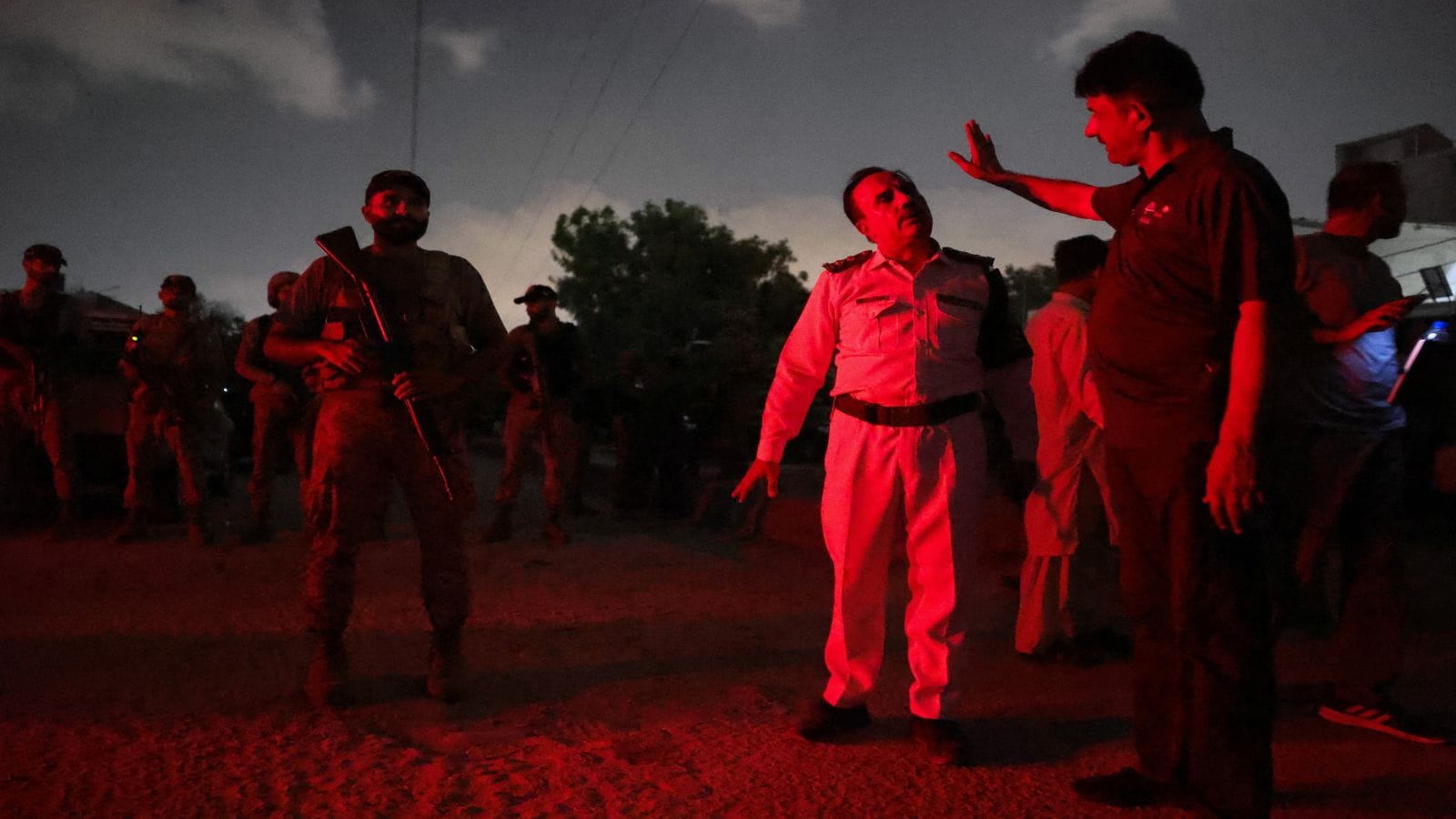
On the evening of Saturday, June 27, 2026, a vehicle packed with explosives rammed through the heavy gates of the Sindh Rangers Bhittai Wing headquarters in the Gulistan-e-Jauhar area of Karachi. The initial detonation shattered surrounding windows and triggered an intense ninety-minute gun battle. Special Security Unit commandos and the Anti-Terrorist Force rushed to reinforce the paramilitary troopers trapped inside.
When the smoke cleared, four Rangers personnel and multiple militants lay dead. Security forces captured one wounded attacker alive, later identifying him as an Afghan national. The responsibility for the assault was claimed by Jamaat-ul-Ahrar, a violent splinter faction of the banned Tehreek-e-Taliban Pakistan, commonly known as the TTP.
The geographical location of the attack exposes severe intelligence deficits. Gulistan-e-Jauhar is not a remote border post. It is a densely populated urban sector surrounded by major educational institutions and civil government infrastructure. For a militant group to transport an explosive-laden vehicle and a team of automatic weapon-wielding fighters into the heart of Karachi requires logistical networks that should have triggered federal counter-terrorism alarms.
The Politics of Instant Accusation
Before local forensic teams could even secure the perimeter of the smoking compound, the political machinery in Islamabad shifted into a familiar gear. Pakistan Interior Minister Mohsin Naqvi and Prime Minister Shehbaz Sharif issued public statements connecting the assault to Indian proxies. They claimed the attack was a deliberate attempt by New Delhi to destabilize Pakistan from within.
This reflexive strategy serves a specific domestic purpose. By framing every internal security failure as an act of foreign aggression, federal authorities redirect public anger away from administrative incompetence. The citizens of Karachi have endured a visible degradation of public safety over the last few years, punctuated by a devastating suicide bombing targeting Chinese engineers near the city's international airport in late 2024. Blaming a foreign intelligence agency offers an easy shield against questions about where tax revenues meant for domestic defense are actually going.
India responded through Ministry of External Affairs spokesperson Randhir Jaiswal, who dismissed the allegations as completely baseless. New Delhi urged Islamabad to focus on dismantling the extensive terror infrastructure operating openly within its own borders rather than relying on geopolitical misdirection. The diplomatic exchange highlights a permanent gridlock that prevents any meaningful binational intelligence sharing on cross-border crime.
Why the Proxy Narrative Fails under Close Scrutiny
Independent security analysts and intelligence veterans find little substance in the official proxy theory regarding this specific operation. The group that claimed the attack, Jamaat-ul-Ahrar, possesses a well-documented ideological and structural history that is deeply rooted in local religious extremism and anti-state militancy.
The organization split from the main body of the TTP a decade ago, reunited briefly, and continues to operate with a clear objective. They want to overthrow the civilian government of Pakistan and replace it with a hardline theological regime. Their primary targets have always been the Pakistani military, the police, and paramilitary groups like the Sindh Rangers.
Attributing this operation to an Indian intelligence operation ignores the logistical reality of how modern militant factions function in South Asia. Jamaat-ul-Ahrar does not need foreign state funding to execute an urban raid. They sustain their operations through extensive local networks built on extortion, protection rackets in Karachi’s sprawling informal economy, and smuggling routes running through Balochistan and the border regions of Afghanistan.
Furthermore, the capture of an Afghan national among the attackers points directly toward a different geopolitical problem. The growing tension between Islamabad and the Taliban leadership in Kabul is the real driver behind the surge in urban violence.
The Growing Rift on the Western Border
The relationship between Pakistan and the Taliban-led administration in Afghanistan has decayed into open hostility. For decades, strategic thinkers in Islamabad believed that a Taliban government in Kabul would provide Pakistan with strategic depth against India. That calculation has proven to be a catastrophic error.
Since returning to power, the Afghan Taliban have consistently refused to crack down on TTP networks operating from Afghan soil. Kabul views the TTP as ideological brothers who assisted them in their war against international coalition forces. They have no intention of alienating these allies to satisfy the security demands of Islamabad.
In response to this refusal, Pakistan has repeatedly conducted cross-border airstrikes into Afghan territory, targeting suspected militant camps. These military actions have achieved little beyond infuriating the Afghan population and provoking retaliatory operations. The presence of an Afghan fighter in the Karachi compound raid suggests that militant networks are finding it increasingly easy to recruit angry, radicalized individuals across the porous western border to launch strikes deep inside Pakistani territory.
The Cost of the Good Terrorist Strategy
To understand why Karachi remains vulnerable to these spectacular breaches, one must examine the historical legacy of the state's security choices. For generations, the internal defense apparatus operated under an unofficial doctrine that separated militant groups into two distinct categories.
There were those groups that targeted regional neighbors like India and Afghanistan, which were quietly tolerated or used as tools of regional influence. Then there were the groups that turned their weapons against the Pakistani state, which were pursued by the military.
This dual approach created a permissive environment where radical ideologies could flourish unchallenged. The infrastructure required to support one type of militant group is virtually identical to what is needed by another. Safe houses, illegal weapon markets, falsified identification documents, and informal financial transfer networks can be utilized by any faction willing to pay.
When the state tried to suppress the anti-Pakistan factions, those groups simply integrated into the broader, pre-existing underground networks. The Karachi attack is the direct result of a security policy that tried to selectively manage extremism instead of completely eradicating it.
Paramilitary Overreach and Urban Policing Failures
The Sindh Rangers have held an outsized role in the administration of Karachi for more than three decades. Originally deployed as a temporary measure to curb rampant political violence and ethnic conflict in the early 1990s, the paramilitary force became a permanent fixture of the city's landscape.
This long-term deployment has severely undermined the development of civilian law enforcement. The local Karachi Police force has been systematically underfunded, starved of modern forensic tools, and subjected to intense political interference. Instead of building a sophisticated, intelligence-driven metropolitan police department, authorities have relied on the heavy-handed, militarized tactics of the Rangers.
Paramilitary forces are trained for combat and border defense, not deep urban counter-terrorism that relies on community trust and neighborhood-level informant networks. Over time, the Rangers have become entangled in the complex civilian administration of Karachi, including real estate management and anti-smuggling operations. This diversion of focus away from core defensive intelligence collection left their own regional headquarters vulnerable to a crude, direct vehicle attack.
The Financial Strangulation of Public Safety
The structural failure of Pakistan's internal security is deeply tied to its ongoing macroeconomic crisis. The federal government remains locked in a cycle of debt repayment and emergency bailouts, leaving minimal fiscal space for long-term institutional modernization.
While the national defense budget consumes a massive portion of federal revenues, the vast majority of that money goes to conventional military capabilities, state-of-the-art hardware, and payroll for a massive standing army. Internal security agencies, border management forces, and provincial counter-terrorism departments receive whatever scraps are left over.
The consequences of this underfunding are visible across the country. Border checkpoints lack automated biometric scanning equipment that could prevent fighters with falsified papers from traveling from the Afghan border to the southern coast. Provincial intelligence services lack the advanced digital monitoring software needed to track militant communications across encrypted messaging applications. Security personnel at major installations are often forced to rely on visual inspections and basic physical barriers that can be easily breached by a speeding vehicle packed with high explosives.
Shifting Focus to Concrete Defensive Architecture
If Pakistan wants to break the cycle of urban vulnerability, federal authorities must abandon the geopolitical theatre that accompanies every domestic tragedy. Accusing external actors might provide a brief reprieve on evening television news broadcasts, but it does nothing to secure the next target.
Real security requires an aggressive reorganization of how internal defense is managed. The civilian police forces must be stripped of political interference and given the primary responsibility for urban intelligence gathering. The Sindh Rangers need to be gradually withdrawn from commercial policing and returned to their primary duty of securing the physical borders.
Furthermore, Islamabad must accept that its policy toward Kabul requires a fundamental overhaul. Relying on military airstrikes inside Afghanistan has not deterred the TTP; it has merely hardened their resolve and expanded their recruitment pool among displaced border populations. A sustainable solution requires a hardheaded diplomatic strategy that forces Kabul to police its own territory through economic leverage and coordinated regional pressure involving other neighboring states.
The attack on the Sindh Rangers headquarters was a stark reminder that internal rot cannot be hidden by pointing fingers across the border. Without a fundamental shift away from selective militancy management and toward structural administrative reform, the commercial heart of Pakistan will remain an open playing field for regional terror networks.