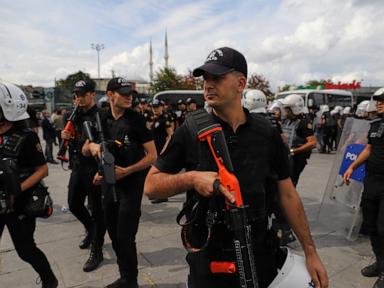
Outside Istanbul's sprawling Caglayan courthouse, a heavy police cordon lines the perimeter, waiting for a spark. When a group of demonstrators attempts to unfurl a banner declaring that human existence cannot be criminalized, the response is immediate and absolute. Officers move in with plastic handcuffs and riot shields, sweeping up more than 150 people in a matter of minutes. This confrontation was not an isolated clash of tempers, but rather the visible summit of an escalating state campaign targeting LGBTQ+ organizations, activists, and civil society advocates across Turkey. While same-sex relations remain technically legal under the country's penal code, the legal architecture surrounding public expression, association, and digital communication is undergoing a profound transformation. Understanding why this crackdown has intensified requires looking past the immediate police reports and examining the complex intersection of domestic politics, economic strain, and shifting legal definitions.
The Boiling Point at Caglayan Courthouse
The events at the courthouse unfolded after authorities initiated a series of sweeping raids against prominent advocacy groups. Offices were searched, websites restricted, and organizers detained under broad accusations that included obscenity, prostitution, and infractions against the strict statutory framework governing public associations. For international observers, the arrests signaled an alarming escalation in the restriction of basic freedoms of assembly and expression. Yet, domestic political dynamics tell a story of calculated strategy. As public frustration mounts over persistent economic pressures and cost-of-living challenges, governments frequently turn to cultural flashpoints to consolidate political backing. By framing human rights advocacy as a foreign-backed threat to public order and traditional social structures, state officials create a polarized environment where dissent is easily conflated with subversion.
To comprehend the mechanics of this pressure, one must examine how the state utilizes bureaucratic and administrative instruments. Turkey has designated specific multi-year initiatives centered on strengthening domestic family structures, responding directly to declining birth rates and shifting demographic trends. Within this framework, political rhetoric increasingly positions independent civil society movements as hostile entities working against national values. Organizations that historically operated with relative autonomy find themselves subjected to continuous financial audits, sudden administrative closures, and relentless scrutiny under laws ostensibly designed to protect public morality. The dissolution requests filed against multiple rights groups in recent months demonstrate that the government is utilizing every available statutory tool to systematically dismantle the organizational infrastructure of the community.
Shifting Political Calculations and the Family Narrative
The deployment of these legal tools relies heavily on ambiguous statutory definitions. Because the penal code does not criminalize individual orientation, authorities must rely on peripheral statutes to restrict visibility and activism. Obscenity provisions and regulations concerning public decency are interpreted with expansive latitude, allowing prosecutors to target educational workshops, art exhibitions, and peaceful assemblies. When activists attempt to hold press conferences or public gatherings to contest these measures, police interventions are justified under emergency security protocols and laws governing public demonstrations. This creates a circular legal trap where peaceful protest is banned for security reasons, and the act of protesting despite the ban is then used to validate further restrictions.
The reaction from international bodies has been swift but largely contained within diplomatic channels. European Union officials and global human rights organizations have repeatedly expressed deep concern over the erosion of civil liberties in candidate countries. Amnesty International and hundreds of civil society groups from dozens of nations have issued formal appeals demanding the immediate release of detainees and an end to the criminalization of advocacy. However, domestic authorities have largely brushed aside external criticism, framing it as an unwarranted interference in national sovereignty. Justice Ministry officials continue to defend the actions of law enforcement, insisting that the measures are necessary to safeguard public order and protect younger generations from harmful cultural influences.
Meanwhile, the local opposition and independent legal networks face a daunting challenge. Opposition political parties have condemned the mass arrests, arguing that a state operating under the rule of law cannot arbitrarily silence citizens who gather peacefully to voice grievances. Yet, the political cost of defending minority rights in a deeply conservative and polarized society is high. Populist narratives often succeed in framing rights advocacy not as a struggle for equal protection under the law, but as a direct assault on traditional customs. This dynamic leaves civil society organizations navigating an increasingly narrow corridor between state repression and public apathy.
Legal Mechanisms of Pressure
The financial and operational toll on these groups cannot be overstated. Beyond the immediate trauma of detentions and police scuffles, organizations face asset freezes, frozen bank accounts, and the exhaustion of legal defense funds. Many activists now operate under the constant threat of sudden raids, forcing them to adopt clandestine communication methods reminiscent of periods of much harsher political repression. The loss of physical spaces where community members could access legal counseling, psychological support, and safe social interaction creates a chilling effect that extends far beyond the major urban centers of Istanbul and Ankara.
At the same time, the state-backed narrative gains momentum through sympathetic media channels that amplify warnings about moral decay and foreign influence. This media ecosystem plays a crucial role in manufacturing consent for harsh policing methods. By portraying independent organizations as subversive cells receiving foreign grants to destabilize traditional institutions, official messaging turns public anxiety into compliance. Consequently, ordinary citizens who might otherwise remain indifferent to cultural debates are nudged into supporting restrictive government policies under the guise of national security.
The resilience of the activist community, however, continues to confound state planners. Despite the constant threat of arrest, individuals continue to find new ways to document abuses, share legal resources, and maintain international solidarity networks. Digital platforms, while heavily monitored and frequently censored, serve as vital arteries for disseminating information that traditional media outlets refuse to touch. When physical spaces are closed down, meetings migrate to private apartments, encrypted chat groups, and university campuses where student solidarity groups have increasingly become the backbone of modern resistance.
The Broader Regional Implications
Looking at the broader trajectory of civil liberties in the region, the situation in Turkey serves as a bellwether for how authoritarian governance adapts to modern advocacy. Traditional censorship methods relying on outright bans have given way to sophisticated administrative strangulation, where organizations are slowly starved of resources and buried under mountain loads of bureaucratic infractions. This approach allows the state to maintain a thin veneer of legal compliance while systematically eliminating effective opposition. The courtroom steps of Caglayan remain a focal point not simply because of the specific protesters detained there, but because they represent the front line in a much larger struggle over who gets to define the boundaries of public life in a changing nation.
As these pressures mount, the question facing civil society is no longer whether they can push back against specific discriminatory policies, but whether they can preserve the institutional memory and operational capacity needed to survive a prolonged period of political winter. The arrests of autumn set a grim precedent, signaling that dissent will be met with the full weight of the security apparatus. Yet, every time the authorities attempt to sweep the streets clean of opposition, they inadvertently draw fresh international scrutiny and force a new generation of citizens to confront the uncomfortable realities of their political system. The vans depart for the holding facilities, the sirens fade into the Istanbul traffic, but the underlying tensions remain entirely unresolved.