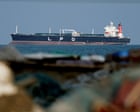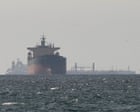
The British government is quietly preparing a deployment of autonomous mine-hunting drones to the Strait of Hormuz. This maneuver is not just a tactical response to Iranian sea mines; it is a desperate attempt to satisfy a volatile White House while avoiding a shooting war that the Royal Navy is currently ill-equipped to fight.
As of March 15, 2026, the global energy market is paralyzed. Oil has breached $100 per barrel for the first time in years. The reason is simple: one-fifth of the world’s oil supply is trapped behind a 21-mile-wide chokepoint that Tehran has turned into a digital and kinetic graveyard. While President Donald Trump uses Truth Social to demand that allies send "Ships to the area," Downing Street is looking for a middle path that doesn't involve putting a billion-pound destroyer in the crosshairs of Iranian shore-based missiles.
The Invisible Blockade
The "artificial constraint" Trump describes is actually a sophisticated layer of asymmetric threats. Iran has reportedly seeded the strait with approximately a dozen smart mines. These are not the rusty spheres of the 20th century. Modern naval mines are acoustic and magnetic; they wait for a specific engine signature before detonating.
The Royal Navy’s problem is that its traditional minesweeping fleet is effectively dead. HMS Middleton, the last dedicated mine-hunter in the region, was recently forced to return to the UK because it was no longer seaworthy. This leaves a massive capability gap at the exact moment the world needs it closed.
Enter the drones. The plan involves deploying autonomous underwater vehicles (AUVs) and "uncrewed surface vessels" (USVs) that mimic the acoustic profile of a massive tanker. By tricking the mines into detonating against a cheap, remote-controlled hull rather than a $200 million crude carrier, the UK hopes to "bleed" the minefields dry without the political fallout of a sunk warship.
Whitehall’s Calculated Risk
Foreign Secretary Ed Miliband and Prime Minister Keir Starmer are walking a razor's edge. Complying with Washington’s demand for a full naval task force risks "decapitating" what remains of British-Iranian diplomacy and potentially inviting direct strikes on UK assets.
The drones offer a convenient exit strategy.
- Plausible Deniability: A lost drone is a technical failure; a lost ship is an act of war.
- Technological Leverage: The UK recently purchased 20 K3 Scout Medium USVs from Kraken Technology Group. These vessels are low-signature, travel at 55 knots, and can be outfitted with "Octopus" counter-drone systems originally designed for the Ukrainian front.
- Cost of Failure: If a drone fails to find a mine, the oil stays stuck. If a drone is captured by the Islamic Revolutionary Guard Corps (IRGC), it provides Tehran with a propaganda victory but no British prisoners.
The Ministry of Defence (MoD) is particularly sensitive about its depleted state. Internal figures show that spending on counter-drone systems fell by nearly 20% between 2021 and 2024. The number of active mine-hunting ships has plummeted from 16 to just seven. In this context, "sending the drones" isn't just about innovation—it’s about a lack of alternatives.
The Asymmetric Math
Iran’s strategy does not require total naval dominance. It only requires a "risk perception" high enough to make insurance premiums impossible. Currently, more than 150 tankers are sitting idle outside the Gulf. Shipowners are refusing to move until a clear "safe lane" is established.
The US Navy has already claimed to have destroyed 16 Iranian mine-laying vessels, but the mines they already dropped remain in the water. Searching for a 500-pound object in a 21-mile-wide channel is a needle-in-a-haystack operation.
Current Strategic Deployments
| Asset | Origin | Status |
|---|---|---|
| HMS Dragon | UK | En route to Cyprus / Middle East |
| USS Abraham Lincoln | USA | Stationed in Arabian Sea |
| Charles de Gaulle | France | Near Cyprus (Defensive Escort) |
| Autonomous AUVs | UK | Proposal Stage for Hormuz |
The IRGC knows the math. A naval mine costing $15,000 can cause $100 million in damage and trigger a global price hike that costs Western economies billions. This is the definition of asymmetric warfare.
The Trump Factor and the French Pivot
While London hesitates, Paris has taken a different route. President Emmanuel Macron has pledged 10 additional warships, including the aircraft carrier Charles de Gaulle, but has explicitly stated their mission is "purely defensive." This creates a fragmented coalition. You have the Americans wanting to "bomb the hell out of the shoreline" and the Europeans trying to act as heavily armed crossing guards.
The UK’s decision to lead with drones rather than hulls puts them at odds with the Trump administration's "strength through presence" doctrine. However, the technical reality is that a destroyer like HMS Dragon is designed to fight airplanes and missiles, not to find small, silent explosives tethered to the sea floor.
The Vulnerability of Global Supply
The stakes extend beyond the gas pump. About 80 million tonnes of LNG pass through this strait annually. Major Asian economies like South Korea, Japan, and India are already negotiating their own "safe passage" deals with Tehran, effectively bypassing the Western coalition. India, for instance, has managed to get two LPG tankers through by leveraging its neutral status.
This fragmentation is exactly what Iran wants. By forcing individual nations to choose between supporting a US-led military opening or negotiating for their own energy security, Tehran is breaking the unified front.
The British drone deployment is intended to provide a technical solution to a political problem. By using "Project Beehive" technology to clear the lanes, the UK can claim it is contributing to global security without explicitly joining an offensive campaign that many in the MoD fear will lead to a broader regional conflagration.
The real question is whether the drones can work fast enough. Minesweeping is notoriously slow. It is a methodical, grinding process. In a world where the price of oil is jumping $2 every time a social media post goes live, "methodical" might not be an option.
We are watching the first major conflict where the "Ghost Fleet"—unmanned, autonomous, and expendable—is being used not just as a tool of war, but as a tool of high-stakes diplomacy. If the drones fail to clear the path, the next step isn't more technology; it's the very escalation Whitehall is trying so desperately to avoid.
Would you like me to analyze the specific technical capabilities of the K3 Scout USVs being deployed?