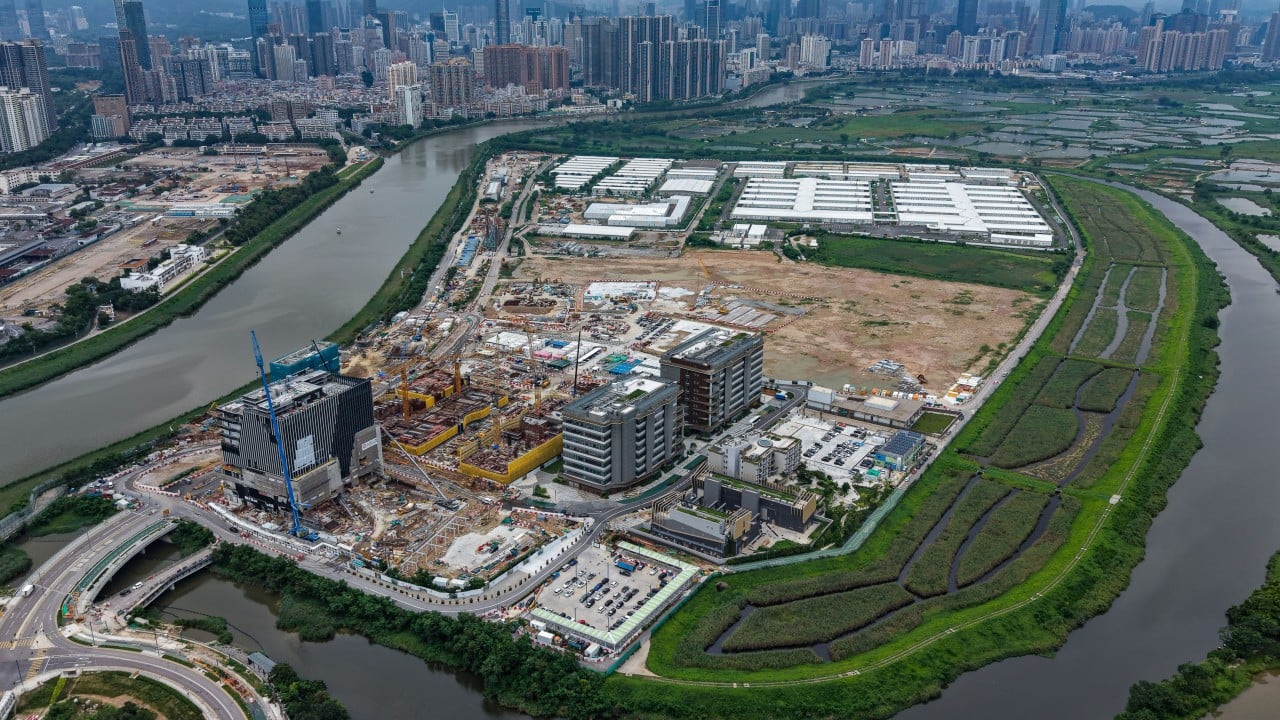
Hong Kong is betting its economic future on a massive spatial transformation and technological pivot, using artificial intelligence and the Northern Metropolis development blueprint as cornerstones for its inaugural five-year plan. Business chambers and financial leaders are rallying around this strategy, arguing that the city must tightly integrate its traditional strengths with deep tech to secure its long-term viability. Yet beneath the optimistic policy announcements lies a grueling operational reality. Transforming a swath of agricultural land and border districts into a high-tech engine requires solving severe structural bottlenecks in computing power, energy consumption, and cross-border data flows.
For decades, the territory relied on a service-oriented economy driven by finance, real estate, and trade. That model is sputtering against mounting geopolitical friction and regional competition. The government’s response is a pivot toward high-end innovation, centering on the 300-square-kilometer Northern Metropolis near the Shenzhen border. Local business associations, including the Chinese General Chamber of Commerce, have pushed for aggressive policy execution, noting that the upcoming economic blueprint must bridge the gap between abstract innovation goals and ground-level commercial application. Meanwhile, you can read similar stories here: The Broken Economics Behind the Four Billion Dollar Air Force One Debacle.
The core ambition relies on an economic doctrine of mutual empowerment between technology and finance. Artificial intelligence demands vast amounts of capital, high-end talent, and specialized infrastructure. Hong Kong possesses the capital markets and international legal framework, while its immediate neighbor, Shenzhen, provides advanced manufacturing ecosystems and entrepreneurial velocity. Merging these capabilities is the central objective of the new planning cycle.
However, ambition faces a harsh physical constraint: computing power. Artificial intelligence training and deployment consume staggering amounts of electricity and require specialized hardware clusters that take years to build. Historically, the city has struggled with high land costs, expensive electricity, and limited computing infrastructure. Training large language models or running industrial machine learning operations locally has often proven prohibitively expensive compared to rival hubs in mainland China or Southeast Asia. To see the complete picture, we recommend the detailed report by CNBC.
To counter these limitations, planners are betting on projects like the Sandy Ridge Data Facility Cluster. Slated to come online incrementally over the next several years, the facility aims to drastically expand local data center capacity and provide tens of thousands of petaflops of computing power. Yet, supercomputing installations are ravenous consumers of power. Operating these hubs profitably without straining the local power grid requires innovative energy strategies. Officials are looking toward cross-border transmission networks and clean energy imports from the mainland to stabilize electricity costs.
Data governance poses an equally formidable barrier. Artificial intelligence models starve without continuous streams of fresh data. Hong Kong operates under a distinct legal and regulatory framework separate from mainland China, which historically complicated the smooth transfer of cross-border data sets. While initiatives like the Greater Bay Area standard contract provide a legal bridge for personal information flow, enterprise-scale data sharing for industrial machine learning remains heavily regulated. Building a thriving artificial intelligence sector inside the Northern Metropolis requires seamless data pipelines that satisfy stringent security requirements on both sides of the boundary without suffocating research agility.
Talent acquisition presents another critical vulnerability. The city boasts world-class tertiary institutions, but retaining top-tier engineering talent in a hyper-competitive global market is an uphill battle. Global technology firms can offer compensation packages that local startups struggle to match. The proposed Northern Metropolis University Town aims to cluster international research talent and academic institutions, but universities alone do not commercialize products. Turning academic research into market-ready applications requires venture capital appetite and risk tolerance that traditional local investors have historically lacked.
The financial sector must adapt its risk models to support hardware-heavy, long-cycle technology ventures. Traditional lenders in the territory favor tangible real estate collateral over intangible intellectual property or early-stage software pipelines. Business chambers are urging the administration to introduce financial incentives, tax preferences, and co-investment funds to coax conservative capital into deep-tech assets. Without a cultural shift in how local finance evaluates risk, technology parks risk becoming empty real estate projects populated by shell offices rather than dynamic engineering powerhouses.
Regional integration remains the ultimate wild card. If the infrastructure projects proceed on schedule, and if cross-border regulatory sandboxes succeed in harmonizing data and computing resources, the Northern Metropolis could genuinely alter the regional economic geography. The initiative moves past mere urban expansion; it represents an attempt to rewrite Hong Kong's industrial identity from a middleman port into a primary creator of core technologies. Success will not be measured by the square footage of concrete poured or the number of Memorandums of Understanding signed, but by whether functional, globally competitive artificial intelligence enterprises take root in the new industrial zones before regional rivals lock down the market.