Hamas has announced the formal dissolution of its internal Gaza government, a move designed to pass administrative burdens to a United Nations-backed technocratic committee while preserving its underlying military infrastructure. Israel immediately dismissed the announcement as a hollow political stunt designed to evade international pressure to disarm. By stepping back from formal civil administration, the militant group seeks to force the entry of international aid and reconstruction funds without relinquishing its weapon stockpiles or underground tunnel networks. The tactical retreat shifts the geopolitical burden to foreign mediators, leaving the fundamental security deadlock completely unresolved.
A Strategic Bureaucratic Retreat
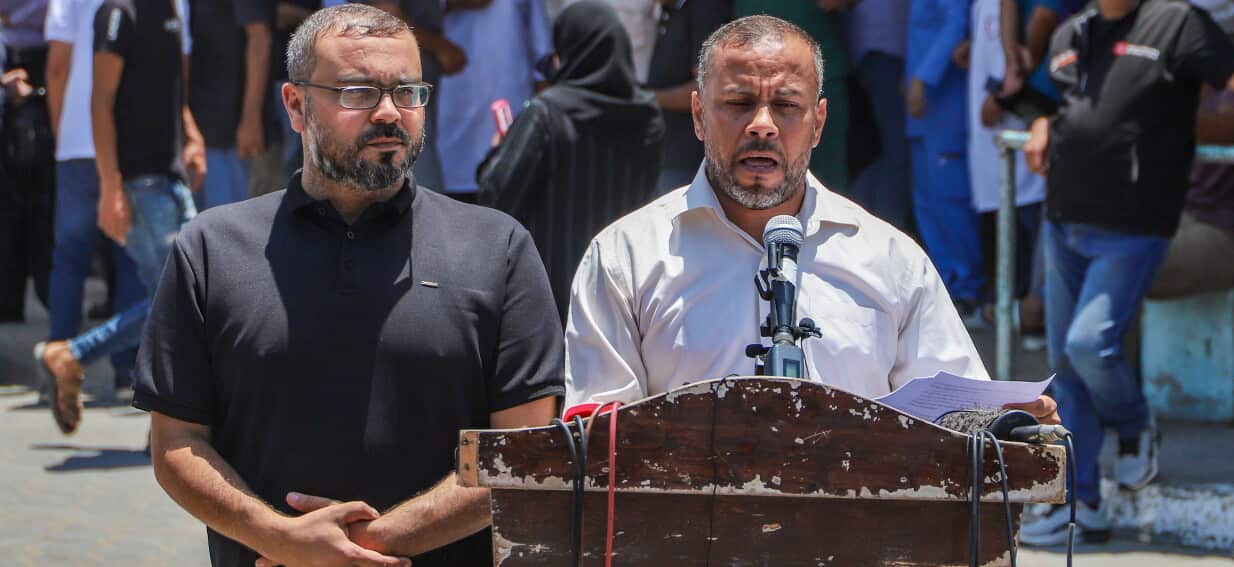
The announcement came from the courtyard of the Al-Aqsa Hospital in Deir al-Balah. Ismail al-Thawabta, the director general of the Hamas-run Government Media Office, declared that the head of the Emergency Committee, Mohammed al-Farra, had submitted his official resignation. This committee had functioned as the de facto executive administration overseeing the ruined cities of the Gaza Strip since the outbreak of the war.
According to Hamas spokesmen, all existing civil servants and municipal workers are now reclassified as public employees ready to operate under the mantle of a neutral authority. The group framing this choice as a major compromise intended to alleviate civilian suffering. Hamas spokesman Hazem Qassem openly stated that the decision was a deliberate effort to remove any excuses for the ongoing blockades, urging international bodies to immediately assume administrative control of the enclave.
This is a classic asymmetric strategy. By transferring the day-to-day misery of managing a destroyed territory to external actors, Hamas aims to preserve its remaining political equity. The local population faces catastrophic infrastructure failures, acute water shortages, and a lack of medical supplies. If an international committee steps in to manage these issues, Hamas unloads the immense logistical liability of governance while maintaining its core cadre of loyalists within the civil service bureaucracy.
The transition remains entirely symbolic until the physical reality on the ground shifts. Bureaucrats cannot fix power grids or distribute food without security guarantees. By maintaining an undeclared grip on local security, Hamas ensures that no new governing entity can make an independent decision without its tacit approval.
The Hezbollah Blueprint in the Mediterranean
Israeli officials wasted no time exposing what they view as a dangerous long-term strategy. Foreign Minister Gideon Sa'ar warned that Hamas is actively pursuing what he termed a Hezbollah model for the Gaza Strip. In this arrangement, a weak, technocratic civilian administration handles the visible, mundane tasks of governance like municipal waste management, water delivery, and public health. Behind this civilian shield, the heavily armed militant wing retains absolute veto power over all strategic, political, and military decisions.
The reality of this setup is visible across the region. When an armed faction maintains a separate military apparatus that dwarfs the official state security forces, the civilian government operates as a hostage. Any attempt by a technocratic body to enforce laws or distribute resources against the wishes of the dominant armed group results in immediate gridlock or violence.
Israeli security analysts argue that accepting this bureaucratic dissolution without verifiable disarmament would validate a massive deception. It would allow foreign donor funds to flow into Gaza to rebuild infrastructure, indirectly subsidizing the militant group by relieving it of any financial responsibility toward the population it rules. Israel maintains that its military operations will continue until the structural capacity of the militant group is fundamentally broken, regardless of whatever administrative changes are declared in Cairo or Gaza.
The Board of Peace and the Disarmament Deadlock
The international community views the situation through a very different lens. The Board of Peace, an international body tasked with executing a comprehensive peace roadmap, responded to the announcement with deep skepticism. The Board stated that its final assessment would be guided strictly by tangible actions rather than public promises.
The crux of the international strategy rests on a strict principle. There must be one authority, one law, and one weapon across the entire territory. This means the proposed National Committee for the Administration of Gaza, led by Gaza-born engineer Ali Shaath, must achieve exclusive control over all security mechanisms and armaments.
Gaza Governance Deadlock: Core Sticking Points
┌───────────────────────────────────────┬───────────────────────────────────────┐
│ Hamas Strategy                        │ Board of Peace / Israel Mandate       │
├───────────────────────────────────────┼───────────────────────────────────────┤
│ Retain underground weapons caches     │ Complete demilitarization             │
│ Maintain internal security dominance  │ Unified security under civilian rule  │
│ Delegate civic liabilities to UN      │ Comprehensive structural authority     │
└───────────────────────────────────────┴───────────────────────────────────────┘
The underlying peace plan requires a phased approach where the civilian administration takes over as Israeli forces execute a gradual withdrawal. However, the transition from the initial ceasefire to the implementation phase has been stuck in neutral for months. Hamas refuses to grant inspectors access to weapons stored in its deep tunnel networks and rejects any requirement to hand over its arsenal to a neutral third party.
The impasse puts international mediators in an impossible position. High representative Nickolay Mladenov emphasized that the sooner an agreement is reached on these implementation provisions, the faster large-scale reconstruction can begin. Yet, without a mechanism to enforce compliance, these statements remain aspirational.
Technocrats in the Crossfire
The civilian face of this planned transition is Ali Shaath, a former Palestinian Authority official who currently operates out of Cairo. Shaath has made it clear that his committee is technically prepared to enter the Gaza Strip and establish an interim administration. However, he has also publicly acknowledged that his team cannot function without a unified security apparatus that is entirely accountable to the civilian authority.
Entering Gaza under the current conditions would be an extraordinary risk for any technocratic group. Without an independent international peacekeeping force or a total security guarantee, these civilian administrators would find themselves caught between residual Israeli military operations and entrenched local armed factions.
Historically, transitional administrations that lack real enforcement mechanisms fail rapidly. If the National Committee for the Administration of Gaza attempts to reallocate resources or dismantle smuggling routes, it will face immediate resistance from the forces that have controlled the territory since 2007. The current workforce in Gaza consists of thousands of employees who have spent nearly two decades operating within an administrative system designed by Hamas. Changing the logo at the top of the stationery does not change the entrenched loyalties of the personnel on the ground.
The current strategy relies on the hope that the sheer weight of civilian suffering will force both sides to compromise. Gaza's Health Ministry reports that tens of thousands of Palestinians have died since the start of the conflict, and the destruction of physical property is nearly total. Hamas is betting that the international community's desire to end this humanitarian crisis will cause it to overlook the group's refusal to disarm. Israel is betting that its continued economic and military pressure will eventually force a total collapse of the militant group's remaining power structure.
The administrative maneuver announced in Deir al-Balah changes the narrative structure of the conflict, but it does not alter the hard math of geopolitical power. A government cannot truly be dissolved when the men with the weapons refuse to step out of the room.