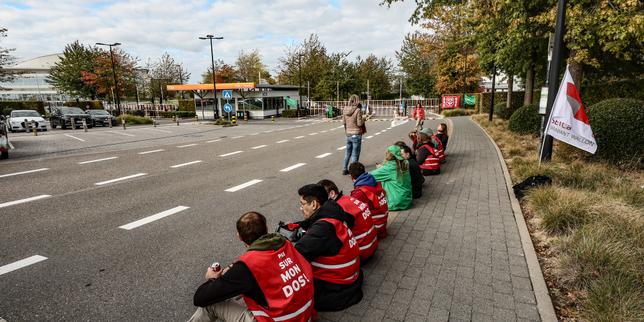
GSK has put up to 1,217 jobs on the chopping block in Wallonia, threatening roughly 15% of its Belgian workforce across Wavre, Rixensart, and Gembloux and triggering the statutory Renault collective redundancy procedure. Announced on October 14, 2026, the plan targets 735 white-collar management or executive staff (cadres) and 482 salaried employees (employés), leaving blue-collar operators (ouvriers) outside the initial cut list.
Headline coverage treats this shock as an abrupt reversal after pandemic-era vaccine highs. After thirty years watching pharmaceutical multinationals rebalance regional footprints, I read that diagnosis differently. What looks like a sudden contraction is a calculated shift in how global drugmakers value white-collar complexity against automated manufacturing, standardized workflows, and shifting vaccine demand.
Why White Collar Bears the Brunt
Most restructuring announcements hit shop-floor assembly lines first. GSK flipped that script.
By concentrating proposed cuts on 735 cadres and 482 employés rather than hourly production workers, management is attacking overhead and coordination layers rather than immediate physical output. In big pharma, layers of project managers, local coordinators, and support specialists accumulate during periods of rapid volume expansion. When global demand cools, those middle tiers become expensive to defend in boardrooms miles away.
Union leaders have called the scale of the plan a social bloodbath, pointing to the human toll across roughly 8,300 to 8,400 Belgian employees. Workers at Wavre and Rixensart staged walkouts and blockades immediately after the announcement, reflecting anger that follows a prior wave of roughly 850 job reductions over three years after the 2020 restructuring.
Yet there is a cold operational logic beneath the outrage. A multinational facing softer structural demand for certain vaccines does not need the same volume of internal governance and administrative routing it built when emergency and post-pandemic supply chains ran hot.
- Management layers: Cadres face the largest numeric hit at 735 threatened roles, signaling a push toward flatter reporting lines.
- Administrative and support staff: 482 employés sit in the crosshairs across R&D, production support, and corporate functions.
- Shop-floor insulation: Blue-collar ouvriers are excluded from the stated reduction scope, even as anxiety spreads across every building.
The Automation and Standardization Gamble
Management says it wants to align industrial capacity with structural shifts in global vaccine demand while leaning harder into digitalization, automation, and more standardized processes. That phrasing is standard corporate shorthand, so look past the buzzwords to the trade-offs.
Standardizing processes across global sites lets a London-headquartered group move decision rights out of regional hubs. Once documentation, batch tracking, and routine analytics are codified into common digital templates, local specialist roles lose their monopoly on institutional memory.
Digitalization trims manual handoffs. It also creates a quieter risk that executives rarely highlight during tense works council negotiations.
Strip out too many experienced employés and cadres at once, and you risk losing the tacit troubleshooting knowledge that keeps complex biological manufacturing running when a line drifts out of spec. Software automates routine checks; it does not replace seasoned judgment when an unusual batch deviation occurs.
GSK has pledged a €300 million annual investment across Wavre, Rixensart, and Gembloux. Capital spending on physical plant and equipment is not the same thing as headcount stability, and unions are right to press management on what that money actually buys for Walloon jobs.
What the Renault Procedure Really Tests
In Belgium, the Renault procedure forces management into a structured information and consultation phase with employee representatives before final layoff decisions and terms are locked in. Unions have pushed for weekly extraordinary works council meetings to scrutinize company justifications and propose alternatives.
Do not mistake consultation for a veto. The law requires genuine engagement, examination of alternatives, and social accompanying measures, not an automatic reversal of corporate strategy.
| Dimension | Management Framing | Union and Regional Pushback |
|---|---|---|
| Core driver | Structural shift in global vaccine demand and cost alignment | Multinational profitability versus heavy social cost on families |
| Target group | Up to 1,217 roles among cadres and employés; ouvriers not targeted | Broad alarm across all ~8,300–8,400 Belgian staff after prior attrition |
| Operating model | Greater standardization, digitalization, and automation | Skepticism toward repeated restructurings and demand for real alternatives |
| Site commitment | Stated €300 million annual investment across three sites | Scrutiny of industrial prospects and ecosystem survival in Wallonia |
Regional leaders have vowed to stand beside affected households and protect Wallonia's biopharmaceutical ecosystem. That commitment faces a hard reality.
Wallonia built one of Europe's premier vaccine and biopharma clusters over decades, anchored by major facilities in Wavre, Rixensart, and Gembloux. Clustering brings world-class talent, specialized suppliers, and academic ties, yet it also leaves local economies exposed when a single anchor employer recalibrates its global footprint.
Consider a hypothetical scenario in which a mid-level regulatory or quality specialist in Wavre sees their local team folded into a centralized European hub. Even if severance and outplacement packages soften the immediate blow, reabsorbing hundreds of specialized white-collar professionals inside a single regional labor market takes time and rarely happens at identical compensation without mobility.
The Gray Area Between Efficiency and Hollowing Out
Every industrial overhaul sits on a razor's edge. Trim redundant layers and you get faster execution; cut too deep into technical and operational coordination and you slow down the very sites meant to anchor future growth.
Watch how the coming works council rounds test three practical questions:
- Whether voluntary departures, natural attrition, or redeployment can shrink the 1,217 figure below the proposed ceiling.
- How management defines the boundary between standardized support roles and critical R&D or quality functions needed to sustain Wavre, Rixensart, and Gembloux.
- What concrete milestones attach to the promised €300 million annual investment so it strengthens local capability rather than merely subsidizing remote consolidation.
A company can survive a painful white-collar reset and emerge leaner. A region only stays competitive if the high-skill brains that solve complex problems remain close to the plants that make the medicine.



