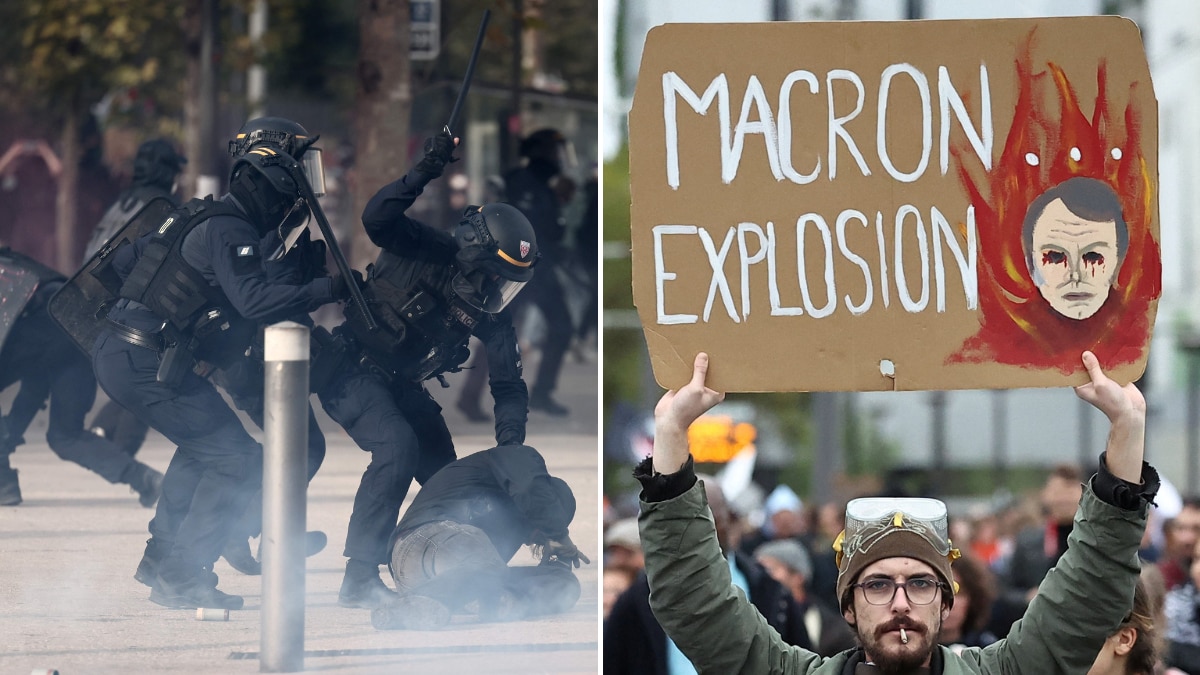
France is burning again, and this time the smoke is thickening faster than the Élysée Palace can contain it. With 135 protesters already in handcuffs and labor unions issuing an explicit ultimatum to Emmanuel Macron to capitulate before a massive nationwide strike on November 5, the latest wave of France protests signals more than routine street theater. It marks a structural collision between an uncompromising executive branch and a population pushed past its financial breaking point.
Surface-level coverage treats these arrests as isolated flare-ups of French street culture. That is a mistake. When riot police deploy tear gas in Paris, Lyon, and Marseille before the primary general strike has even begun, you are watching a pressure cooker lose its safety valve. The November 5 mobilization is not merely another day of picket lines and delayed commuter trains; it is a coordinated chokehold aimed at paralyzing refineries, transit networks, and public infrastructure until the government blinks.
The Anatomy of a Pre-Strike Crackdown
To understand why 135 people were detained ahead of the main event, you have to look at how French protest policing has evolved over the past decade. Historically, riot squads—the CRS and the gendarmes mobiles—maintained a buffer zone, allowing union marshals to police their own marches. Under Macron, that doctrine shifted toward preemptive containment and aggressive dispersal.
Security forces now routinely kettle crowds early, execute preventive identity checks at train stations, and move in at the first sign of autonomous black-bloc agitators. The result is a high arrest count before noon. Authorities point to those 135 detentions as proof of firm law enforcement against property destruction. Union leaders see something entirely different—an effort to intimidate rank-and-file workers out of showing up on November 5.
The tactic cuts both ways. Heavy-handed policing restores temporary order on evening news broadcasts, yet it radicalizes moderate participants who came out simply to protect their purchasing power. When a schoolteacher or a hospital nurse gets caught in a cloud of tear gas next to a radicalized student, the political distance between the union hall and the street vanishes overnight.
Why the November 5 Ultimatum Hits Differently
Unions do not issue public warnings to a sitting president to "give in" unless they believe they hold a decisive logistical advantage. In France, union membership sits at roughly 10 to 11 percent of the workforce—one of the lowest rates in the industrialized world. Critics outside the country often wonder how such a small fraction of workers can bring the seventh-largest economy on earth to a standstill.
The answer lies in strategic chokepoints. French labor federations like the CGT do not need millions of dues-paying members to shut down the country. They only need high concentrations of disciplined workers in four critical sectors:
- Energy and Refining where a walkout by a few hundred specialized operators halts fuel distribution across entire regions within seventy-two hours.
- Rail and Urban Transit where SNCF and RATP strikes prevent millions of white-collar employees from reaching their offices, multiplying the economic damage instantly.
- Ports and Freight where dockworkers block import-export arteries, squeezing supply chains for manufacturers and retailers alike.
- Public Education and Civil Service where school closures force working parents to stay home, creating a secondary wave of absenteeism across the private sector.
When union bosses warn Macron to back down ahead of November 5, they are signaling that these specific levers are ready to be pulled simultaneously. The early arrests have failed to disrupt the organizational backbone of these sectors. If anything, the police crackdown has given rival labor confederations—groups that frequently bicker over ideology and strategy—a common enemy to rally against.
The Fiscal Trap Behind the Rage
Politicians love to frame street unrest as a communication problem. Macron’s allies routinely argue that the public simply does not understand the necessity of budget belt-tightening, pension adjustments, or tax restructurings. Voters understand the math perfectly well. They just reject who is being asked to pay the bill.
For years, the French economic model relied on heavy public spending to cushion households against global shocks. When inflation spiked and energy costs surged, Paris spent tens of billions on tariff shields and subsidies to keep domestic peace. Now the bill has come due. Bond markets and European Union fiscal watchdogs are demanding steep deficit reductions, leaving the government scrambling to plug multi-billion-euro holes in the national budget.
Instead of targeting corporate windfalls or high-net-worth capital gains, the administration’s fiscal adjustments repeatedly land on the backs of wage earners, retirees, and public sector workers. Freezing pension indexations, cutting local municipal budgets, and raising hidden taxes on electricity and transport hit household cash flow immediately.
This is the core fuel behind the France protests. A factory worker in northern France or a nurse in Bordeaux does not care about Brussels deficit thresholds. They care that groceries cost twenty percent more than they did three years ago while their real wages remain stagnant. Telling them to tighten their belts while corporate dividends hit record highs in Paris is not a policy pitch; it is a provocation.
Macron’s Shrinking Margin for Maneuver
In previous crises, Emmanuel Macron survived by outlasting the street. During the Yellow Vests revolt of 2018 and 2019, he absorbed months of Saturday riots, launched a nationwide listening tour, and eventually bought peace with ten billion euros in emergency concessions. During the 2023 pension battle, he bypassed a hostile parliament altogether by invoking Article 49.3 of the French Constitution, forcing the bill through without a final vote and daring the opposition to topple him.
Neither playbook works today.
First, the treasury is empty. Macron cannot write a ten-billion-euro check to pacify the November 5 strikers without triggering a sovereign debt crisis and a downgrade from credit rating agencies. The financial cushion that saved his first term no longer exists.
Second, his parliamentary armor is shattered. Following the snap legislative elections that left the National Assembly fractured into three mutually hostile blocs—a weakened centrist alliance, a resurgent left-wing coalition, and a dominant far-right bloc—the government governs on borrowed time. Every major budget vote carries the existential threat of a successful no-confidence motion. If Macron uses constitutional strong-arm tactics to ram through unpopular austerity measures while hundreds of thousands of workers are marching in the streets, opposition parties on both ends of the spectrum have every incentive to unite and bring the cabinet down.
The Counter-Argument Nobody Wants to Hear
Strip away the tear gas and the union rhetoric, and an uncomfortable reality remains. France’s public spending—hovering near 57 percent of GDP—is the highest in the developed world. The country runs persistent structural deficits, and its national debt has climbed past 110 percent of economic output.
Economists who back the government’s hard line point out a cold mathematical truth. You cannot fund a generous cradle-to-grave welfare state indefinitely on borrowed money when interest rates are no longer near zero. Debt service alone is rapidly becoming one of the largest line items in the French state budget, crowding out investments in schools, hospitals, and green energy.
From this perspective, giving in to the November 5 strike demands is a recipe for long-term national decline. If Paris abandons fiscal discipline every time unions threaten to block a refinery, bond yields will rise, borrowing costs will spiral, and the International Monetary Fund or European Central Bank will eventually impose far harsher austerity than anything Macron is proposing today.
Both sides are trapped in a zero-sum logic. The unions are fighting to defend a social contract that households can no longer afford to lose. The government is trying to balance a ledger that the country can no longer afford to ignore.
How Street Escalation Reshapes the Political Board
History shows that French street movements rarely win outright policy reversals on their first punch. More often, they succeed by eroding a president’s political capital until his own allies begin to defect.
Watch the fault lines inside the governing coalition as November 5 approaches. Centrist lawmakers who represent working-class or rural districts are already nervous about facing voters in future elections while carrying the baggage of unpopular austerity measures and images of mass arrests. When police detain 135 protesters before the main strike even starts, it creates visual ammunition for political rivals on both the left and the right.
Marine Le Pen’s National Rally and Jean-Luc Mélenchon’s France Unbowed share almost nothing in terms of governance philosophy, yet both benefit directly from the chaos. The far left gains legitimacy by standing shoulder-to-shoulder with striking unionists on the picket lines. The far right positions itself as the quiet champion of forgotten, law-abiding workers crushed by Parisian elites and disorder. Every broken storefront and every baton charge feeds their respective narratives while hollowing out the political center that Macron built in 2017.
What Happens When the Ultimatum Expires
If the government refuses to offer concrete concessions on wages, taxes, or budget cuts before November 5, the confrontation will shift from a political dispute to a test of physical endurance.
A successful general strike in France operates like a slow-motion siege. Day one brings massive marches and transit chaos. Day three brings empty fuel pumps and shuttered factories. By day seven, garbage piles up on city sidewalks and supply chain bottlenecks begin costing the economy hundreds of millions of euros per day. At that point, business leaders—traditionally Macron’s most loyal constituency—start quietly telephoning ministers to demand a settlement before quarterly earnings are wiped out.
Conversely, if the November 5 turnout falls flat and commuters find ways to work around the transit disruptions, the momentum flips instantly. The Élysée will claim a silent majority backs fiscal responsibility, isolate the union leadership as out-of-touch obstructionists, and press ahead with its agenda.
Right now, the early arrest numbers suggest the street is angry, organized, and unwilling to wait politely for parliamentary debates. Macron has spent seven years betting that French voters will eventually accept hard economic medicine if it is administered with enough resolve. On November 5, the unions are betting they can shut down the patient before the dose is delivered.