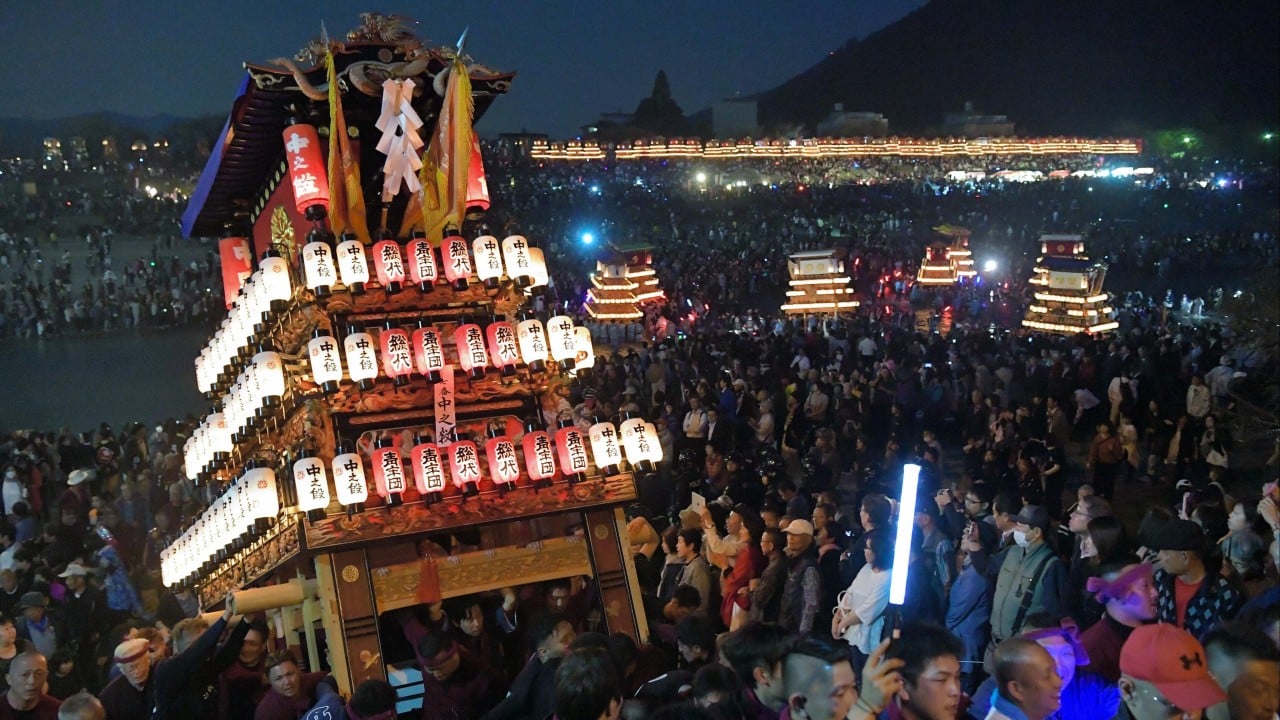
Fatal crush accidents involving giant festival floats in Japan expose a collision between centuries-old street tradition, municipal prestige, and modern crowd mechanics. When a deputy mayor is killed beneath a multi-ton danjiri or yama float, the immediate headlines focus on tragedy and grief. Yet anyone who has covered regional civic life in Japan for decades knows the deeper story usually sits inside town hall agendas, unwritten hierarchy rules, and the physics of moving several tons of timber and steel through narrow, sloped streets lined with thousands of spectators.
Competitor coverage of a single fatal incident tends to treat the event as an isolated freak accident. That framing misses the structural pattern. Across prefectures from Osaka and Hyogo to Nagano and Kyoto, festival floats are not static monuments. They are heavy, kinetic machines steered by human muscle, rope tension, and wooden wedges, often operating without brakes or modern engineering certification. Discover more on a similar subject: this related article.
Why Officials Stand in the Danger Zone
Municipal leaders in rural and suburban Japanese towns face a quiet, relentless pressure to show up. Festivals are not mere calendar entries; they are expressions of local identity, tourism marketing, and civic solidarity. A deputy mayor or mayor who skips a major neighborhood procession risks looking detached from the electorate and from the community associations that anchor local politics.
Standing near a massive float carries status. In traditional processions, proximity signals participation rather than passive observation. Yet officials rarely train as pullers, steersmen, or wedge operators. A seasoned municipal bureaucrat understands budgets, zoning, and welfare policy, not how several tons of oak and iron react when a front wheel drops into a drainage grate or catches an uneven patch of asphalt. Additional journalism by The New York Times highlights comparable perspectives on the subject.
Consider a hypothetical example to see how routine civic duty turns hazardous. Imagine a mid-sized town hosting an autumn procession where a deputy mayor walks alongside the front steering section to greet neighborhood elders and project municipal support. The street angles downward slightly toward a narrow intersection, and hundreds of spectators press close to the curb. If the steering crew loses leverage for even two seconds, the momentum of heavy timber can overwhelm the people guiding it. Anyone standing in that lateral or forward path has almost no margin for error.
The Physics Behind Multi-Ton Street Traditions
Giant festival floats vary widely by region, from the fast, cornering danjiri carts of southern Osaka to tall, tiered floats that tower over rooftops and utility lines. What they share is sheer mass concentrated on relatively small wheels or rollers, paired with human-powered steering.
Stopping or redirecting several tons on a gradient is fundamentally different from moving a light cart. Momentum builds quietly. A crew of dozens or hundreds can pull a float forward with impressive speed on a straightaway, yet decelerating on a decline requires coordinated braking ropes, wooden chocks, and split-second communication that breaks down easily in noise, adrenaline, and alcohol.
Steering Without Modern Margin
Many traditional floats rely on manual leverage at the front axle or heavy ropes to pivot around tight corners. High-speed turns—famous in certain regions for dramatic sharp angles—push the center of gravity outward. Even slower, deliberate turns create pinch points where a float swings wide toward walls, utility poles, or pedestrians.
Road surfaces add another variable that gets too little scrutiny. Decades ago, many procession routes were dirt or packed gravel where wheels dug in slightly and moved at a crawl. Modern paved streets with crown slopes, manhole covers, storm drains, and painted crosswalks alter friction dramatically. A wheel slipping on wet paint or catching a sunken drain cover can jerk the tongue or frame with violent force.
Crowd Density and Bottlenecks
A fatal crush rarely happens in an open plaza. It happens where width narrows and spectators compress. Narrow lanes between buildings trap both the float and the people watching it. When spectators surge forward for a better photograph or step onto the roadway to wave at familiar faces, buffer zones vanish.
Crowd control at local festivals often leans heavily on volunteers, neighborhood youth groups, and part-time marshals rather than large contingents of specialized event staff. Volunteers know their neighbors, which can make enforcement polite and informal. Politeness is a virtue in daily civic life, yet it can delay telling someone to step back three feet from a multi-ton timber frame.
Tradition Versus Municipal Liability
After a fatality involving a public official or a civic-backed event, municipal governments confront an uncomfortable tension. Local assemblies and residents often insist that tradition must go on, arguing that centuries of heritage should not be dismantled because of one tragic day. At the same time, legal liability, insurance underwriting, and public safety scrutiny demand documented risk management.
Safety rules written in Tokyo or a prefectural capital frequently collide with customs guarded fiercely at the ward or chonaikai level. A safety manual might call for wider clearances, strict alcohol bans during operation, engineered braking systems, or spotters with clear sightlines. On the ground, changing a traditional position or restricting who walks near the front can be viewed as disrespecting custom or diminishing the spectacle.
The Politics of Safety Reforms
Town officials walk a tightrope. Push too hard for sweeping rule changes, and you face accusations of killing local culture or overreacting to a rare event. Do too little, and the municipality looks negligent when an inspection report or civil claim follows.
Even when safety committees are formed after an accident, implementation often stalls at the operational level. A written guideline on paper does not automatically change habits formed over years of participating in the same street route. Without clear authority on the street to halt a procession when conditions deteriorate, rules remain aspirational.
What Competitors Miss in Routine Coverage
Fast-turnaround news reports usually stop at the timeline of the incident, official condolences, and initial police statements. That leaves readers with a sense of shock, but little insight into why these accidents keep recurring across different years and regions.
First, standard reporting often treats crowd crush and vehicle-like crush as the same thing. In a pure pedestrian crush, dense human pressure restricts breathing and movement. When a heavy festival float is involved, blunt mechanical force—pinning a victim against a wall, curb, ground, or structural member—is often the immediate lethal mechanism, compounded by crowd congestion that slows rescue and ambulance access.
Second, coverage rarely examines route geometry in plain terms. Gradients, blind corners, parked vehicles, overhanging wires, and narrow choke points dictate risk far more reliably than speeches about heritage. A route that felt manageable thirty years ago can behave very differently today with denser roadside fixtures, different pavement, and larger spectator crowds.
Third, the role of alcohol in festival culture deserves candid examination without moralizing. Drinking has long been woven into communal celebrations as a social lubricant and marker of festivity. Yet impairment degrades reaction time, spatial judgment, and coordination right around heavy moving equipment. Pretending alcohol has zero effect on crew discipline or crowd behavior protects comfort, not safety.
Practical Fixes That Do Not Erase Heritage
Saving lives does not require erasing cultural identity. Plenty of historical practices around the world have adapted to modern physics while keeping their core character intact. The real question is whether organizers are willing to separate sacred ritual meaning from avoidable physical hazards.
Route Engineering and Buffer Zones
Start with the street itself. Municipalities can map every slope, tight turn, and narrow bottleneck along a procession route and designate non-negotiable clearance zones. Physical or visual markers on the pavement—combined with firm marshals who actually hold the line—keep bystanders out of pinch points.
Ambulance and emergency access lanes are another practical necessity. In tight historic streets, a float stalled or a crowd packed wall-to-wall can delay medical response by critical minutes. Planning clear extraction routes before the first drumbeat is basic operational competence, not an attack on tradition.
Clear Roles and Command Authority
A giant float needs one unambiguous chain of command while moving. Pullers, steersmen, spotters, and officials must know who has the authority to call an immediate stop if a wheel slips, a crowd presses in, or visibility drops. Titles like deputy mayor or honorary guest should never put untrained people in high-risk mechanical zones.
Pre-event briefings sound unglamorous compared to ceremonial attire, yet a ten-minute operational check on steering gear, ropes, braking wedges, and radio or whistle signals prevents confusion when noise peaks. Tradition thrives best when participants come home intact.
Walk the route before the festival begins, measure the tightest pinch point with a tape measure rather than memory, and assign one person with real authority to blow the whistle and stop the float the moment clearance disappears.


