U.S. Immigration and Customs Enforcement has ordered an immediate, nationwide suspension of most vehicle stops by its Enforcement and Removal Operations division. This sudden policy shift follows two fatal officer-involved shootings within six days: the killing of 52-year-old Lorenzo Salgado Araujo in Houston, Texas, and 26-year-old Joan Sebastian Guerrero in Biddeford, Maine. In both instances, the men killed were not the intended targets of the operations. Under intense political pressure and mounting scrutiny over tactical failures, the Department of Homeland Security has paused the practice, exposing systemic flaws in federal immigration enforcement.
The official line from federal authorities frames this suspension as a temporary pause designed to facilitate tactical retraining. Behind the scenes, however, the halt points to a much deeper crisis of authority, credibility, and operational safety.
Blood on the Asphalt in Maine and Texas
On July 7, 2026, Lorenzo Salgado Araujo, a Mexican national, was driving a white van with three other men on their way to work in Houston. Unmarked vehicles belonging to ICE’s Enforcement and Removal Operations (ERO) began trailing them. The agents had been surveilling a nearby property and spotted the van, believing someone inside matched the description of an immigration target.
The stop quickly turned fatal. Federal officials claimed Salgado Araujo ignored commands and "weaponized" his vehicle by attempting to ram an agent. Shots were fired, and Salgado Araujo died on the street. Almost immediately, the official narrative began to unravel. The three passengers in the van, who were subsequently detained, flatly disputed the government’s account. Their attorney, Hugo Balderas-Ibarra, publicly stated that no officer was ever in front of the vehicle or in danger of being struck. The shots, they insisted, came entirely from the sides.
Six days later, a near-identical tragedy played out 1,700 miles away in Biddeford, Maine.
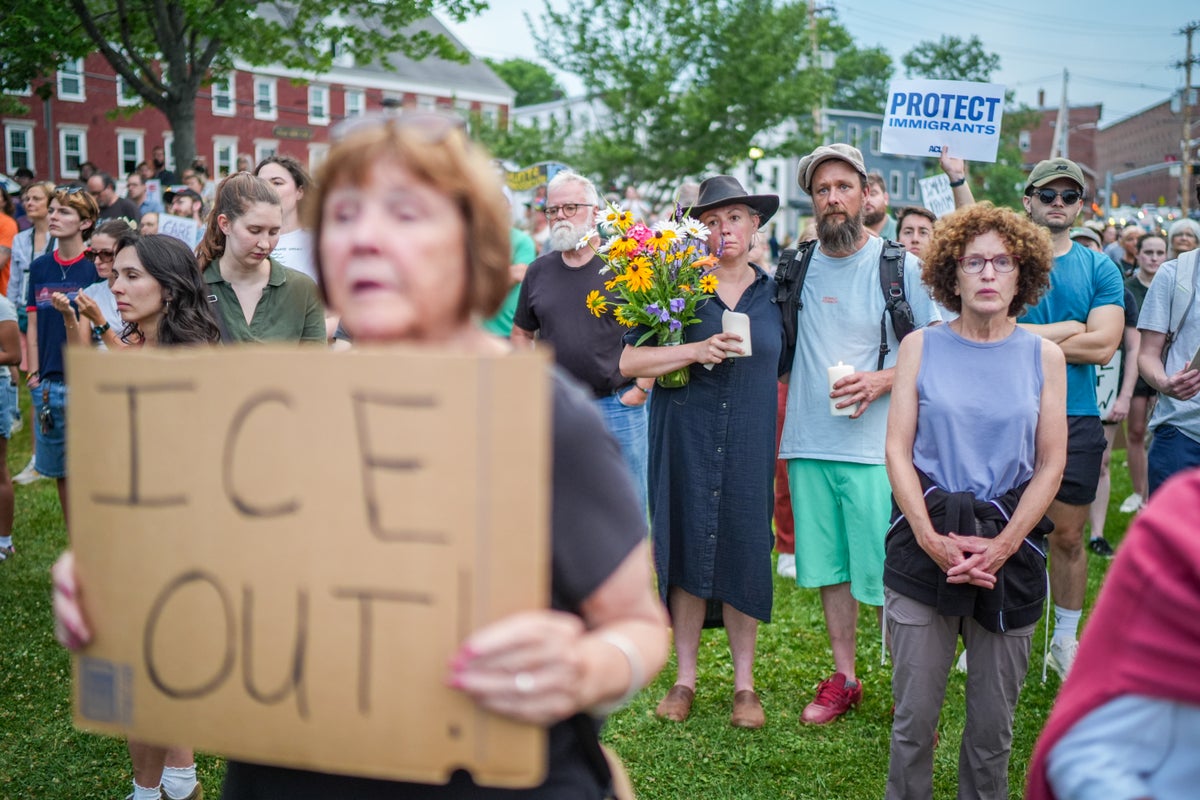
At 7:20 a.m. on Monday, July 13, ERO officers were surveilling a residence linked to an undocumented immigrant with a final order of removal. They watched Joan Sebastian Guerrero, a 26-year-old Colombian national, leave the building and get into a car. Guerrero was not the target of their warrant. When federal agents tried to stop his vehicle, Guerrero allegedly attempted to flee. Claiming to fear for public safety, an officer opened fire. Guerrero died at the scene, leaving behind a wife and a three-year-old daughter.
Two non-targets. Two deaths. One week.
The Weaponized Vehicle Playbook under Fire
The Department of Homeland Security has historically relied on a highly specific defense when vehicle stops turn lethal: the vehicle itself was used as a deadly weapon. This defense serves a vital legal purpose. It satisfies the Supreme Court's standard for the use of deadly force, which requires an officer to possess an objectively reasonable belief of an imminent threat of death or serious physical injury.
By claiming a suspect "weaponized" a sedan or a work van, the agency attempts to insulate its officers from civil and criminal liability.
Yet, this defensive playbook is losing its efficacy under public scrutiny. In the Houston case, local representatives and defense lawyers pointed out that the vehicles present showed no physical signs of a collision or ramming. In past cases across the country, bystander video has repeatedly contradicted federal assertions that officers were about to be run over.
The tactical execution of these stops is fundamentally fraught. Unlike local police officers who are extensively trained in PIT maneuvers and high-risk traffic stops, immigration enforcement officers operate in a grey area. They frequently use unmarked vehicles, wear vests that may not clearly identify them to a panicked driver, and execute stops in busy civilian areas. When an unmarked car cuts off a driver, the natural human reaction is often panic, not compliance. When that driver attempts to maneuver away from what they perceive as an attempted carjacking or assault, agents interpret the movement as active resistance, leading to gunfire.
Unmasked and Unrecorded
One of the most glaring vulnerabilities in ICE's operational integrity is the persistent absence of recording equipment. In both the Houston and Biddeford shootings, the involved ERO officers were not wearing body-worn cameras, nor did their vehicles possess dash-cams.
This lack of transparency has infuriated local officials and civil rights advocates alike. Senator Angus King of Maine expressed deep skepticism regarding the federal government's ability to investigate itself in the absence of objective video evidence.
"The feds don't have the credibility today," King remarked, demanding that state authorities and the FBI handle the investigation rather than leaving it to internal DHS watchdogs.
The systemic resistance to body cameras within ERO is a choice. While municipal police departments nationwide have adopted body cameras as a standard tool for accountability and officer safety, federal immigration units have lagged behind. This creates an information vacuum. In this vacuum, the government’s word is pitted against the accounts of terrified passengers or grieving families—passengers who, in the Houston case, were immediately hustled to a private detention facility and pressured to sign self-removal orders before they could fully testify to local investigators.
The Pressure Cooker of Mass Deportation Quotas
To understand why these tactical errors are happening now, one must look at the immense political pressure bearing down on the agency. The administration has heavily promoted aggressive enforcement metrics, boasting of thousands of arrests within short spans.
This push for raw numbers incentivizes high-risk, low-yield operations.
When agents are under pressure to execute final orders of removal, they increasingly turn to vehicle stops. Why? Because entering a private home to make an arrest requires either consent or a judicial warrant signed by a judge. Obtaining a judicial warrant requires meeting a high evidentiary standard. Conversely, ICE administrative warrants are signed by ICE officers themselves, not judges. These administrative warrants do not grant agents the legal authority to enter a private residence against the occupant's will.
To circumvent this legal barrier, agents conduct "targeted surveillance" outside homes, waiting for individuals to exit and step into their vehicles. Once the target is on a public street, agents execute a vehicle stop, exploiting a much lower legal threshold for detention.
This workaround is highly efficient for inflating arrest statistics, but it is tactically volatile. It transforms quiet residential streets and busy commuter intersections into active tactical environments. The margin for error is razor-thin. When agents act on loose descriptions or "resemblances," they end up stopping innocent people, and when those stops go wrong, the consequences are permanent.
The temporary suspension of non-urgent vehicle stops is a tactical retreat. It protects the agency from further immediate public relations disasters while it figures out how to manage the political fallout in states like Maine, where even moderate Republican lawmakers like Senator Susan Collins felt compelled to intervene and demand a halt. Training alone will not resolve the underlying contradiction of an agency pressured to deliver historic deportation numbers while relying on aggressive, low-transparency tactics in civilian neighborhoods. Until the systemic drive for volume over precision is addressed, the safety of both the public and the officers themselves remains compromised.