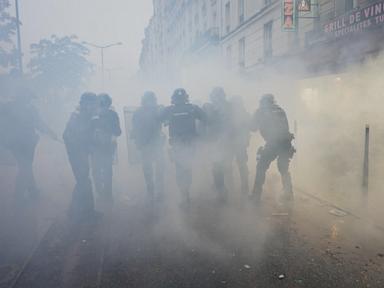
France is entering its third consecutive weekend of street demonstrations, and the mobilization has spilled far beyond the borders of the Fifth Republic into major European capitals. What began as localized pushback against austerity budgets, pension reforms, and stagnant entry-level wages has hardened into a coordinated, youth-led movement across the continent. Unlike previous cycles of European unrest dominated by legacy trade unions and traditional political parties, this wave is decentralized, digitally native, and driven by a demographic facing structural economic exclusion.
If you have covered European street politics long enough, you learn to recognize the standard choreography. Unions call a general strike, transit workers shut down the rail lines, and leadership negotiates a compromise behind closed doors while the rank and file march along a pre-approved route from République to Nation.
That playbook is dead.
The crowds gathering in Paris, Lyon, Madrid, Berlin, and Milan over the past month operate without central committees or recognizable figureheads. They are mostly between 18 and 28 years old. They are not marching to protect existing collective bargaining agreements because most of them have never had a permanent contract to begin with.
The Structural Math Behind the Anger
Mainstream coverage tends to treat these protests as a sudden flare-up of generational frustration or a reaction to a single piece of legislation. That framing misses the balance sheet. Across the Eurozone, young adults have absorbed the cumulative shock of three distinct economic crises within fifteen years, leaving them with a fundamentally broken social contract.
Consider the mechanics of modern European labor markets. Over the past two decades, governments across Southern and Western Europe liberalized hiring rules to combat high headline unemployment. On paper, the policy worked. Youth unemployment numbers dipped in several member states. In practice, policymakers created a two-tier system that trapped an entire generation in precarious work.
A hypothetical example illustrates how this trap functions in daily life. Imagine a 24-year-old university graduate in Lyon or Valencia. Instead of a standard full-time contract with housing stability and pension contributions, she cycles through six-month temporary placements, unpaid or low-paid internships, and gig-economy contracts. Her nominal income looks acceptable in aggregate government statistics, yet she cannot qualify for a standard apartment lease because landlords require permanent employment verification. She spends upwards of 55 percent of her net income on shared housing, leaving zero margin for savings or family formation.
When governments subsequently introduce fiscal tightening—whether through higher transit fares, reduced housing subsidies, or delayed retirement ages that keep older workers in senior roles longer—the reaction is immediate. The state is asking young citizens to fund a welfare architecture they are increasingly convinced will be insolvent before they ever draw from it.
Housing as the Primary Flashpoint
While wages and pension math dominate parliamentary debates, the true accelerant on the street is urban housing costs. Short-term tourist rentals, institutional real estate investment, and chronic underbuilding have turned European city centers into financial assets rather than living spaces.
In cities like Paris, Lisbon, and Barcelona, the gap between median entry-level salaries and average rent has widened to historic extremes. Young workers are pushed to outer suburbs with deteriorating public transit, forcing two-hour daily commutes just to staff the service economies of the urban core. When protests erupt, the targets are rarely random. Demonstrators consistently blockade transit hubs, municipal housing offices, and luxury commercial districts. They are targeting the physical infrastructure of an economy that extracts their labor while pricing them out of the neighborhood.
How Decentralized Mobilization Outpaces Policing
Interior ministries across Europe have struggled to contain these weekends of action because their intelligence models are built for hierarchical organizations. Traditional riot policing relies on identifying marshals, negotiating parade routes in advance, and isolating radical flanks from the main body of demonstrators.
Today’s youth-led rallies organize through encrypted messaging channels, ephemeral social media threads, and decentralized local assemblies. Calls to gather are issued hours before an event, often naming three or four simultaneous meeting points across a city. By the time riot police deploy water cannons and perimeter fencing to one square, the primary crowd has already shifted three kilometers away via metro lines or bicycles.
This tactical fluidity creates a massive asymmetry on the ground. State security forces are heavy, expensive to maintain on high alert for consecutive weekends, and bound by rigid chains of command. The protesters are light, adaptive, and capable of dissolving into normal weekend foot traffic within minutes.
The Erosion of Union Mediation
Historically, labor federations acted as a pressure valve during periods of social unrest. Unions channeled anger into structured demands, negotiated concessions with the executive branch, and ordered their members back to work once a deal was signed.
In the current European unrest, legacy unions are playing catch-up. Many union leaders were caught off guard by the speed with which university students, high schoolers, and non-unionized service workers took to the streets in France and neighboring countries. When unions attempt to co-opt the marches by placing their sound trucks at the front of the column, younger demonstrators routinely bypass them to form independent blocs.
Without a recognized negotiating partner, governments face a political nightmare. You cannot invite a Telegram channel to the presidential palace to sign a binding memorandum of understanding. Concessions offered to traditional union bosses fail to clear the streets because the people occupying the intersections do not recognize the authority of those bosses to speak on their behalf.
The European Contagion Effect
Why has a movement centered heavily on French domestic policy resonated so quickly in Germany, Spain, Italy, and Belgium? Because the underlying macroeconomic pressures are synchronized across the European Union.
European fiscal rules, combined with elevated interest rates and rising defense expenditures, have left national governments with minimal fiscal headroom. From Berlin to Rome, finance ministries are looking for spending cuts to satisfy bond markets and Brussels budget rules. Almost uniformly, those cuts fall disproportionately on public services, education grants, green transition subsidies, and youth employment programs—areas with weaker lobbying power than corporate tax breaks or senior entitlement programs.
Cross-border solidarity among European youth is no longer an abstract ideological slogan. Cheap rail passes, student exchange networks, and shared digital platforms have created a genuinely pan-European political consciousness among people under 30. Activists in Madrid watch live streams of police clashes in Nantes in real time, adopting the exact same slogans, graphic styles, and blockade tactics within 48 hours.
The Counter-Argument from Fiscal Hawks
To understand the deadlock, one has to look seriously at the position of European policymakers. Finance ministers are not inventing budget constraints out of spite. Europe faces an aging demographic profile where the ratio of active workers to retirees is shrinking every single year.
From the perspective of treasury officials in Paris or Berlin, refusing to reform pension systems or rein in public deficits guarantees a sovereign debt crisis within a decade. If borrowing costs spike, the resulting austerity will be far more brutal than anything currently being debated in parliament. Economists aligned with current governments argue that structural reforms are the only way to preserve long-term solvency and keep European industries competitive against the United States and China.
There is hard truth in that demographic math. You cannot wish away an aging population. However, the political failure lies in how the burden of that transition is distributed. By protecting current retirees and shielding corporate balance sheets from new taxes while asking young workers to absorb higher living costs and longer working lives, governments have violated basic norms of generational fairness.
What Happens When Force Replaces Dialogue
As France enters its third weekend of demonstrations, the response from the state has tilted heavily toward deterrence. Massive police deployments, preemptive identity checks, and aggressive crowd-dispersal tactics have become standard operating procedure.
Veteran observers of European civil unrest know where this trajectory leads. Heavy-handed policing rarely extinguishes a movement rooted in material deprivation; instead, it radicalizes participants who initially showed up with peaceful intentions. Every viral video of a baton charge against university students acts as a recruitment poster for the following weekend, bringing out moderate peers who might otherwise have stayed home.
Furthermore, prolonged street conflict carries a steep economic toll that undermines the very fiscal stability governments claim to be protecting. Retail revenues in major city centers drop sharply on Saturdays, tourism bookings soften, and municipal repair bills climb into the tens of millions of euros.
The Failure of Institutional Representation
Beneath the immediate disputes over budgets and policing lies a deeper crisis of democratic legitimacy. Voter turnout among Europeans under 30 has plummeted in national elections over the past decade, leading political strategists to ignore youth priorities in favor of reliable older voting blocs.
That calculation made sense on election spreadsheets, right up until the moment young citizens realized that voting was failing to protect their standard of living. When institutional channels stop delivering tangible results, political energy does not vanish. It migrates to the streets.
European leaders are currently treating these protests as a public order problem to be managed by interior ministries until fatigue sets in and the crowds go home. Even if cold weather or police pressure temporarily clears the boulevards next month, the underlying math remains unchanged, and a generation locked out of housing, stability, and political representation has very little left to lose by coming back out.