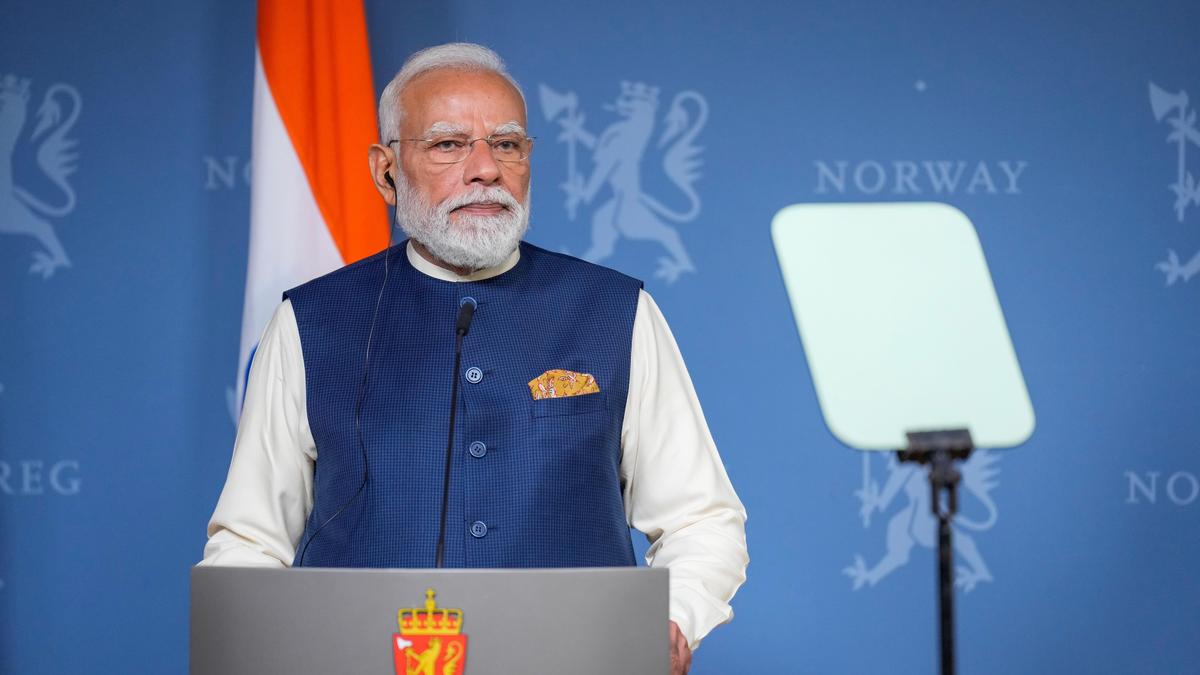
The diplomatic machinery of New Delhi is running into a wall of northern European journalistic norms. During a high-profile multi-nation tour, Ministry of External Affairs officials found themselves repeatedly deflecting a specific, institutionalized irritation from local reporters, exposing a deep friction between Indian domestic political management and European state-visit traditions.
The immediate catalyst occurred in Oslo, immediately following a joint press statement by Prime Minister Narendra Modi and his Norwegian counterpart, Jonas Gahr Støre. As the two leaders prepared to exit the podium, Helle Lyng Svendsen, a commentator with the Norwegian newspaper Dagsavisen, bypassed protocol to shout a question directly at the Indian leader. She asked why he would not take questions from what she described as the freest press in the world.
The Indian Prime Minister did not answer, walking away in tandem with Støre, though the Norwegian leader later returned to interact with reporters. The moment quickly transitioned into a political skirmish back home, with opposition leader Rahul Gandhi amplifying the video to criticize the administration's media strategy on the global stage.
This was not an isolated incident of acoustic friction. Just forty-eight hours prior, in The Hague, Dutch Prime Minister Rob Jetten had expressed public concerns regarding Indian press freedom and minority rights ahead of a bilateral dinner. When Ashwant Nandram, a journalist with the Dutch daily De Volkskrant, asked the Ministry of External Affairs why the standard European tradition of a joint, bilateral press conference with Q&A was abandoned for the visit, the official response exposed the widening gap in diplomatic communication.
The Friction of Conflicting Diplomatic Playbooks
For decades, international state visits operated under tightly choreographed scripts. However, northern European political cultures treat unscripted media availability as a non-negotiable tenet of state accountability. When foreign heads of state visit Norway or the Netherlands, the host government typically expects a joint press conference where reporters from both nations can ask unscripted questions.
New Delhi operates on an entirely different doctrine. The current administration has consistently favored structured media statements over open, adversarial press conferences, a strategy deployed successfully at home for over a decade. When this domestic communication model is exported to capitals like Oslo or The Hague, it collides directly with local journalistic expectations.
+--------------------------------------------------------------------------+
|                        Press Freedom Contrast Matrix                     |
+--------------------------+-----------------------------------------------+
| Host Country             | RSF World Press Freedom Index Position        |
+--------------------------+-----------------------------------------------+
| Norway                   | 1st                                           |
| Netherlands              | Top Tier                                      |
| India                    | 157th                                         |
+--------------------------+-----------------------------------------------+
The friction is structural. European journalists view the refusal to hold a joint Q&A session as an erosion of transparency, while Indian diplomats view the aggressive questioning from local reporters as a failure to respect bilateral diplomatic protocols.
Civilization Arguments and Bureaucratic Disconnects
The Ministry of External Affairs has attempted to counter these critiques by shifting the conversation toward civilizational history and demographic scale. When questioned about Prime Minister Jetten's remarks, MEA Secretary (West) Siby George attributed the criticism to a lack of understanding regarding India's domestic fabric.
George delivered a lengthy defense of India's multi-religious identity, pointing out that India is home to millions of Christians, a flourishing Muslim population, and historically provided safe refuge to Jewish populations. He emphasized that India’s minority population had grown significantly since independence, framed against the backdrop of a five-millennium-old civilization and a massive, modern electorate.
The Problem with Asymmetric Arguments
While these historical and demographic points are factually valid narratives regarding India's diverse heritage, they fail to address the specific structural critique raised by European reporters. A diplomat explaining the ancient origins of Christianity or Buddhism does nothing to answer a specific question from a Dutch or Norwegian journalist about why a press podium lacks a microphone for questions.
This creates an ideological stalemate. The MEA speaks in the language of civilizational exceptionalism and national sovereignty, while the European press corps speaks in the language of contemporary institutional metrics and press freedom indices. Neither side is engaging with the other's core premise.
The Ghost of Washington 2023
The reluctance to open the floor during Western tours is heavily informed by past diplomatic incidents. During a 2023 state visit to Washington, the White House insisted on a joint press conference with U.S. President Joe Biden. The Indian delegation agreed to a highly restricted format where only two questions were permitted.
One of those questions, posed by Sabrina Siddiqui of The Wall Street Journal, focused on minority rights and freedom of speech within India. The subsequent online backlash and intense political scrutiny that followed the interaction demonstrated to New Delhi's strategists that even a single unscripted question from a Western journalist could entirely hijack the narrative of a multibillion-dollar diplomatic triumph.
The True Cost of Narrative Control
The strategic choice to avoid open press conferences is designed to protect the domestic political narrative. By ensuring that the only footage emerging from Oslo or The Hague features clean, unchallenged statements, the administration maintains total control over how the trip is consumed by voters back home.
However, this strategy carries a clear, quantifiable cost on the international stage.
- Host-Country Alienation: It irritates host governments and local media institutions, turning what should be a celebration of bilateral ties into a debate over democratic backsliding.
- Diplomatic Distraction: Instead of focusing on green energy, technology transfers, or maritime security, headlines are dominated by videos of journalists shouting over departing entourages.
- The Irony of Scale: It undermines the core diplomatic assertion that India is the world's largest, most vibrant democracy, as Western observers note that leaders from far smaller nations routinely face intense press scrutiny without administrative panic.
The current strategy assumes that domestic narrative security outweighs foreign public relations friction. In the close-knit, highly transparent media ecosystems of the Nordic and Benelux nations, however, avoiding the press creates exactly the kind of critical, high-visibility spectacle that the diplomatic corps was instructed to avoid.