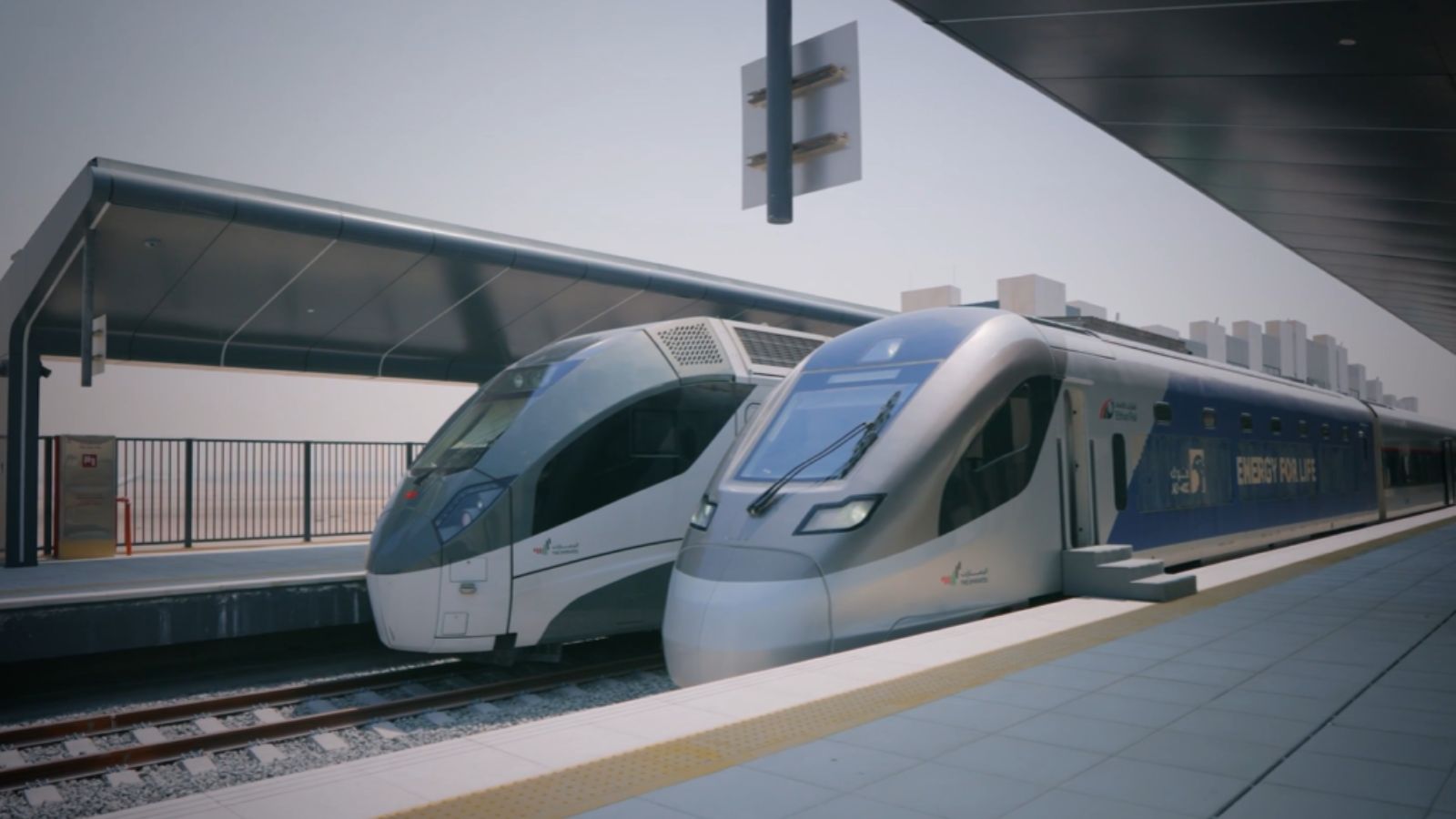
The Concrete Reality Beneath the Desert Tracks
Strip away the glossy press releases and the promotional launch videos, and you find a stark reality about infrastructure development in the Arabian Gulf. For decades, the dominant mode of movement between the Emirates has been rubber on asphalt. Millions of commuters, freight trucks, and weekend travelers have choked the E11 highway, turning a routine drive between Abu Dhabi and Dubai into an exercise in high-stakes patience. Every expansion of the tarmac offered only temporary relief before induced demand filled the extra lanes.
Then came the heavy steel networks of the Etihad Rail project. While initial media coverage focused heavily on freight operations and industrial logistics, the arrival of the passenger rail service marks a definitive break from car-centric dependency. This is not merely a transportation upgrade. It is an economic restructuring of how population centers interact across the federation.
Understanding this transformation requires looking past the ticket booking portals and promotional fare charts. We must examine how a national railway alters land value, commuter psychology, and regional labor markets. When passenger trains begin moving at high speeds across sovereign borders, the traditional boundaries of metropolitan areas dissolve.
Decoding the Passenger Network Mechanics
The operational framework of the Etihad Rail passenger service relies on cutting-edge European signaling systems adapted for extreme desert environments. Extreme thermal expansion and fine windblown sand present unique engineering challenges for high-speed bogies and overhead catenary lines. Engineers have had to specify specialized metallurgy for the rolling stock, ensuring that structural integrity remains uncompromised when ambient temperatures soar past fifty degrees Celsius.
Fares and ticketing structures are designed to capture both daily corporate commuters and leisure travelers, positioning the train as a direct economic competitor to regional shuttle flights and private automobile travel. By undercutting the total cost of fuel, parking tolls, and vehicle wear-and-tear, the rail service presents a compelling value proposition. Yet, the true friction lies not in the ticket price, but in the efficiency of the first-and-last-mile connectivity.
A high-speed rail terminal is only as effective as the transit network feeding it. If a traveler saves forty minutes on the inter-city trunk line only to spend an hour navigating congested local feeder roads upon arrival, the utility of the train diminishes. Urban planners in both Abu Dhabi and Dubai have quietly re-engineered surrounding district zoning to accommodate transit-oriented development, integrating metro links, bus rapid transit lanes, and micro-mobility hubs directly into the station footprints.
The Economic Shocks of Inter-City Rail
When movement between economic hubs becomes frictionless, wealth and talent do not simply flow—they redistribute. Historically, high housing costs in Dubai forced a distinct separation between residential choices and workplace locations. With the introduction of reliable, high-capacity passenger trains operating on fixed schedules, that calculus shifts entirely.
Workers can reside in one Emirate while maintaining primary employment in another without enduring the cognitive and physical toll of highway commuting. This spatial arbitrage exerts downward pressure on hyper-inflated rental markets in specific districts while driving intensive commercial growth around suburban and secondary station nodes. Real estate speculators have spent the last thirty-six months positioning capital along the planned corridor, betting heavily that accessibility will dictate capital appreciation far more effectively than traditional prestige addresses.
At the same time, regional tourism experiences a structural realignment. Weekend getaways that previously required driving across multiple emirates now become effortless day trips. Cultural institutions, entertainment districts, and hospitality venues find themselves competing on a unified regional playing field rather than relying on localized tourist capture.
Navigating the Operational Roadblocks Ahead
No megaproject of this scale launches without friction. Integrating a national passenger network into existing urban cores requires navigating complex administrative layers across different municipal authorities. Scheduling alignment between freight operations and passenger corridors demands absolute precision. Because the infrastructure shares capacity between heavy commercial freight and high-speed passenger carriages, maintenance windows are exceptionally narrow.
Delays on a freight line can cascade rapidly through the passenger timetable if dispatchers fail to manage priorities ruthlessly. Commuters accustomed to the absolute schedule adherence of European or East Asian rail networks will test the operational resilience of the operators during peak morning windows. Furthermore, cyber-physical security remains an ongoing challenge. Modern signaling systems are digital battlegrounds, requiring continuous monitoring and redundant fail-safes to prevent system-wide vulnerabilities.
The success of the passenger service ultimately hinges on public adoption rates during the critical opening quarters. If initial service disruptions or ticketing bottlenecks frustrate early adopters, winning them back from private vehicles becomes an uphill battle. Operators know this, which is why system reliability remains the single most scrutinized metric inside control rooms across the network.
The Broader Geopolitical and Environmental Calculus
Beyond economics and convenience, the project serves as a cornerstone of national carbon reduction commitments. Shifting thousands of daily commuters from internal combustion engine vehicles and regional aviation corridors to electrified rail significantly reduces the carbon intensity of the country's transport sector. While the energy powering the grid itself transitions through ongoing national diversification programs, the baseline efficiency of moving masses of people via steel wheels on steel rails outperforms rubber-tired transit by orders of magnitude.
This modal shift also redefines national security of supply chains and internal mobility. In an era where regional stability and infrastructural resilience are paramount, possessing a unified, state-of-the-art domestic transit spine ensures that human capital and critical goods can traverse the federation regardless of external shocks or maritime disruptions.
The tracks are laid, the stations are open, and the trains are running on schedule. What remains to be seen is how rapidly society reorganizes itself around the iron artery cutting through the desert sands.


