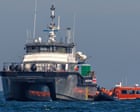
Another overloaded rubber vessel has failed on the gray waters of the English Channel. One hundred and fifty-seven people were forced into the sea after their boat's engine caught fire within the French search and rescue zone, exposing the structural escalation of human smuggling operations. French authorities, alongside British Border Security Command boats and an RNLI lifeboat, pulled the survivors from the water. Fifty-four of those individuals were transferred onto British vessels before being processed toward Boulogne-sur-Mer.
This incident is not an isolated maritime mishap. It represents an evolving engineering and logistical escalation by trafficking networks operating out of northern France.
The Mechanics of the Mega Dinghy Escalation
Smuggling syndicates have steadily shifted their tactics away from standard, smaller Zodiac-style inflatables toward what enforcement agencies now term mega dinghies. These vessels often stretch past forty feet in length, constructed from cheap, flexible PVC and powered by multiple outboard motors lashed haphazardly to a reinforced transom.
To maximize profit per launch, syndicates pack these hulls far beyond any rational safety margin. Cramming 157 human beings into a single inflatable creates a floating powder keg.
Weight distribution becomes instantly unstable. Freeboard—the distance between the water line and the top of the gunwale—shrinks to mere inches. When an engine compartment fails or catches fire, the resulting panic transforms a crowded deck into a catastrophic sinking event. The combustible fuel canisters stored openly on deck to sustain the long crossing act as floating incendiary devices.
The Reality of Maritime Enforcement Limits
The response to this disaster underscores the complicated jurisdictional and operational realities of the Channel. The vessel caught fire while still in French territorial waters, requiring a coordinated multi-agency deployment that highlights both the cooperation and the friction between London and Paris.
Border Command and the RNLI function as emergency safety nets at the end of a broken chain. Interception at sea rarely stops the business model of the networks onshore. Every time a heavier, more dangerous vessel is deployed, the risk profile shifts exponentially higher. The cartels know that European maritime law mandates rescue at sea. They design their logistics around that legal and moral obligation, treating human cargo as disposable assets against high border security overhead.
Political reactions quickly followed the disaster, with various factions seizing on the wreckage to push competing security frameworks. Proposals ranging from naval pushback operations to expanded intelligence sharing continue to dominate Westminster debates. Yet, policy announcements from politicians rarely address the fundamental manufacturing and supply chain aspects utilized by the gangs. Smugglers source these commercial-grade engines and raw materials through complex shell companies across Europe, remaining one step ahead of fragmented continental law enforcement.
The Human Cost Behind the Statistics
Numbers obscure the reality of what happens when a 40-foot rubber tube burns and deflates miles off the coast. Survivors arriving in French ports carry physical trauma from smoke inhalation and hypothermia, compounded by the psychological toll of watching a maritime transit dissolve into total chaos.
The shift toward mega-capacity vessels ensures that future incidents carry a higher statistical potential for mass casualties. As long as the demand for clandestine passage meets an unyielding supply of improvised maritime equipment, the middle of the Channel remains a zone of acute hazard.
The fire aboard the vessel carrying 157 people is a warning marker. The crossing has grown more lethal not despite increased policing, but because the economics of smuggling have forced syndicates to double down on scale.

.png?itok=1mb05mKJ)

