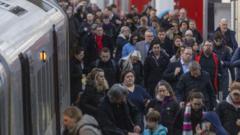
The morning rush hour on overcrowded commuter trains is a daily erosion of human dignity. Thousands of passengers push onto platforms across the country, bracing themselves for a commute defined by delayed timetables, stifling carriage temperatures, and standing shoulder-to-shoulder for an hour or more.
Official reports often reduce this issue to a simple math problem of headcounts, seat counts, and peak-hour passenger volumes. That metric misses the point entirely. The real crisis of overcrowded commuter trains is not just about passenger numbers exceeding physical seat availability. It is a systemic failure of infrastructure planning, inflexible corporate scheduling, and decades of underinvestment disguised as modernization. Discover more on a similar issue: this related article.
Commuters face daily train congestion not merely because too many people want to travel at eight in the morning, but because the entire ecosystem of public transit operates on an outdated, rigid paradigm that refuses to bend to modern realities.
The Anatomy of a Bottleneck
To understand why certain lines consistently degenerate into moving parking lots of frustrated humanity, look at the physical choke points of the rail network. A train timetable is a fragile, tightly choreographed sequence. When a single service encounters a slight delay at a suburban junction, the domino effect cascades down the line, bunching trains together. Further analysis by TIME explores similar views on the subject.
When two services arrive at a major interchange five minutes apart instead of fifteen, the platform crowd doubles. The first train absorbs a crushing load, while the second arrives half-empty because passengers have already spilled over or given up.
Operators point to rolling stock limitations as the primary culprit. They argue that platforms can only accommodate ten or twelve carriages, and factories cannot churn out new carriages overnight. This defense deflects responsibility. The bottleneck is rarely just physical platform length. It is signaling technology that dates back generations, junction layouts designed for steam locomotives rather than high-frequency electric transit, and maintenance schedules that cannibalize peak-hour fleet availability.
The Economics of Peak Pricing
Economic incentives actively worsen the problem. Peak-hour fare structures penalize workers who have no control over their hours. Rigid office cultures demand physical presence by nine in the morning, forcing millions into a narrow two-hour window.
Rail operators charge premium rates for this privilege, banking on captive customers who rely on the train to keep their jobs. When a passenger pays top dollar for an annual season ticket only to spend forty-five minutes pressed against a carriage door, the social contract of public transport fractures.
Flexibility remains an empty promise for the vast majority of blue-collar and frontline workers. Retail staff, healthcare professionals, and manufacturing employees cannot work remotely. They bear the brunt of crowded commuter trains while corporate workers enjoy hybrid schedules that smooth out mid-week passenger curves.
The financial burden of peak pricing falls disproportionately on those least able to afford alternative transportation, creating a two-tiered system of mobility.
Why Simple Solutions Fail
Politicians love quick fixes. Announcements of new train orders or minor timetable tweaks make for great headlines, but they rarely solve the root cause. Adding two carriages to a train sounds logical until you realize that station platforms down the line require expensive civil engineering overhauls to accommodate the extra length.
Frequency increases sound equally promising until you factor in track capacity. If freight trains, regional expresses, and local commuter services share the same dual-track corridor, adding more commuter trains becomes mathematically impossible without knocking out other essential services.
Hypothetically, imagine a major trunk line operating at ninety-five percent capacity during peak hours. Introducing a new express service to appease suburban voters requires stripping out local stops, stranding passengers at smaller stations and forcing them onto already overburdened bus networks. Every operational choice involves a trade-off that transit authorities rarely communicate honestly to the public.
The Hidden Toll of Daily Gridlock
The cost of this ongoing transit failure extends far beyond inconvenience. Chronic overcrowding exacts a heavy toll on public health and workplace productivity.
Cortisol levels spike the moment a commuter confronts a delayed train or realizes they cannot physically board the service. Standing upright in a packed carriage for an hour without access to fresh air or adequate ventilation breeds physical exhaustion before the workday even begins.
Musculoskeletal strain, elevated anxiety, and the rapid transmission of seasonal illnesses thrive in confined, high-density spaces. When employees arrive at their desks drained and frustrated, the economic loss in output is immeasurable.
Communities suffer, too. Towns situated along hyper-congested rail corridors often see housing demand soar, yet residents find themselves trapped by a transport bottleneck that makes travel unpredictable.
Beyond the Timetable
Solving the crisis of overcrowded commuter trains requires abandoning the illusion that we can simply build our way out of congestion by buying longer trains. The solution demands a radical restructuring of how cities function.
Decentralizing employment hubs, enforcing true flexible work incentives for white-collar sectors, and heavily subsidizing off-peak travel can redistribute passenger loads more effectively than any new rolling stock order.
Until transit agencies, municipal governments, and corporate employers stop treating commuter rail as a simple logistics puzzle and start viewing it as the foundational lifeline of modern society, the morning crush will remain an unyielding daily ritual.